Shaped by Global Challenges
Transforming THE KINGDOM and the World
At PSE, we are dedicated to driving innovation and advancing research to address global challenges in green energy, new materials, climate change, and the environment.
We offer an inspiring academic environment where students learn from global experts, participate in cutting-edge research, and gain the skills needed to address global challenges in energy, environmental science, and materials sciences.
We invite students and researchers to follow the Dean’s Distinguished Lectures, a series of talks featuring internationally acclaimed scholars and professors from top universities worldwide.
20 March, 2025
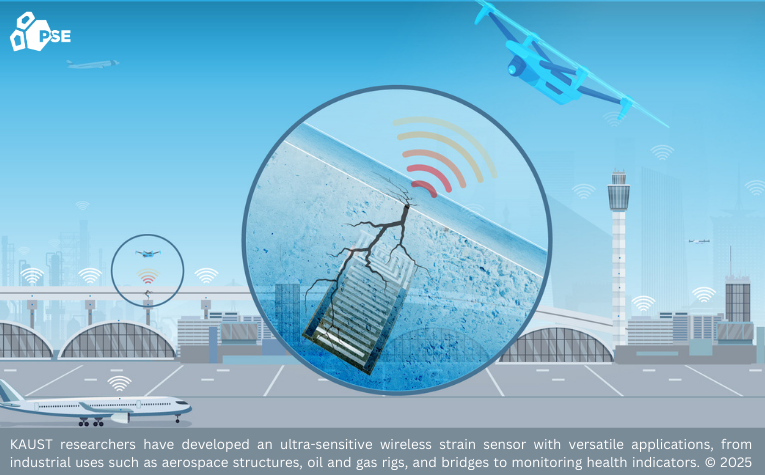
A simple new design for a passive wireless strain sensor offers unprecedented sensitivity while being thin enough to be embedded within structures without causing defects. With further development, the KAUST team expects that the chipless design could be adapted to make sensors that respond to other stimuli, such as the temperature or chemical environment.
The design combines several existing technologies into a very efficient package. “The advantage in terms of sensitivity comes from merging different physics for two different responses from two materials,” explains Hassan Mahmoud, a doctoral researcher in the team of Gilles Lubineau, who led the study.
The sensor is printed with inks that change their electrical resistance in response to strain. The ink is printed in such a way as to create a circuit with capacitive domains, enabling the sensor to be activated wirelessly by a specific frequency. The circuit is designed to make the activation frequency very sensitive to stimulation, so it reflects the amount of strain the sensor is under.
Manufacturing the new sensor should be quick and easy. “Our mechanism uses simple available materials and techniques, so it is suitable and scalable for use by industry,” says Mahmoud.
The design might have to be adjusted depending on the use case, but Mahmoud does not expect that to be challenging. “The R&D is done, so it is just about customizing it to be suitable to the application, like using a substrate that’s right for wearables or that can withstand the high temperatures in structural manufacturing,” he explains.
Read more at KAUST Discovery.
Feb 2026
Mechanical Engineering Seminar
Static electricity whispers its secrets through a microscopic mechanical contactFeb 2026
Earth Systems Science and Engineering Seminar
Recent Micropaleontological Highlights from Saudi ArabiaFeb 2026
Dean's Distinguished Speaker Seminar
My quantum dot journey: from water to infrared, and finally to luminescent saltsIn PSE, we advance scientific discovery and innovation through interdisciplinary collaboration, addressing global challenges with impactful research. Join us in shaping a sustainable future through excellence in science and technology.