
12 April, 2026
A process to trap carbon dioxide underground in solid minerals, without large volumes of freshwater demanded by existing techniques, could provide a promising carbon removal solution even in the world’s driest regions, expanding the tools available to address climate change. A new study from KAUST, published in Nature, now shows how to store CO2 underground using far less freshwater, opening the door to applications in arid regions.
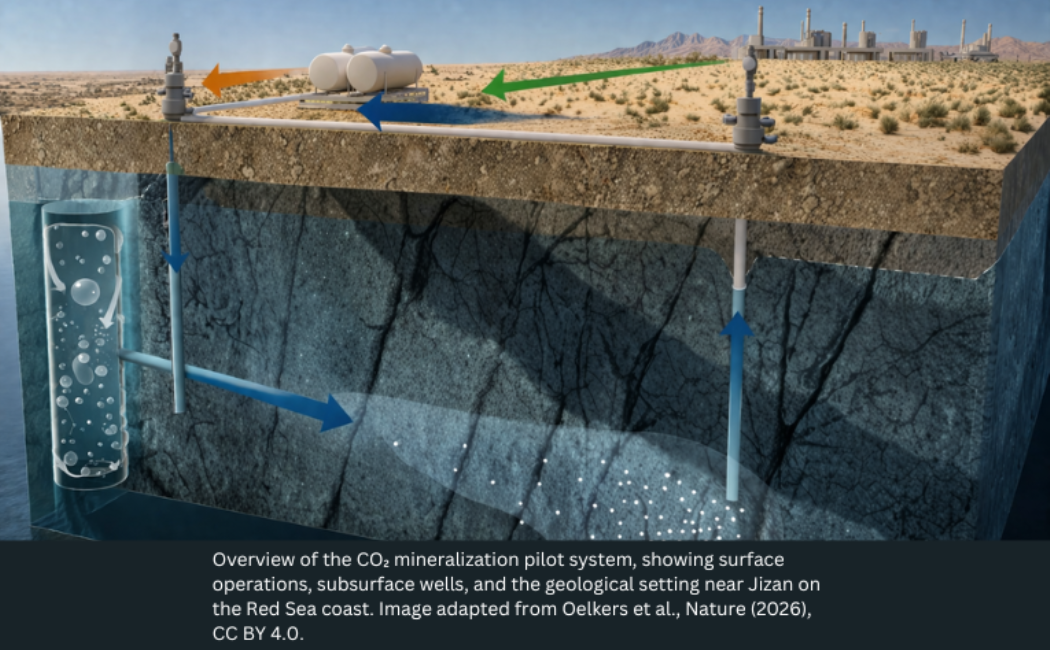
One way to deal with carbon emissions is to sequester them underground. To prevent CO2 from leaking back into the atmosphere it needs to react with rocks and form carbonate minerals, such as calcite, which store the carbon in a stable solid form. This can be accomplished by dissolving CO2 in water and pumping this mixture down into natural fractures in suitable rock formations, where the mineralization reactions then occur. The carbon gets bound into the minerals instead of being released into the atmosphere, but the freshwater cost is high.
“Previous estimates suggested that carbon mineralization required 20 to 50 times more water than the mass of CO2 being stored,” explains Eric Oelkers, who led the study alongside Hussein Hoteit, Abdulkader Afifi, and Thomas Finkbeiner of KAUST. That renders existing approaches poorly suited to arid regions like Saudi Arabia which hosts major carbon-emitting industries, including petroleum extraction and refining, power generation, and desalination plants.
The key insight for the new approach is to use the site’s groundwater and recirculate it through wells, creating a fully cyclical process. “In our study, the CO2 gas was dissolved directly into water that is pumped up from deep underground,” says Oelkers.
Read more KAUST Discovery.