
05 February, 2026
Putting the freeze on climate change, King Abdullah University of Science and Technology (KAUST) continues to lay the groundwork for industrial emissions reductions through cryogenic carbon capture (CCC) technology, while also working to apply this innovation at sea and generating strong international interest along the voyage.
“We have developed a smart Lego-blocks concept of portable, containerized carbon-capture cabins that can be stacked on a ship to capture carbon dioxide (CO2) along with sulfur dioxide (SO2) for two to four weeks of the ship voyage, with post-processing purification done onshore,” said Dr. Sai Shrinivas Sreedharan, technology manager for KAUST’s CCC initiative.
“This has a dual benefit of reducing the footprint of the CO2 capture system and eliminating scrubbers for ships running on heavy fuel oil — the most widely used marine fuel,” he added, referring to a system of modular units fitting together, with the captured CO2 purified, compressed, and prepared for storage or reuse. A hub-and-spoke model centralizes processing while using distributed units to collect emissions.
“It garnered strong interest when we visited the Powering the Intelligent Age Summit 2025 in Kuala Lumpur, co-organized by Malaysia Centre4IR and the World Economic Forum.”
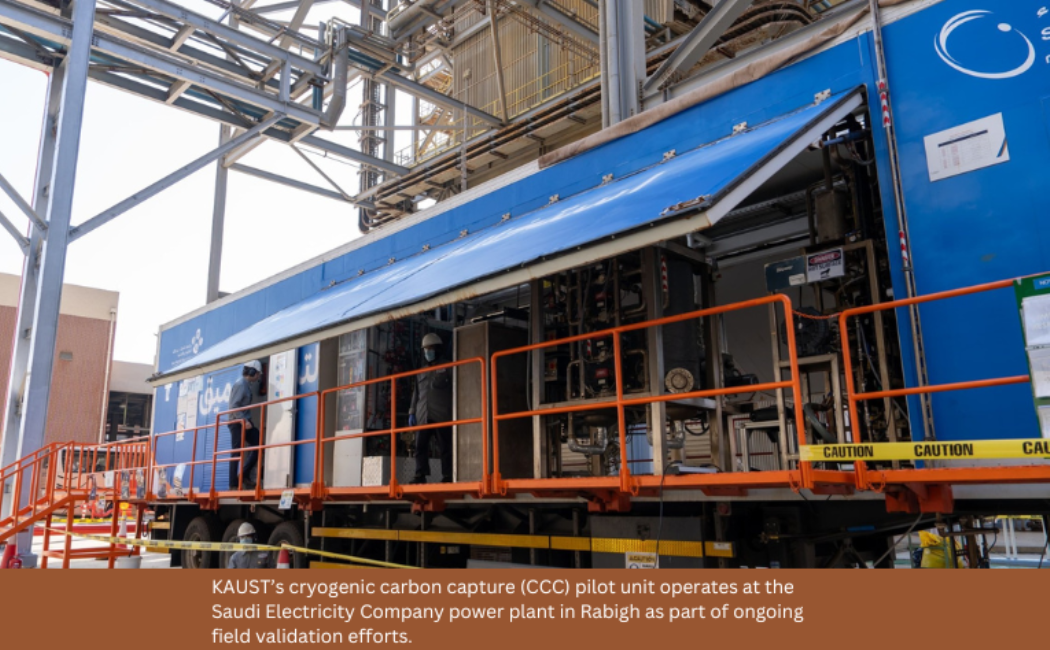
The University has been active on the CCC front since 2020. In November 2024, KAUST and Saudi Electricity Company (SEC) launched a demonstration exercise, Sreedharan noted, showcasing the world-first cryogenic technology that captures multiple pollutants and greenhouse gases.
“KAUST, with its facilities and talent, is well placed to engage in technology development, then to bring the technology into the real world and have impact. One of the approaches is for the University to collaborate with strategic third-party entities to support commercialization of the technology.”
Read more at KAUST News.