
02 February, 2026
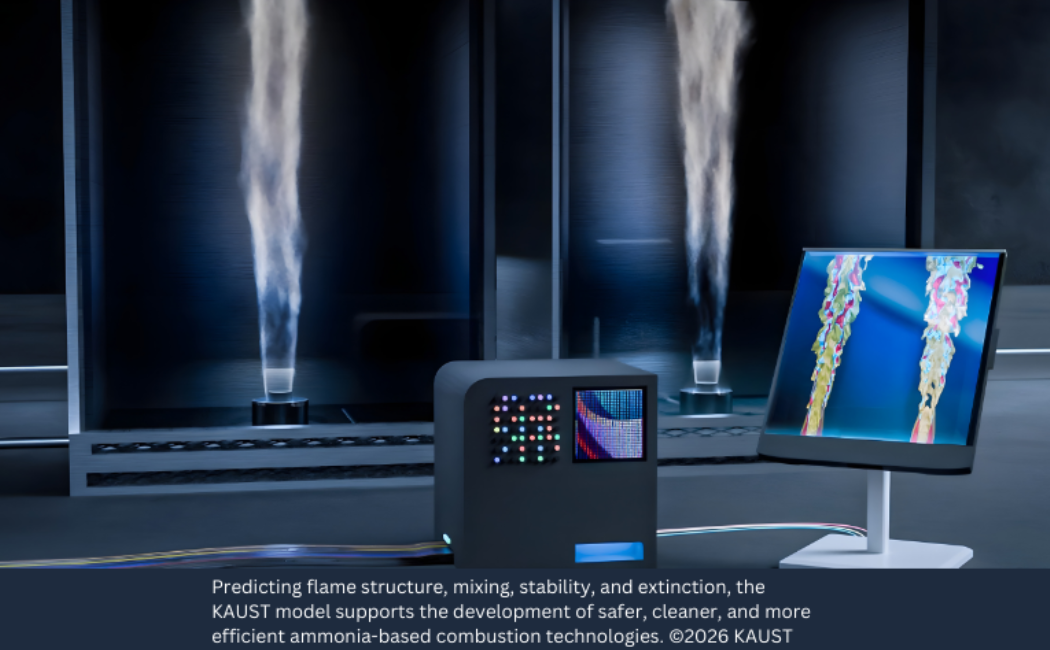
Advanced computer modeling reveals the complex combustion behavior of ammonia, a promising clean-burning carbon-free fuel, potentially accelerating its role in renewable energy systems.
Wind and solar energy promise to make the electricity grid greener by delivering renewable energy at scale. But to smooth out seasonal renewable energy fluctuations and decarbonize parts of the global energy and transport system that are difficult or impossible to electrify, we will need clean-burning, carbon-free fuels produced from renewable sources.
Ammonia (NH3) is a carbon-free molecule that can serve directly as a fuel, can be produced renewably at scale, and can be stored and transported easily. However, in its pure form, ammonia has a low burn rate and is difficult to ignite. To address this, ammonia can be ‘cracked’ — heated to high temperatures over a catalyst — to partially break it down into a mixture of ammonia, hydrogen, and nitrogen, which increases the fuel’s reactivity and improves flame stability.
“Partially cracked ammonia is a realistic and promising fuel for future clean power and propulsion systems,” says Suliman Abdelwahid, postdoctoral researcher in Hong Im’s lab. “Understanding its combustion behavior under realistic conditions is essential for its safe and efficient deployment.”
The components of partially cracked ammonia have widely varying physical and combustion properties. The fuel burns in complex, turbulent flows that can produce toxic emissions of unburnt ammonia and NOx. “Using high-fidelity computer simulations, we aim to identify optimal combustion configurations and conditions to ensure complete combustion of ammonia with minimal NOx emissions,” Im says.
Read more at KAUST Discovery.