
15 January, 2026
Stand in direct sunlight and you can feel it: the Sun delivers its biggest kick not as visible light, but as the infrared energy we experience as heat. Capturing this rarely tapped form of solar power could offer an efficient way to generate renewable fuels, KAUST researchers have shown.
“Saudi Arabia has some of the richest solar energy resources on Earth,” says Yunzhi Wang, a Ph.D. student in the lab of Huabin Zhang, who co-led the research. By harnessing this energy to split water molecules and release hydrogen, Saudi’s solar riches could be converted into an exportable resource. “Hydrogen is a versatile clean fuel, considered one of the most promising renewable energy sources,” Wang adds.
Although a range of known photocatalyst materials can harness the energy in sunlight to split hydrogen from water, most of these materials only absorb ultraviolet light, which makes up less than 5% of the solar spectrum. More recently, an unconventional type of photocatalyst made of organic molecules has been developed, which can capture the infrared light that makes up more than 50% of the Sun’s power.
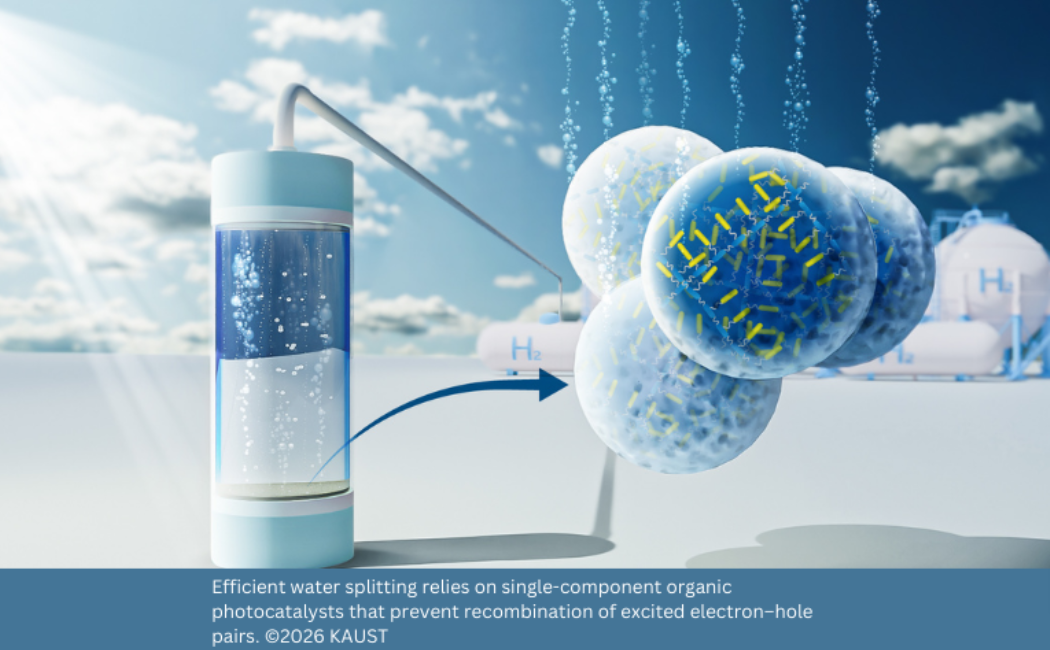
To achieve efficient water splitting with these materials, however, researchers have had to use blends of two organic photocatalysts. Sunlight striking these materials generates pairs of excited-state electrons and positively charged holes. If the electron-hole pair immediately recombines, the captured solar energy is lost.
To counter this recombination, KAUST researchers mixed electron donor and electron acceptor photocatalysts, creating blends that quickly draw the excited electron and hole apart and enable hydrogen production.
“Producing these organic photocatalyst blends for real-world applications poses significant challenges,” Zhang says. It can be difficult to get the two components to mix, requiring complex fabrication processes. The resulting materials can also be unstable. “Single-component organic photocatalysts would therefore be more suitable for large-scale applications,” Zhang adds.
Read more at KAUST Discovery.