
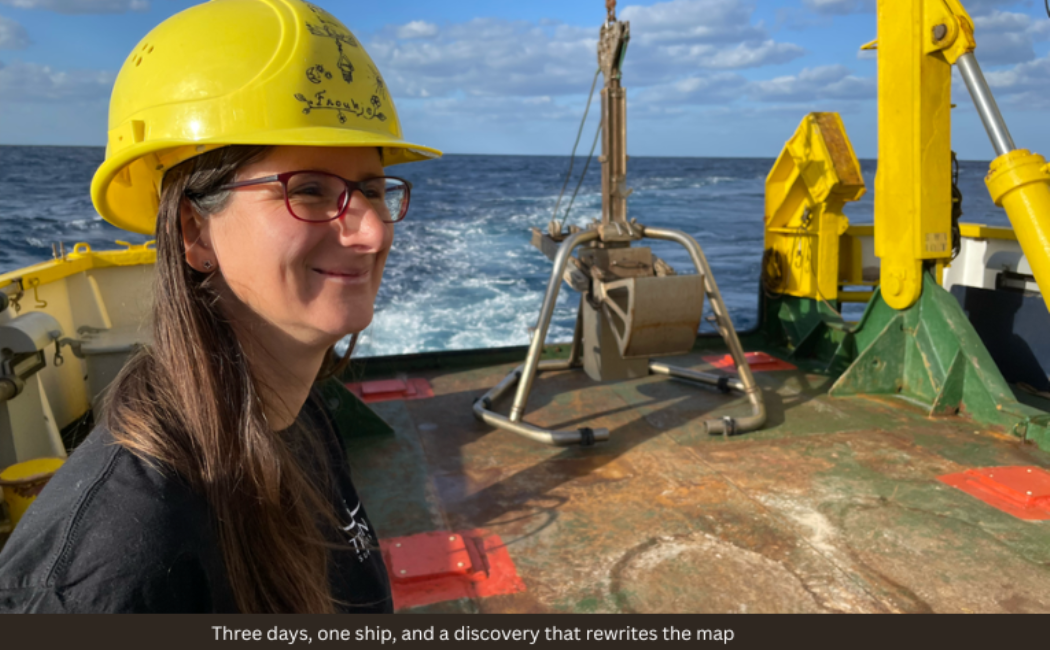
Froukje van der Zwan was no different. She always loved reading about adventures or watching movies about them, but never thought of becoming an explorer herself. Her first explorations took place closer to home, in dunes and fields—choosing the quieter paths, paying attention to details others overlooked.
“Wandering into nature, trying to understand what lay beneath and beyond was just part of my personality,” she recalls. “I could never have imagined how this passion would shape my entire life.”
Recently, van der Zwan was elected a Fellow of The Explorers Club, a highly prestigious international society dedicated to exploration and scientific discovery.
Founded in 1904, the Club is composed of leaders in polar exploration, deep-sea diving, aerospace, archaeology, zoology, astronomy, geology, and conservation. Its members include Neil Armstrong, the first person to walk on the Moon; Tenzing Norgay, who climbed Everest with Edmund Hillary; and modern explorers like Victor Vescovo, James Cameron and Sylvia Earle, reknown for their deep-sea discoveries and ocean research.
Three days, one ship, and a discovery that rewrites the map
Van der Zwan’s career has taken her around the world in pursuit of a simple question: Why are volcanoes where they are?
This question led her to months of fieldwork in Cameroon and to many seasons mapping the Harrat volcanic fields in Saudi Arabia, and offshore to some of the least explored volcanic environments of the deep sea—from the Atlantic to the South China Sea, and to the Red Sea. There, she became the first woman to descend to a depth of 2 kilometers in a submarine.
As her work in the Red Sea deepened, one question became central: Could one of the world’s youngest oceans be hiding active hydrothermal vents that no one had ever found?
In 2022, the chance to test that idea finally arrived.
“It was an expedition shaped by the pandemic, by technical failures, by the kind of frustration that usually kills ambitious plans,” she says.
She and her team had only three days aboard the research vessel Aegaeo—a narrow window cut short after one of the scientists tested positive for COVID while still in port.
Even so, van der Zwan had two aces up her sleeve: high-resolution maps and data from earlier expeditions and a determined team operating a remotely controlled robot built to explore the deep sea. For long hours, they searched where the team had projected the vents might be. But, as is often the case in discovery, the result was unexpected.
What they found did not resemble the classic black smoker hydrothermal vent fields known from other oceans. There were no high-temperature fluids, dramatic plumes, no shrimps, worms, or mussels clustered around the vents. Instead, they encountered extremely large, microbe-rich systems with clear fluid venting -so subtle, that took nearly a full day to detect.
“We were staring at something that didn’t match the textbooks,” she says. “And then we realized—that was exactly why it mattered.”
Follow-up expeditions only deepened the wonder: brine pools where none should exist, geological terrains that challenged conventional models.
“It’s like stepping into a new world, a reminder that the Earth still has surprises left,” she says.
The discovery of the first active hydrothermal vents in the Red Sea is not simply a new point on the map; it is a gateway. It opens a window onto research on microbial life, ocean chemistry, mineral formation, and the evolution of one of Earth’s youngest ocean basins.
It also offers researchers a rare and unexpected laboratory: a deep-sea system operating under conditions unlike any other site on the planet, and a potential analogue for understanding early life on Earth—or even life elsewhere in the solar system.
“The Red Sea is one of the most extraordinary geological environments on Earth—young, evolving, and still largely unexplored,” she adds.
KAUST as a gateway to modern exploration
Van der Zwan made this discovery a few years ago while serving as Professor of Earth Science at King Abdullah University of Science and Technology (KAUST), a position she continues to hold.
From ship access and logistical support, to international and Saudi students eager to join expeditions, KAUST provides both opportunity and location: the Arabian desert on one side, the Red Sea on the other. Its academic and governmental alliances—with partners such as GEOMAR in Germany, OceanQuest and the National Center for Wildlife in Saudi Arabia, and collaborators from the UK, Macau, and Canada, make pioneering expeditions possible.
Van der Zwan’s groundbreaking work in the Red Sea has brought together an international, interdisciplinary team of geologists, oceanographers, microbiologists, and zoologists because, as she puts it, “impactful exploration in the 21st century refuses to belong to a single field.”
“The Explorers Club fewllowship places KAUST on the map in a different way,” she continues. “Not just as a research institution—but also as a place of exploration and fundamental discovery.”
The next frontiers
Her next ventures will take her back on land—returning to the Harrat volcanoes during the winter field season. But the Red Sea continues to call.
“The next phase of marine exploration will come when we can return to the deep Red Sea,” she says. “Much of that volcanic and hydrothermal terrain has never been seen by human eyes. The deep sea is truly one of the last frontiers —similar to outer space in the challenges it presents, and in many ways even less understood.”