
14 December, 2025
The continued growth of solar and wind power is reshaping global energy systems, creating an urgent demand for storage technologies that are both durable and affordable. Sodium-ion batteries are an attractive alternative to lithium technologies because sodium is abundant, widely distributed, and inexpensive.
Despite their promise, high-voltage sodium batteries have remained difficult to commercialize due to a fundamental materials challenge: the electrolyte must stabilize both the highly reactive sodium metal anode and the high-voltage cathode — two surfaces that typically require opposite chemical conditions to remain stable.
“Traditionally, additives that protect one side of the battery tend to damage the other,” says Husam Alshareef, a materials scientist at KAUST who leads the Center of Excellence for Renewable Energy and Storage Technologies (CREST). “This trade-off has been a major barrier to developing practical high-voltage sodium batteries.”
Alshareef and his collaborators from CREST at KAUST have now broken this long-standing limitation by introducing a new class of electrolyte additives called non-solvating additives (NSAs). The approach offers a simple, low-cost route to stabilizing both electrodes simultaneously, enabling long-life sodium batteries that operate at voltages comparable to commercial lithium-ion systems.
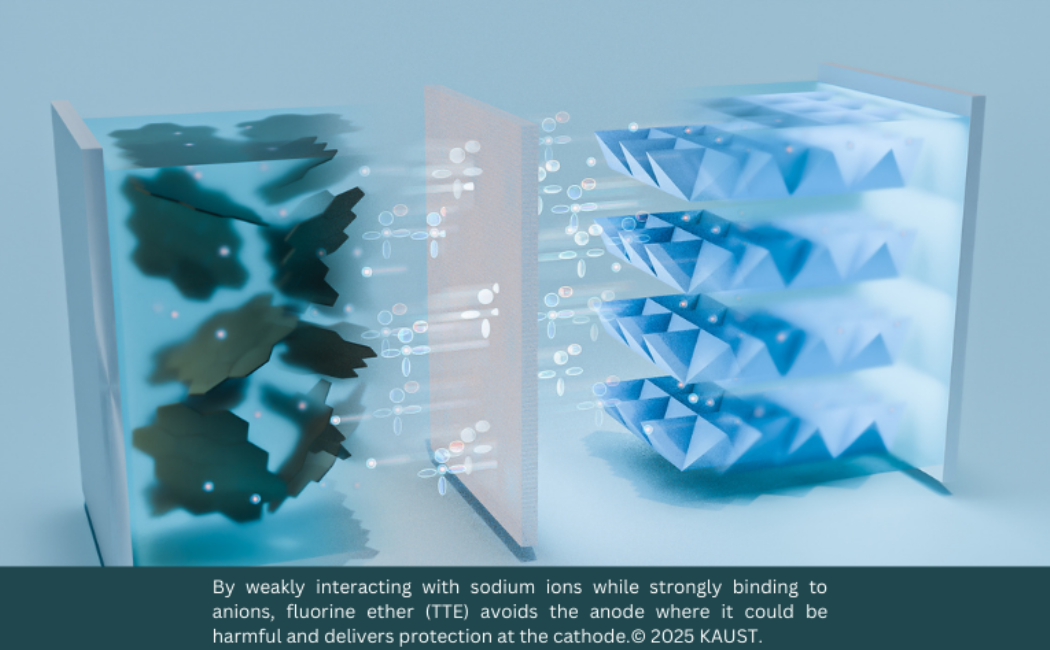
The study focuses on how the additive interacts with ions in the electrolyte. Most existing additives are strongly solvating: they bind tightly to sodium ions, follow them to the anode during charging, and often decompose there, destabilizing the sodium metal surface. Meanwhile, they leave the cathode insufficiently protected against high-voltage degradation.
The KAUST team took the opposite approach. They identified a fluorinated ether molecule — 1,1,2,2-tetrafluoroethyl 2,2,3,3-tetrafluoropropyl ether (TTE) — that interacts weakly with sodium ions but preferentially binds to negatively charged anions. “Because these additives do not cling to sodium ions, they aren’t dragged to the anode, where they could be harmful,” explains Dong Guo, the study’s lead author. “Instead, they travel with the anions toward the cathode, where their protective effect is actually needed.”