
27 November, 2025
A KAUST-designed reactor uses renewable electricity to convert captured carbon into high-value chemicals, making CO₂ reuse economically viable.
An electrocatalytic reactor that directly converts a high-pressure stream of captured CO2 into a major commodity chemical could offer an economically viable option for addressing climate change.
Conventional carbon capture prevents industrial CO2 emissions from reaching the atmosphere by trapping the greenhouse gas from factory or power plant emissions and pumping it underground for long-term geological storage. The high economic cost of this process prompted a KAUST team to consider an alternative approach. “We aimed to convert industrially captured high-pressure CO2 directly into valuable chemicals, which would turn carbon capture into an economic opportunity,” says Xu Lu, from the Chemical Engineering programme, who led the study.
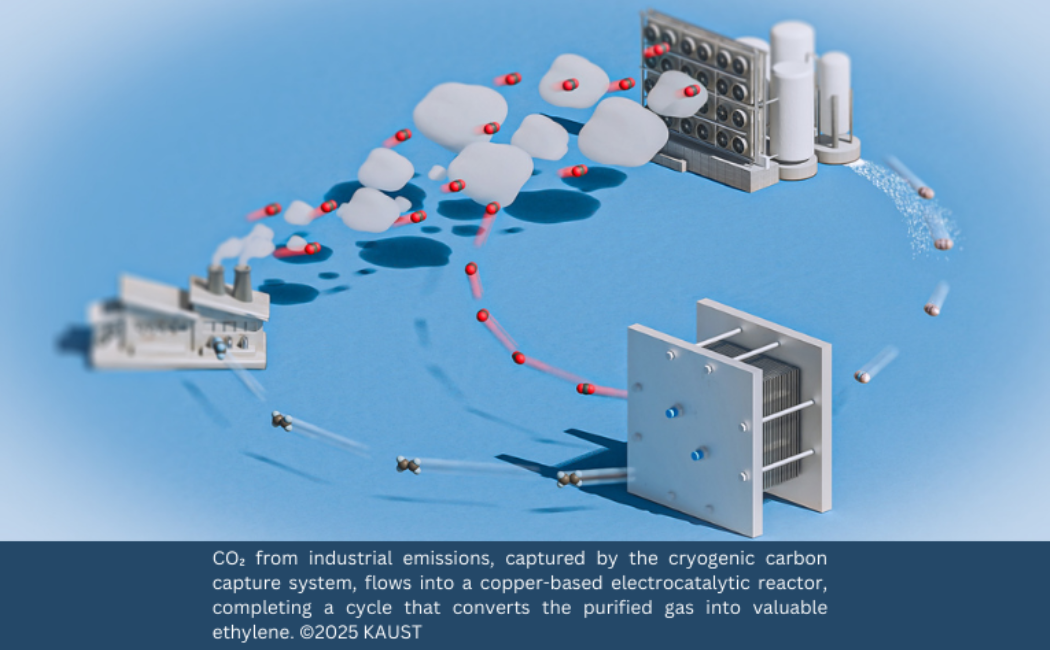
The team devised an electrocatalytic reactor that directly connects to the latest cryogenic carbon capture systemarticle. " id="return-reference-1" href="https://discovery.kaust.edu.sa/en/article/26233/electrocatalytic-co2-upcycling-excels-under-pressure/#reference-1">[1]. The reactor’s copper-based electrocatalyst turns the high-pressure, high-purity stream of captured CO2 into industrial-grade ethylene.
“This commodity chemical is essential to plastics, textiles, and construction, and has a global market that exceeds US$200 billion per year,” says Liang Huang, a member of Lu’s team.
Previous attempts to electrocatalytically convert captured CO2 into valuable chemicals, using reactors that run at ambient pressure, had limitations that prevented real-world use. These limitations have included sluggish reactivity; low reaction selectivity that then required additional steps to purify the products generated; and a buildup of salt byproducts in the reactor that choke its performance.
The new process involved operating the reactor under pressure, which significantly enhanced reactivity and selectivity for ethylene production, say the researchers. The high-pressure process had the dual benefit of significantly increasing CO2 coverage of the electrocatalyst as well as accelerating the C–C coupling reaction required for ethylene formation. “Also, by directly using the high-pressure captured CO2 gas stream, we avoid the energy loss of depressurizing and repressurizing the gas,” Lu explains.
Read more at KAUST Discovery.