
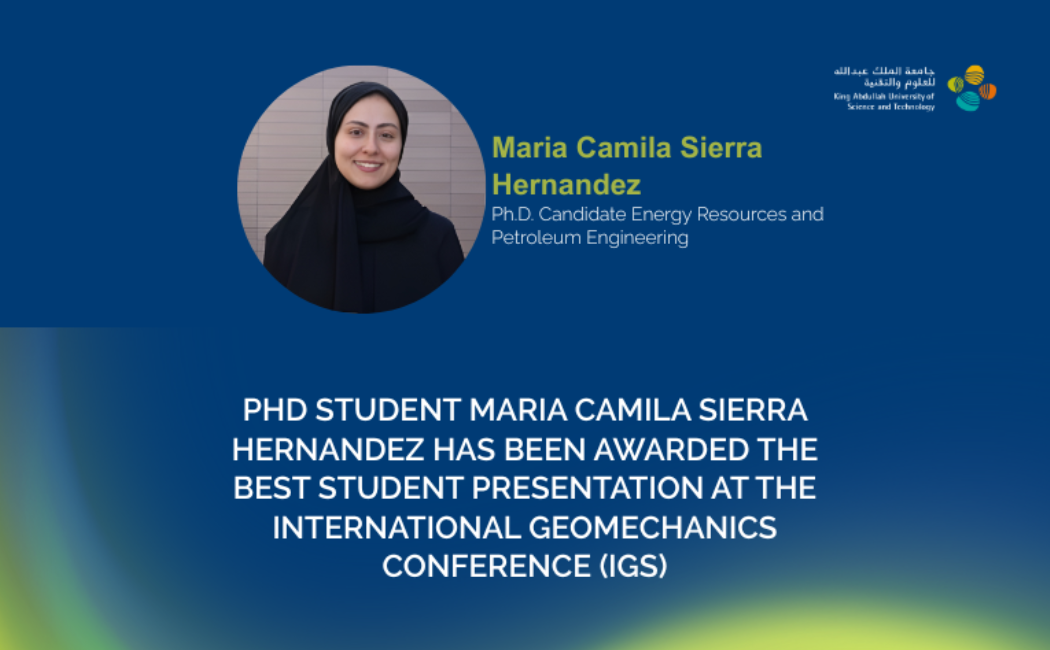
PhD student Maria Camila Sierra Hernandez has been awarded the Best Student Presentation at the International Geomechanics Conference (IGS), held on November 18-20 in Al Khobar.
The event was sponsored by Aramco and attended by more than 450 participants from industry, academia, and government.
PhD student Maria Camila Sierra Hernandez has been awarded the Best Student Presentation at the International Geomechanics Conference (IGS), held on November 18-20 in Al Khobar. The event was sponsored by Aramco and attended by more than 450 participants from industry, academia, and government.
Maria’s talk, “Mechanical characterization of Upper Jurassic anhydrite-carbonate sequences in Saudi Arabia and its implications for seal integrity,” addresses a key gap in subsurface research: how evaporitic seals behave when used for CO₂ or hydrogen storage. These formations, especially the Hith and Arab units, are central to Saudi Arabia’s Circular Carbon Economy strategy. Her work provides essential mechanical data that helps de-risk storage projects and supports the development of safe, large-scale carbon storage.
Her presentation stood out among 34 competing student talks, earning the highest overall score. Judges recognized her work for its originality, technical strength, and clear contribution to the field.
Reflecting on the effort behind the results, Maria says:“This project is the result of two years of intense work. I tested more than 210 meters of core, analyzed 20 additional plug samples, and processed nearly 3,000 datasets. It demanded precision, persistence, and patience at every step — but the scale of the work is also what makes the outcome meaningful.”
Her results strengthen KAUST’s position as a leader in evaporite geomechanics. They also support national efforts in carbon storage and help build stronger connections with industry. Moving forward, Maria will prepare a peer-reviewed publication on the Hith and Arab formations and continue additional testing to deepen the understanding of these geological units, which are fundamental components of the Kingdom’s broader energy-transition vision.