
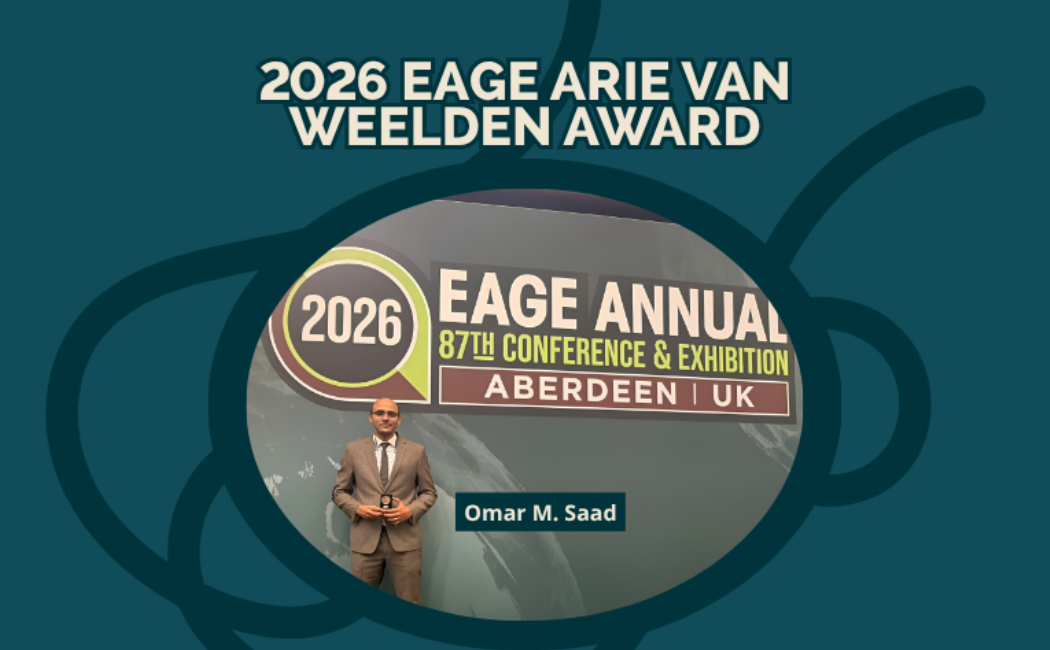
Dr. Omar M. Saad, a researcher in the DeepWave Consortium led by Prof. Tariq Alkhalifah at King Abdullah University of Science and Technology (KAUST), has received the 2026 Arie van Weelden Award from the European Association of Geoscientists and Engineers (EAGE). The award recognizes early-career scientists who have made significant contributions to geoscience and geophysics.
Saad was recognized for his contributions to full-waveform inversion (FWI), seismic denoising, and the integration of artificial intelligence into geophysical analysis. His research focuses on advancing subsurface characterization by combining wave-equation-based inversion with modern machine learning approaches, including deep and self-supervised learning.
Through advances in elastic and multiparameter full-waveform inversion, learning-based seismic representations, and data-driven denoising, Saad’s work improves the accuracy and reliability of subsurface models derived from seismic data. These advances provide improved velocity and physical property models that ultimately lead to more reliable seismic imaging and interpretation, particularly in complex geological environments.
These developments address key challenges in modern seismic exploration and energy geoscience. As exploration increasingly targets structurally complex environments, conventional methods often struggle because of complicated wave propagation, strong contrasts in subsurface properties, and noisy seismic data. Saad’s research improves how seismic waves are modeled and how information about the Earth’s subsurface is extracted from seismic data, enabling geoscientists to build more accurate models of underground structures and reservoirs.
In addition to his scientific contributions, Saad is recognized for his service to the geoscience community, including the development and release of open-source software, as well as extensive contributions as a journal reviewer, associate editor, and active participant in international professional committees.
Saad also emphasized the importance of early-career scientists contributing to the broader scientific community.
“Young scientists and engineers have a responsibility not only to advance their fields, but also to support the broader scientific community,” he said. “This means developing innovative methods that remain grounded in physical principles, embracing open and reproducible research, and contributing to the profession through activities such as peer review, editorial service, and engagement with professional societies.”