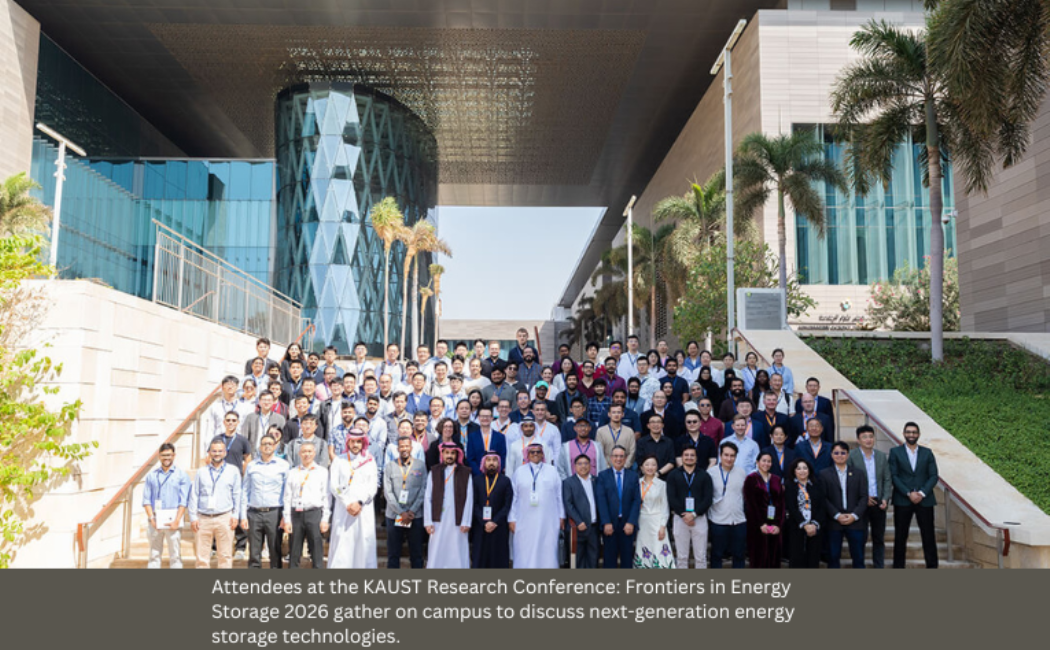
For decades, Saudi Arabia has been a driver of the global economy, leveraging its hydrocarbon resources to power economies around the world.
Now, as the global energy transition accelerates toward renewables, King Abdullah University of Science and Technology (KAUST) is pivoting that legacy, advancing collaborative, in-Kingdom energy-storage technologies essential to delivering reliable, clean baseload energy and addressing the intermittency challenge of solar and wind power.
“We are here to rewrite the rules — at least in part — of what is possible,” KAUST President Sir Edward Byrne AC told the delegates at the KAUST Research Conference: Frontiers in Energy Storage 2026. “The future of energy is being written here, now, in 2026, on the shores of the Red Sea.”
Hosted by the Center of Excellence for Renewable Energy and Storage Technologies (CREST), February 2-4, the conference presented a unified, multi-layered vision of energy storage spanning electrochemical and chemical systems, including advanced batteries and hydrogen, positioning them not as competitors, but as complementary layers for long-duration and industrial resilience.
“This conference brought batteries, chemical storage, grid integration, and different storage scales into the same discussion, putting component, materials, and grid engineers into the same room,” said Professor Husam Alshareef, chair of CREST and dean of the Physical Science and Engineering Division at KAUST. “KAUST is creating energy-storage solutions that are relevant for the Kingdom and valuable to partners around the world.”