
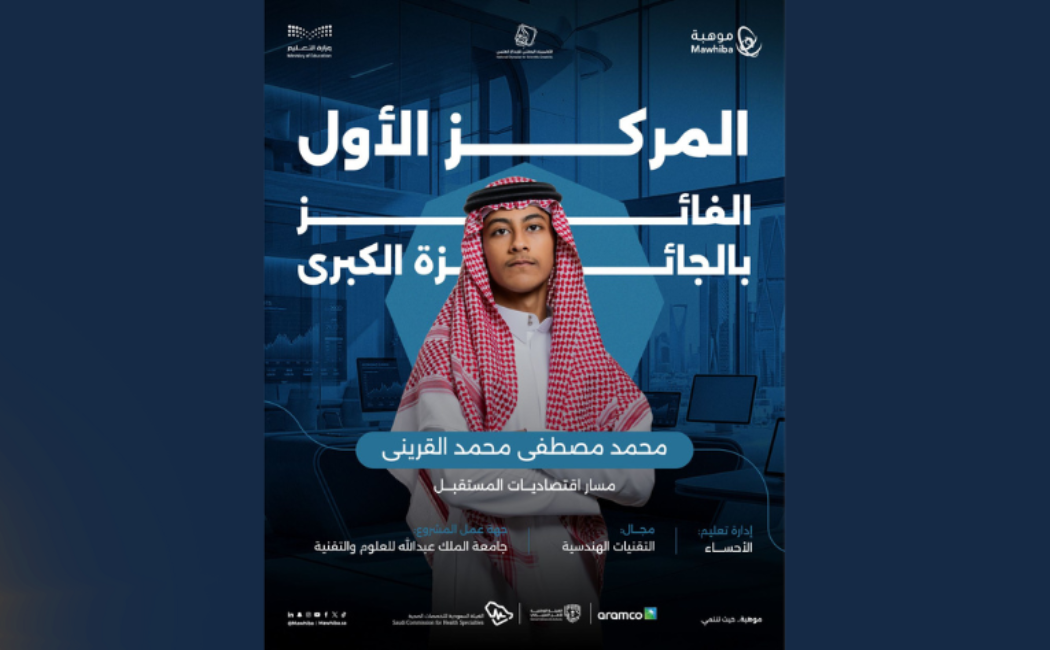
Collaboration also played a decisive role. Working closely with Abdulaziz Aljoaid, who also ranked fourth at Ibdaa’, allowed the two students to approach problems from different angles. “The collaboration helped me tackle problems from two directions. Abdulaziz provided critical feedback and was a major asset in graphic design, data visualization, and refining the phrasing of our final findings,” Alquraini said.
He recalls realizing the project was truly working when he stopped relying on his poster and began engaging the judges in direct discussion. “Having a solid answer for every ‘why’ the judges asked showed the work was grounded in reality.”
The project stood out for its detailed exploration of the counter-current downer reactor, an area where hydrodynamic behavior is still not fully understood. Judges recognized its potential to improve Fluid Catalytic Cracking efficiency and contribute to more sustainable, high-yield energy systems.
STEM early exposure is key
From its earliest days, KAUST has treated early exposure to STEM not as an add-on, but as part of its foundation. Through internships, visiting student programs, and hands-on lab experiences, the university has consistently brought school and undergraduate students into real research environments, positioning itself as a strong advocate for learning through practice.
This approach echoes the work of Carl Wieman, Nobel laureate and long-time leader in science education reform, who has shown that students involved in authentic research develop deeper conceptual understanding and stronger problem-solving skills than those trained only through traditional classroom methods.
“Early immersion in STEM research transforms students from learners into creators of solutions,” said Prof. Castano. “By engaging with complex problems early on, they develop the analytical rigor and curiosity needed to lead the scientific breakthroughs of tomorrow.”
Castano added, “In practical terms, early exposure shapes how students think. They arrive at graduate school already comfortable with uncertainty, data, and experimentation. And once that mindset takes hold, it rarely stays contained. It spreads through collaboration, strengthens teams, and quietly contributes to the circulation of scientific know-how across generations.”
Next stop: ISEF
For Alquraini, the award marks a beginning rather than a conclusion. With his sights set on the International Science and Engineering Fair — the world’s largest pre-university science competition, bringing together around 1,800 participants from more than 75 countries — he sees the next step as a chance to test his ideas on a global stage and continue building toward a future in engineering.