Dec 2026
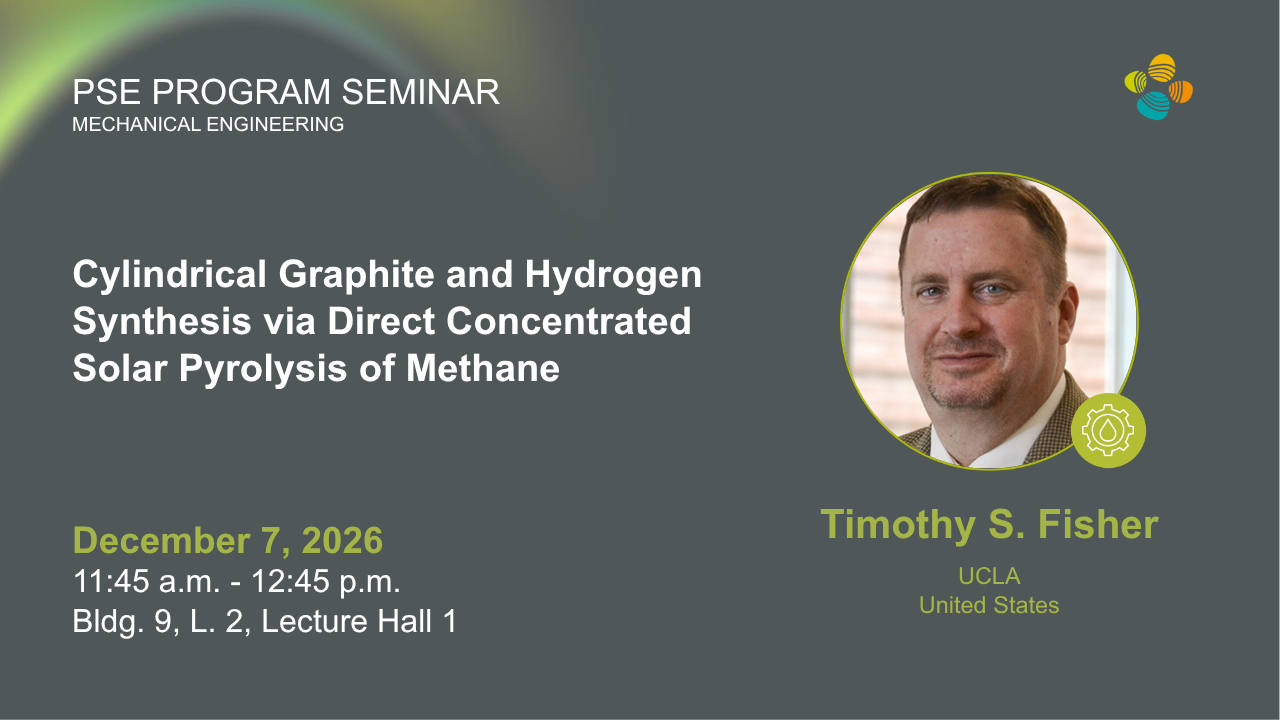
Cylindrical Graphite and Hydrogen Synthesis via Direct Concentrated Solar Pyrolysis of Methane
Abstract
One of the most underutilized resources across the entirety of human history is our solar resource. While we have utilized its energy for sustenance through the food chain, cooking, brick making, timekeeping, etc., we have yet to fully harness the potential of the sun’s heat flux. Here, through direct solar-thermal methane pyrolysis, we demonstrate the production of two high-grade energy materials while simultaneously preventing a greenhouse gas, methane, from entering into the atmosphere. By using a solar concentrator dish in the southwestern United States (SST LLC, Arizona), we directly concentrate solar energy onto a carbon fiber cloth near which methane rapidly decomposes to produce not only hydrogen gas but also solid carbon that deposits onto the cloth’s fibers in a highly graphitic form. This process has been proven at the laboratory scale with a xenon arc bulb solar simulator in our prior work, but no full-scale demonstration has occurred using real sunlight until recently. Concentrated solar energy at a scale of approximately 10 kW was used to produce graphite and hydrogen in two field test campaigns. These campaigns prioritized demonstration of basic process feasibility and scale-up viability through throughput enhancements such as continuous roll-to-roll processing. Hydrogen and carbon yields provide a baseline for the process, with hydrogen production exceeding 20 g/hr and conformal, cylindrical graphite production surpassing 70 g/hr. In addition, the graphite produced is of high quality for future potential use as a Li-ion battery anode material, as signified by the low D to G ratio of Raman spectrum of the solid product and the d-spacing evaluated via X-ray diffraction (XRD). This work demonstrates the feasibility of this new technology as a replacement for current carbon-positive sources of graphite for use in the battery industry by removing dependency on or decarbonizing fossil fuels while simultaneously producing a green energy co-product in hydrogen.
Biography
Timothy S. Fisher (PhD in Mechanical Engineering, Cornell 1998) joined the UCLA faculty in 2017 as Professor of Mechanical & Aerospace Engineering (MAE) after spending 15 years in Purdue’s School of Mechanical Engineering, and several previous years at Vanderbilt University. In 2018 he received the John P. and Claudia H. Schauerman Endowed Chair in Engineering at UCLA, as well as the ASME Heat Transfer Memorial Award. He served as MAE Department Chair from 2018 to 2022, and in 2023 became the Editor in Chief of the ASME Journal of Heat and Mass Transfer. His research has included studies of nanoscale heat transfer, electronics cooling, carbon nanomaterial synthesis, solar-thermal fuels and materials production, coupled electro-thermal effects in materials and devices, microfluidics, biosensing, thermal systems, and related computational methods ranging from atomistic to continuum scales. He has mentored more than 45 doctoral advisees to candidacy and completion, and in 2012 he received the McDonald Mentoring Award from ASME. He has authored more than 300 papers in peer-reviewed journals, and made a similar number of contributions to conference proceedings and presentations.