Nov 2026
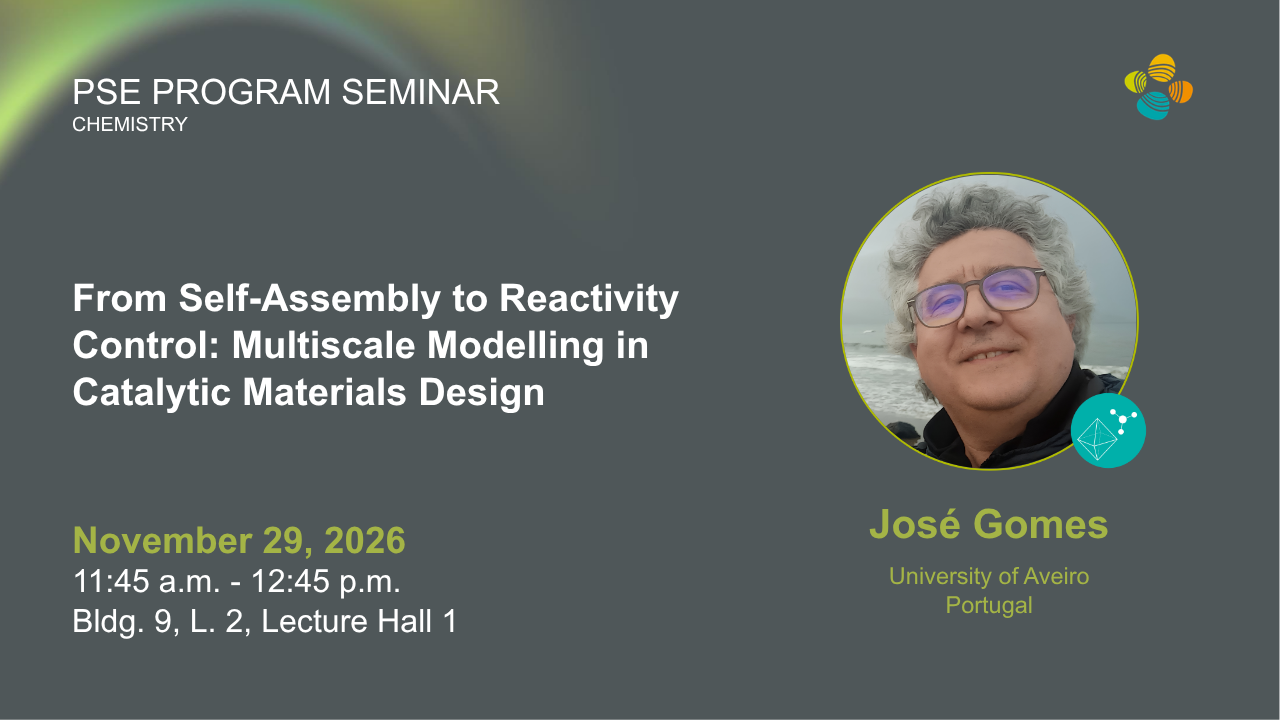
From Self-Assembly to Reactivity Control: Multiscale Modeling in Catalytic Materials Design
Abstract
The development of next-generation catalysts requires a molecular-level understanding of how materials are formed and how they perform under reaction conditions. In this talk, I will present how multiscale computational modelling provides insights across this spectrum, from the synthesis of porous catalytic materials to the design of active catalytic surfaces.[1]
Mesoporous silicas are widely used as catalyst supports and host materials due to their high surface area and tunable pore architectures. Through atomistic and coarse-grained molecular dynamics simulations, we investigate their formation mechanisms, revealing the active role of silicate species in directing surfactant self-assembly and mesostructure development. Building on these studies, we have developed reactive coarse-grained models based on the Martini framework, enabling the simulation of silica condensation and framework growth at experimentally relevant length and time scales. These approaches open new avenues for the rational design of porous materials with tailored catalytic properties.
The talk will also explore MXenes, a rapidly emerging platform for heterogeneous catalysis. Using density functional theory and microkinetic modelling, we show how surface terminations, defects, and nanostructuring can tune adsorption energies and catalytic performance, enabling a balance between activity and stability.
Overall, this work illustrates how computational methods bridge materials synthesis and catalytic function, providing predictive tools for the design of advanced catalysts for sustainable chemical processes.
Acknowledgments
This work was developed within the scope of the project CICECO-Aveiro Institute of Materials, UID/50011/2025 and LA/P/0006/2020, financed by national funds through the FCT/MCTES (PIDDAC). It was also financed in the frame of projects SILVIA (CENTRO-01-0145-FEDER-31002), ForTheShift (2022.02949.PTDC), and MINIONS (2024.16387.PEX). Thanks are also due to FCT I.P. for the computational resources granted in the framework of the Calls for Advanced Computing Projects, projects refs. (2023.10404.CPCA.A2; 2024.13633.CPCA.A3; and 2026.01111.CPCA.A3).
References
[1] M. Bordonhos, T. L. P. Galvão, J. R. B. Gomes, J. D. Gouveia, M. Jorge, M. Lourenço, J. M. Pereira, G. Pérez-Sánchez, M. L. Pinto, C. M. Silva, J. Tedim, B. Zêzere, Adv. Theor. Simul., 2023, 6, 2200628.
Biography
Dr. José R. B. Gomes is a computational chemist whose career has been defined by the development of advanced multiscale modelling tools and their application to materials, interfaces, and reactive systems. After earning his Ph.D. in Chemistry from the Univ. of Porto in 2000, with a thesis focused on the computational study of surface reactions, Dr. Gomes pursued postdoctoral research in Barcelona and Porto before joining the Univ. of Aveiro/CICECO in 2007. There, he established a computational chemistry laboratory that has become a reference in the field, integrating electronic-structure methods, atomistic simulations, coarse-grained and reactive models, and machine-learning (ML) approaches.
Dr. Gomes's scientific achievements include the development of transferable force fields for diverse materials, the Sticky-MARTINI reactive coarse-grained model, the SCEE method for polarization, and ML tools for corrosion inhibitor discovery, such as Datacortech and Cordata. He has elucidated adsorption mechanisms, surface chemistry, and structure–property relationships with atomic-level resolution, contributing to fields such as catalysis, corrosion protection, sensing, gas adsorption, and MXene chemistry. His scientific output comprises approximately 270 SCI-indexed papers, 10 book chapters, and numerous invited talks. Throughout his career, Dr. Gomes has secured sustained competitive funding, successfully coordinating twelve research projects. He has also participated as a team member in numerous other national and international projects. In addition, he has mentored 11 postdoctoral researchers, 7 Ph.D. students, 4 M.Sc. students, and 8 researchers within research projects.
Dr. Gomes's career is also marked by scientific leadership. He has been coordinating Research Lines and Research Groups at CICECO and co-founded the Computational Chemistry Group of the Portuguese Chemical Society. His service to the scientific community includes extensive evaluation activities for national funding agencies of many countries and the European Commission, as well as editorial responsibilities as Associate Editor of RSC Advances and membership on the editorial boards of several scientific journals. Dr. Gomes has organized several national and international conferences. He has also contributed to the organization of workshops and advanced schools.
In recognition of the quality, originality, and impact of his scientific contributions, Dr. Gomes was awarded the Vicente de Seabra Medal by the Portuguese Chemical Society in 2010, the Society's highest distinctions for Portuguese chemists under the age of 40.
Looking ahead, Dr. Gomes aims to further advance reactive multiscale modelling under realistic operating conditions, strengthen artificial intelligence-driven materials discovery pipelines, and deepen the mechanistic understanding of emerging materials, particularly MXenes. He is also committed to consolidating open computational materials tools and databases, thereby expanding the impact of computational chemistry on the design of next-generation materials.