Nov 2026
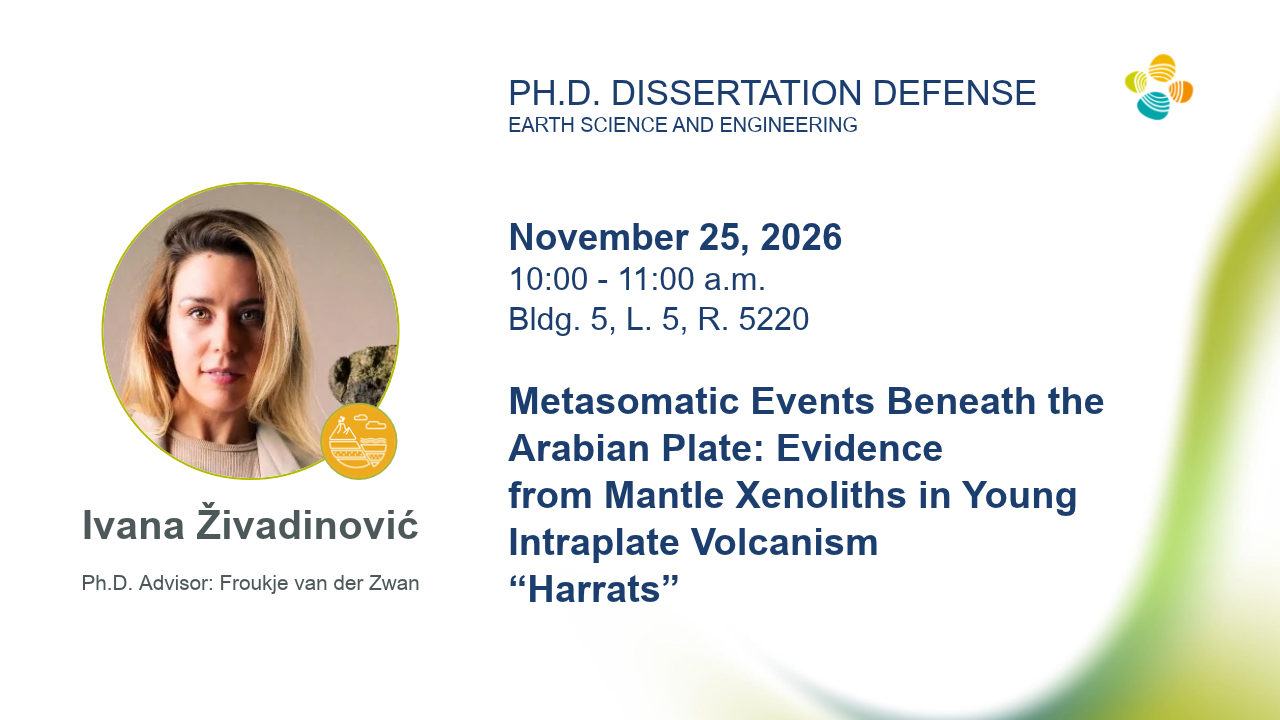
Metasomatic events beneath the Arabian plate: Evidence from mantle xenoliths in young intraplate volcanism “Harrats”
Abstract
The Arabian Plate hosts one of the largest Cenozoic intraplate volcanic provinces on Earth, the “Harrats”. The processes responsible for this volcanism remain debated, particularly the role of mantle composition and the relative contributions of mantle metasomatism by Afar plume activity, Red Sea rifting, and inherited heterogeneity. This thesis systematically investigates the composition and evolution of the lithospheric mantle beneath the Arabian-Nubian Shield using mantle xenoliths from six Harrats along a 1,200 km north-south transect crossing along the western Arabian Plate margin. The study focuses on two complementary enriched mantle domains, previously associated with rifting: an anhydrous domain represented by peridotite, pyroxenite, and clinopyroxene megacryst xenoliths, and a hydrous domain represented by amphibole-bearing xenoliths. Major-element mineral compositions for 63 samples characterize their lithology, mineral chemistry, and equilibration conditions. Geothermobarometric estimates indicate sampling from approximately 49 to 125 km depth (15.6–40.1 kbar), and temperatures of 739.9–1351.7 °C. The data reveal thermal heterogeneity and record heating events that affected the lithospheric mantle before, or during the early stages of, Cenozoic extension.
Trace-element concentrations and Sr-Nd-Hf-Pb isotope systematics were then used to evaluate the origin of the pyroxenites and amphibole enrichments, the processes responsible for fertilization, and the nature and timing of metasomatism. The anhydrous domain comprises depleted but subsequently fertilized pyroxenites, together with selected peridotites and clinopyroxene megacrysts. Their trace-element and isotope compositions record repeated Paleozoic re-enrichment and melt-rock interaction. The hydrous domain contains both depleted and strongly enriched lithologies, reflecting heterogeneous modification by hydrous melts and subduction related fluids. Model ages and mineral isochrons indicate that the principal enrichment events in both domains predate opening of the Red Sea at approximately 30 Ma extending back to Proterozoic times.
The combined results show that Arabian Plate lithosphere retains ancient subduction-related and melt-enrichment signatures associated with Neoproterozoic assembly and later pre-rift metasomatism. Cenozoic rifting and intraplate volcanism transported this heterogeneous mantle to the surface rather than ultimately creating its fundamental composition. These findings demonstrate that the SCLM beneath the Arabian-Nubian Shield is dominated by ancient lithospheric components with contrasting anhydrous and hydrous histories, followed by thermal heating events during rifting.