Nov 2026
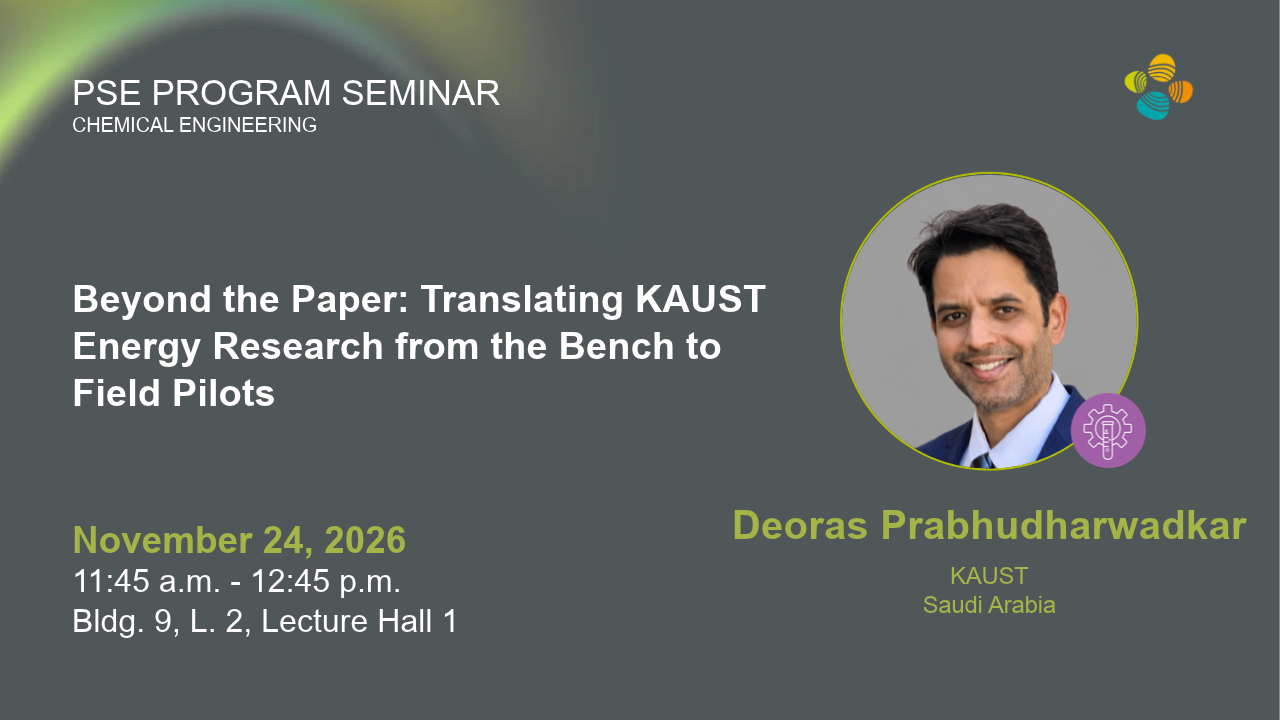
Beyond the Paper: Translating KAUST Energy Research from the Bench to Field Pilots
Abstract
Most promising lab-scale technologies never reach the field. The barrier is rarely the core science; it is the gap between what is demonstrated at the bench and what must be proven at scale. As KAUST sharpens its focus on accelerating impact, closing this gap has become a priority and poses new challenges for the researchers.
This talk draws on two KAUST technologies I have led through successive stages of translation: Ultrasonically Enhanced Oxidative Desulfurization (uODS) and Cryogenic Carbon Capture (CCC). In both, techno-economic analysis played a significant role as a design tool. It identified the cost-driving process steps early, redirected experimental priorities, and drove an innovation pipeline of more than 30 invention disclosures over five years.
Using these case studies, I will address three questions that every translation researcher would benefit from:
- Why does a “translation mindset” matter, and how does it change the research questions we ask in the lab?
- What skillsets and team structures are needed to take a process from the bench to a field pilot?
- How should demo and pilot scales be sized so that they validate the right technology readiness levels (TRLs) and key performance indicators (KPIs)?
I will close with practical guidelines for future projects and introduce "SPARK", a new KAUST initiative that helps researchers navigate translation and commercialization.
Biography
Dr. Deoras Prabhudharwadkar is a Senior Research Scientist in the Clean Energy Research Platform at KAUST, working with Prof. William Roberts, where he leads the group’s technology translation and spin-out efforts. He has served as interim CTO and CEO of two recent KAUST startups focused on decarbonizing the maritime sector, and he is a Scientific Advisor to the United Nations International Maritime Organization (IMO), supporting its decarbonization strategy and policy development.
Before joining KAUST in 2020, Deoras spent a decade at General Electric (GE), progressing from Lead Researcher to Technology Manager across gas turbines, nuclear, and renewable energy applications. His expertise spans the full lab-to-field spectrum: from thermodynamics, heat transfer, and multiphase flows to techno-economic and life-cycle assessment, design-led innovation, and product management.