Nov 2026
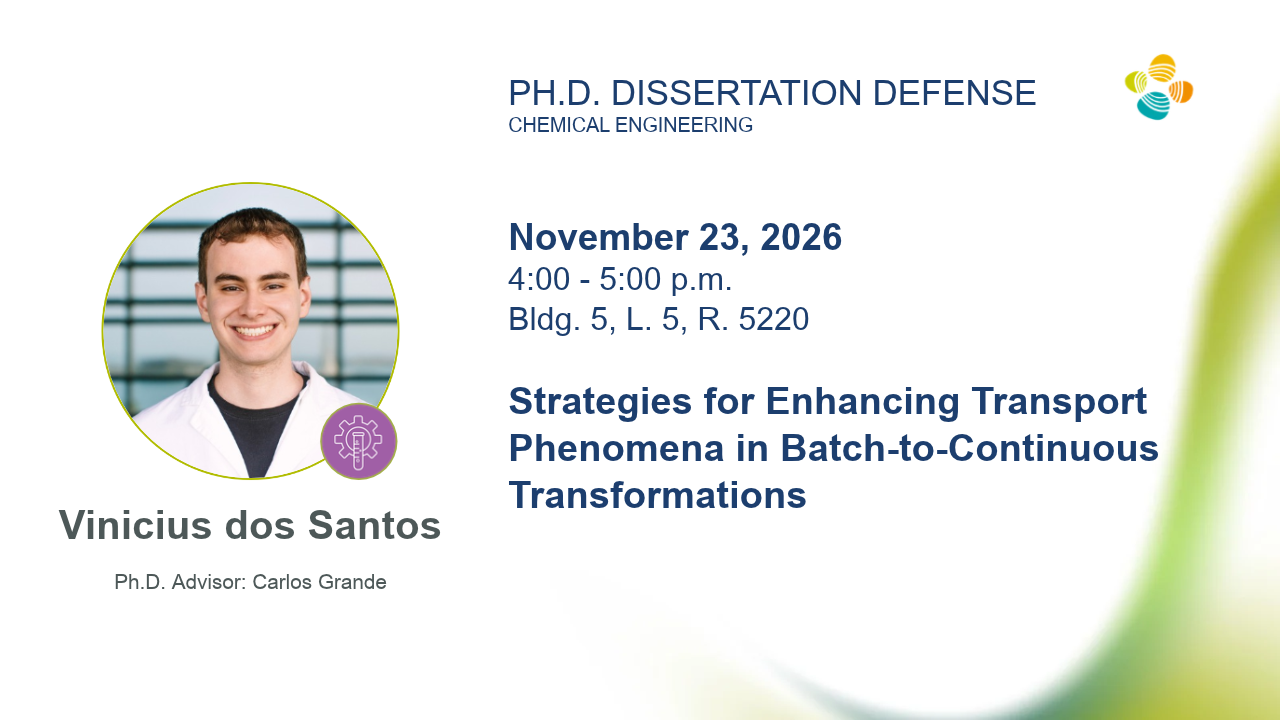
Strategies for enhancing transport phenomena in batch-to-continuous transformations
Committee Members Information
- Ph.D. Advisor: Professor Carlos Grande (KAUST, Chemical Engineering)
- External Examiner: Professor Simon Kuhn (Department of Chemical Engineering, KU Leuven)
- Committee Chair: Professor Alfonso Caraveo (KAUST, Material Science and Engineering)
- 4th Committee Member: Professor Pedro Castano (KAUST, Chemical Engineering)
Abstract
Batch processing dominates chemical manufacturing, yet continuous flow offers safer, more efficient, and more scalable production. Converting a batch process to flow takes more than moving reactants through a tube. It required reactor hardware that delivers the necessary mixing, heat transfer and residence-time control, a synthesis protocol that works under flow conditions, and kinetic knowledge of the reaction.
This dissertation addresses each requirement through process intensification, with one reactor-design study and two applications: a powder synthesis (a metal-organic framework) and an exothermic reaction (vitamin B3 production). Chapter 2 examines the effect of reactor geometry and manufacturing using 3D printing. Different 2D Hilbert space-filling curve reactors were fabricated by stereolithography, varying the cross-sectional shape and adding channel twisting to promote mixing.
The 3D printed reactors can deviate from the computer-aided design (CAD) by up to 13% in the internal volume, reducing the agreement between predictions by computational fluid dynamics modelling and experimentally measured residence time distributions (RTDs). Twisted channels produced higher vorticity and Peclet number, indicating enhanced mixing. Chapter 3 translates the solvothermal synthesis of the bimetallic metal-organic framework UTSA-16 into continuous flow. At 100°C and a 3-minutes residence time, the process produced 72 nm crystals with a narrow particle size distribution. Surface area and CO2 uptake matched or exceed those of batch-synthesized material, and the MOF remained stable over more than 20 CO2 adsorption cycles.
Chapter 4 dives into a safer vitamin B3 route compatible with continuous flow. Kinetic analysis established a first-order dependence on oxidant concentration and an activation energy of 67.6 kJ mol-1, and flow experiments reached selectivity values above 50%.
