Nov 2026
Acoustic Metamaterials and Metasurfaces Based on Space Coiling Structures
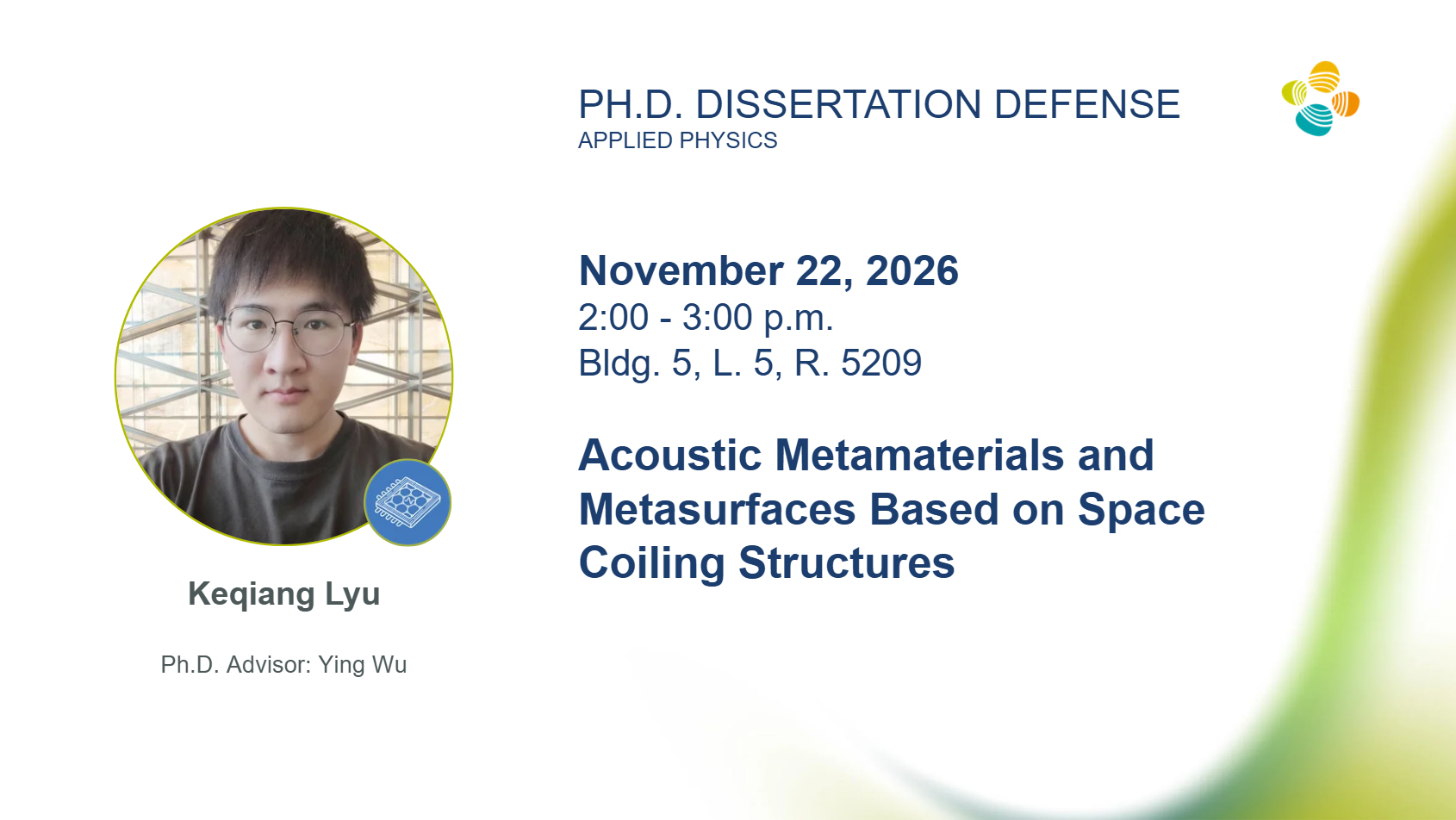
Ph.D. Dissertation Committee:
- Committee Chair: Prof. Hakan Bagci
- Ph.D. Advisor: Prof. Ying Wu
- External Examiner: Prof. Badreddine Assouar
- Committee Member: Prof. Udo Schwingenschlögl
- Committee Member: Prof. Qiaoqiang Gan
Abstract:
In recent years, artificial subwavelength acoustic metamaterials and metasurfaces have been widely adopted for precise low-frequency acoustic manipulation, attributed to their compact size, versatile spatial arrangement, and tunable operating frequencies. By folding the sound propagation path, space-coiling structures provide a flexible platform for deep-subwavelength phase and impedance modulation. In this dissertation, I used space-coiling resonators as the fundamental building blocks to design acoustic subwavelength structures for antenna and absorption applications.
I first designed a variable-cross-section space-coiling resonator that enables flexible tuning of multipolar resonances. This design overcomes the longstanding challenge of achieving accidental degeneracy between monopole and dipole resonances at the Brillouin-zone center, thereby realizing an acoustic double-zero-index metamaterial for airborne sound. Building on this platform, I developed an acoustic leaky-wave antenna that eliminates the need for spatially separated radiating elements, achieving a radiation efficiency of 75%, approximately three times that of conventional designs, while decoupling efficiency from antenna length.
In the second design, I addressed broadband low-frequency sound absorption by designing an absorbing metasurface based on coupled concentric space-coiling resonators. The structure achieves a 60% semi-absorption bandwidth at only 1/15 wavelength thickness. By efficiently utilizing resonant volume in confined spaces, this integrated resonator provides a compact and efficient solution for broadband low-frequency absorption. To enable ventilation, I coupled a highly dissipative space-coiling resonator with a square air chamber to develop a tunable asymmetric ventilated absorber. The system achieves near-perfect forward absorption and near-total backward reflection. Simply rotating the resonator induces up to 92% (~11 dB) modulation in absorptivity, producing an “acoustic switching” effect with tunable absorption levels and peak frequencies. Furthermore, cascading identical units at different rotation angles enables broadband asymmetric absorption and offers a simple route to dynamically reconfigurable acoustic devices.
Overall, this thesis addresses several key challenges associated with conventional airborne acoustic metamaterials via space-coiling resonators, leading to the realization of double-zero-index metamaterials, high-efficiency and flexible acoustic leaky-wave antennas, broadband low-frequency absorbers, and ventilated asymmetric absorbers. The underlying mechanisms are systematically investigated using various theoretical approaches, including effective-medium modeling, transmission-line theory, and temporal coupled-mode theory.