Nov 2026
Engineering Nano (Photo) Catalysts for Sustainable Chemical Technologies
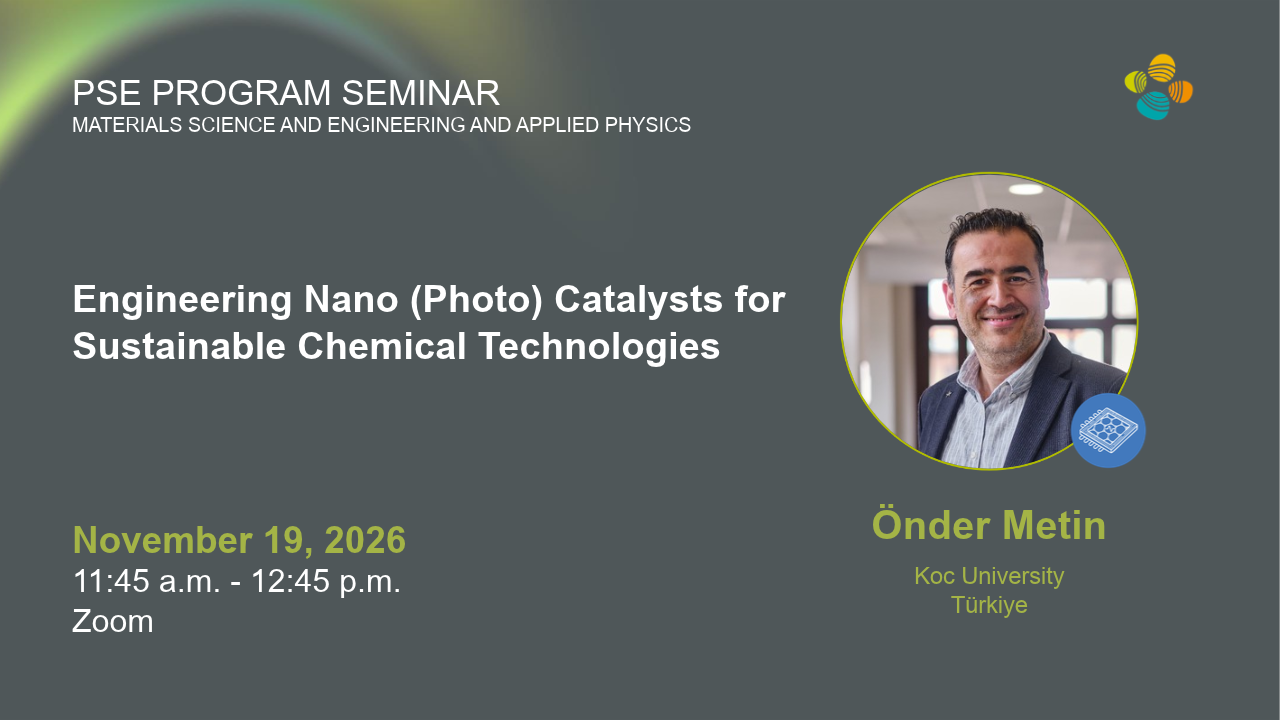
Zoom Meeting: Zoom link
Abstract
Catalysts are central to numerous industrial processes, including fuel synthesis, polymer production, and pharmaceutical manufacturing, enabling reactions to proceed under milder conditions, with lower energy requirements, and with better selectivity by minimizing undesirable byproducts. Over the last quarter century, transition metal nanoparticles (NPs) have emerged as highly effective catalysts due to their large surface-to-volume ratio and the enhanced reactivity of surface atoms compared to bulk metals. These properties have enabled the rapid advancement of nanocatalysis, which often offers superior performance compared to traditional homogeneous and heterogeneous catalysts. Bimetallic NPs, either alloys or core-shell structures, are particularly important, as they often exhibit enhanced catalytic activity, selectivity, and stability due to synergistic interactions between two-distinct component metals. This approach is particularly useful for combining noble and non-noble metals, reducing cost without sacrificing efficiency.
In parallel, aligning catalytic strategies with green chemistry principles has motivated efforts to integrate photocatalysts capable of harvesting a broad spectrum of the solar spectrum. Such systems offer a sustainable route to more efficient and cost-effective chemical transformations. While semiconductor-based photocatalysts have long been under investigation, their widespread application is limited by challenges such as poor band-edge alignment with target reactions and rapid recombination of photogenerated charge carriers, both of which significantly reduce photocatalytic efficiency.
In this talk, I will highlight our rational approach to synthesizing monodisperse monometallic and bimetallic NPs, including alloy and core-shell structures supported on two-dimensional materials. I will also describe the rational design of g-CN and other 2D semiconductor-based photocatalysts for various chemical transformations. The catalytic performance of these nanomaterials will be demonstrated in various applications, including hydrogen energy, energy storage and conversion, green organic synthesis and biomedicine.
Biography
Dr. Onder Metin is a full professor at Department of Chemistry, Koc University, Istanbul, Türkiye. He received his Ph.D. degree from Department of Chemistry, Middle East Technical University (METU), Ankara, Türkiye, in 2010. He studied as visiting scholar at Department of Chemistry, Brown University (Rhode Island/USA) in 2009 and at Darmstadt Technical University, Germany in 2010. In 2011, he got an Assistant Professor position at Department of Chemistry, Atatürk University, Erzurum, Türkiye. He then joined the Department of Chemistry, Brown University, USA, as a post-doctoral research associate in 2012-2013. After working as a faculty member of Department of Chemistry at Atatürk University for seven years, he moved to Koç University, the best research university of Türkiye, Department of Chemistry, Istanbul, Türkiye, in 2018. He received numerous scientific awards including the most prestigious ones, 2017 The Scientific and Technological Research Council of Turkey (TUBITAK) “Research Encouragement Award”(TÜBİTAK Teşvik), and Turkish Academy of Sciences “The Highly Successful Young Scientists Award” (TÜBA-GEBİP) and several others given to outstanding young scientists working in Türkiye. He was also awarded a prestigious Fulbright Scholarship in 2025 and worked as a Visiting Professor in the Department of Chemical&Biological Engineering at the University of Wisconsin–Madison, WI, U.S.A. He also worked as a visiting professor at the University of Science and Technology of China (USTC) for one month in 2026. He has been an elected full member of Turkish Academy of Sciences since 2018. He served as the Vice-President of the Turkish Chemical Society (2022-2025) and the Secretary General of Federation of Asian Chemical Societies (FACS) (2023-2025). He is a Titular Member of IUPAC Division II-Inorganic Chemistry since 2023. He has also served as the Associate Editor-in-chief of the Turkish Journal of Chemistry, Editorial Board Member of Scientific Reports (Nature Publishing), Tungsten (Springer Nature), cMAT (Elsevier) and IUPAC Pure and Applied Chemistry (PAC) journals. His research interests are transition metal nanoparticles, 2D materials, nanocomposites, nanocatalysis, photocatalysis, heterogeneous catalysis, electrocatalysis, hydrogen storage, fuel cells, rechargeable lithium batteries, green chemistry and sustainable organic transformations. He has published more than 180 papers, primarily in highly prestigious journals, with an h-index of 58 and over 12,000 citations.