Committee Members Information
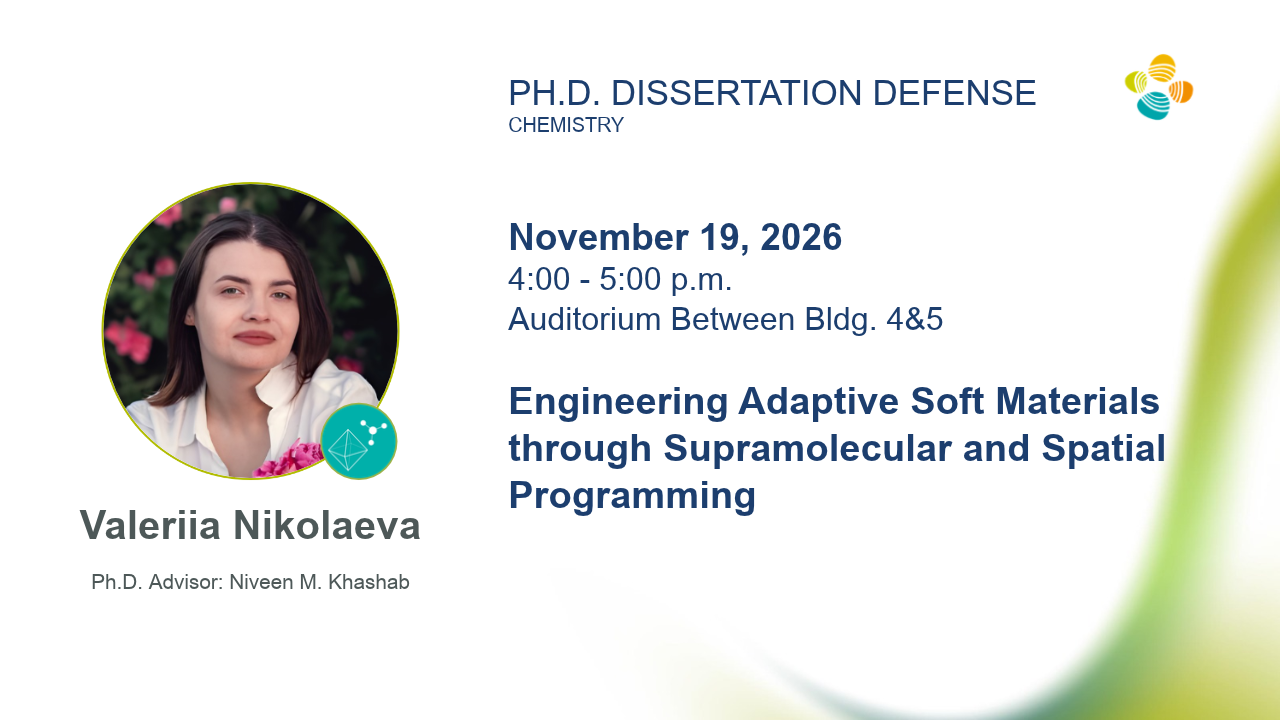
- Ph.D. Advisor: Professor Niveen M. Khashab (KAUST, Chemistry)
- External Examiner: Professor Paul Weiss (UC Presidential Chair; Distinguished Professor of Chemistry & Biochemistry, Bioengineering, and Materials Science & Engineering, UCLA)
- Committee Chair: Professor Nazek El-Atab (KAUST, Electrical and Computer Engineering)
- 4th Committee Member: Professor Martin Heeney (KAUST, Chemistry)
Abstract
Adaptive soft materials derive their functionality not only from their chemical composition, but also from how molecular interactions, network connectivity, hydration, and structural heterogeneity are organized across multiple length scales. Achieving deliberate control over this organization remains a central challenge in the design of responsive materials, particularly when the desired behavior extends beyond a simple stimulus-induced transition to include reconfigurability, environmental information transduction, directional deformation, and time-dependent shape evolution. This thesis explores how supramolecular and spatial programming can be used as complementary strategies to regulate the physical state, responsiveness, and macroscopic behavior of adaptive polymer networks.
The first part of this work focuses on supramolecular programming of dynamic network states. A protonated trianglamine macrocycle is introduced into a polymer–clay network to reorganize the underlying noncovalent interaction landscape and convert a conventional elastic hydrogel into a dynamic, injectable paste. The resulting material combines moldability and rapid self-healing with a reversible temperature-triggered paste-to-gel transition, enabling shape fixation, reprogramming, and restoration of conductive pathways after damage. Molecular calculations and simulations further reveal how redistribution of intermolecular interactions and changes in network mobility underlie this transition from a relatively static gel to a reconfigurable supramolecular state.
This strategy is subsequently extended using a three-dimensional organic cage as a multivalent regulator of network connectivity and relaxation dynamics. Increasing cage content progressively tunes the material from an elastic gel through deformable paste-like states to a highly flowable regime, demonstrating continuous control over the dynamic state of the network. An intermediate paste composition is further coupled with ion-dependent reorganization and thermoresponsive behavior, allowing salt concentration to be encoded into a characteristic thermal transition temperature. The resulting chemical-to-thermal transduction is converted into a directly observable optical transition, enabling quantitative visual determination of unknown ion concentrations.
The final part of the thesis expands network programming from bulk material states to spatially organized behavior. One-sided mild ultraviolet polymerization of a conductive hydrogel precursor generates an in situ porous/dense heterostructure with distinct local composition, hydration, morphology, conductivity, and thermal response. This built-in asymmetry translates molecular- and network-level differences into reversible direction-dependent actuation and enables spatial control over deformation pathways. Through subsequent salt-assisted plastic deformation, asymmetric mechanical states can be encoded within the heterostructure and released sequentially upon rehydration, producing a temporally ordered multistage shape readout involving coiling, reversal, and gradual relaxation.
Together, these studies demonstrate that adaptive soft-material behavior can be programmed by controlling not only what components are incorporated into a network, but also how their interactions, dynamic states, and spatial distributions are organized. By progressing from supramolecular regulation of bulk network states to environmental information transduction and finally to spatial and temporal programming of deformation, this thesis establishes a multiscale framework for engineering soft materials capable of reconfiguration, sensing, actuation, and information-bearing response.