Nov 2026
The Anion Sublattice in High-Entropy Materials: Structure, Diffusion, and Functional properties of Oxides and Oxyhydrides
Committee Members Information
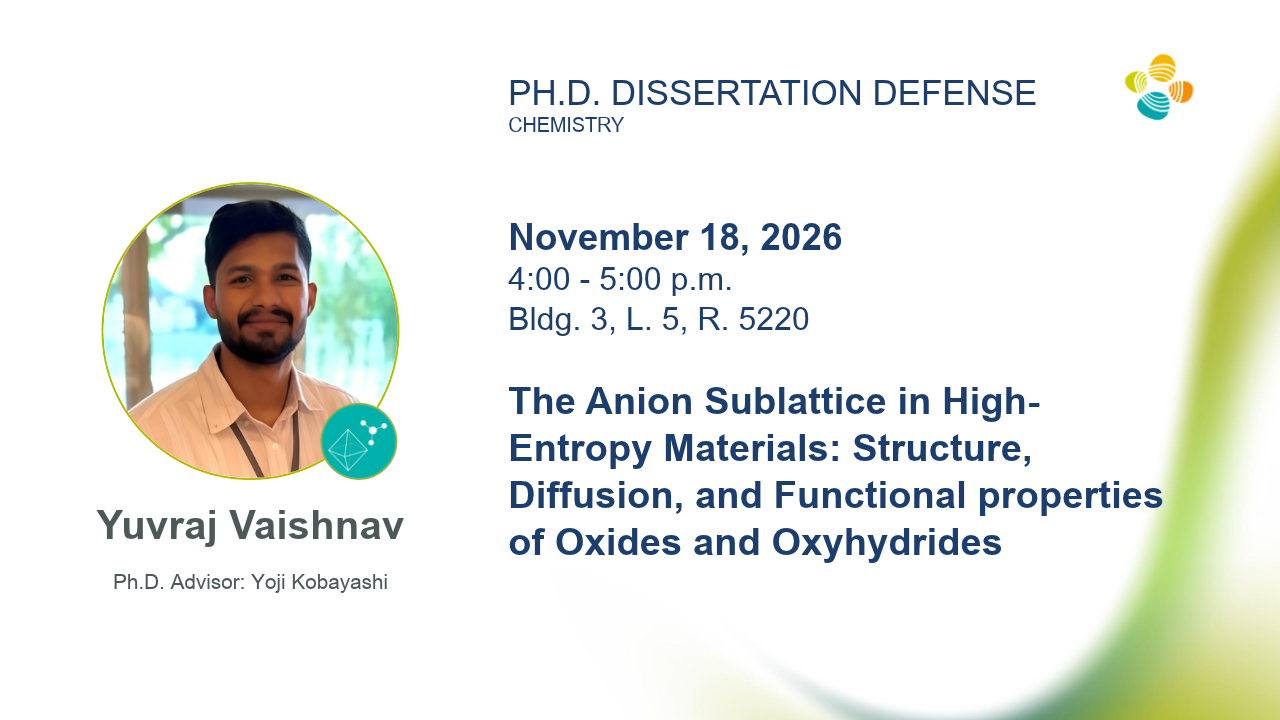
- Ph.D. Advisor: Professor Yoji Kobayashi (KAUST, Chemistry)
- External Examiner: Professor Kyriaki Polychronopoulou (Khalifa University)
- Committee Chair: Professor Pedro Castano (KAUST, Chemical Engineering)
- 4th Committee Member: Professor Luigi Cavallo (KAUST, Chemistry)
Abstract
High-entropy materials have attracted significant attention for their versatile applications, but the structural role of anions in these systems is not fully understood. While manipulating cationic disorder has yielded new phases and tailored properties, the behavior of anions, specifically their ordering, diffusion, and vacancies follows unique local chemistry and requires dedicated study. This thesis investigates the anion sublattice in high-entropy lanthanide oxides and oxyhydrides, focusing on three aspects: selective ordering, enhanced diffusion, and low anion content stabilization.
Enhanced anion diffusion is demonstrated in the fluorite-like high-entropy oxide (La,Ce,Pr,Nd,Y)O1.68. Here, precise oxygen content and structure reveal a large oxygen storage capacity, enabled by efficient Ce/Pr redox activity and facile oxide diffusion pathways. Bond valence energy mapping reveals reduced migration barriers, while suppressed sintering enhances cycling stability and performance as a methane-oxidation catalyst support.
Selective anion ordering is observed in (La,Ce,Pr,Nd,Y)H1.5O0.75, where cation disorder creates new interstitial sites preferentially occupied by hydride ions. This structure differs from single-lanthanide analogues, which lack such complexity. Hydride ion conductivity measurements and energy maps show low activation energy for hydride migration, boosting ammonia synthesis activity.