Nov 2026
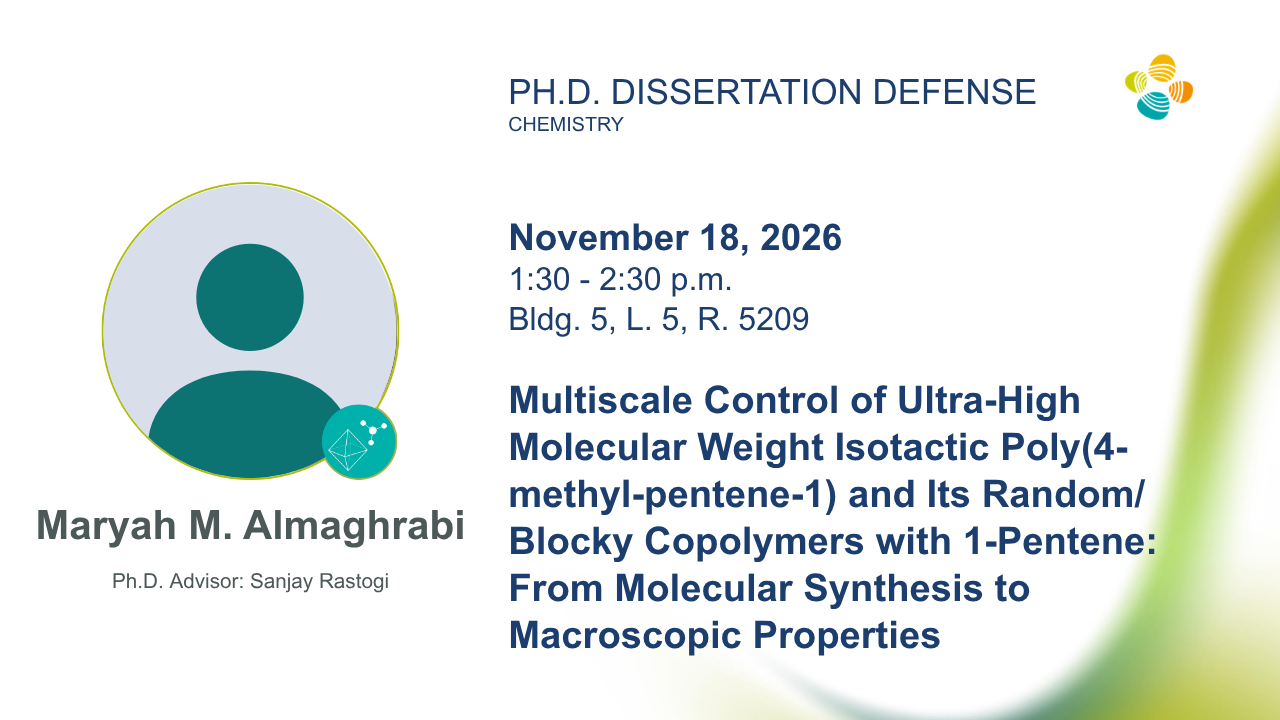
Multiscale Control of Ultra-High Molecular Weight Isotactic Poly(4-methyl-pentene-1) and Its Random/ Blocky Copolymers with 1-Pentene: From Molecular Synthesis to Macroscopic Properties
Committee Members
- Ph.D. Advisor: Professor Sanjay Rastogi (KAUST, Chemical Engineering)
- External Examiner: Professor Theo Tervoort (ETH Zürich, Department of Materials)
- Committee Chair: Professor Shadi Fatayer (KAUST, Materials Science and Engineering & Applied Physic)
- 4th Committee Member: Professor Martin Heeney (KAUST, Chemistry)
Abstract
Isotactic poly(4-methyl-1-pentene) (iP4MP1) is a high-performance polyolefin distinguished by its transparency, gas permeability, thermal stability, chemical resistance, and complex polymorphic behavior. Despite these attractive characteristics, the relationships among polymerization conditions, molecular architecture, crystal structure, phase-transition kinetics, melt organization, and mechanical performance remain insufficiently understood. This thesis establishes multi-scale understanding iP4MP1 and its 1-pentene (1P) copolymers from synthesis, crystallization and morphology to macroscopic properties.
First, the influence of the polymerization medium on crystal polymorphism and morphology was investigated. Polymerization in n-heptane, in which iP4MP1 chains exhibit poor miscibility, promoted the formation of metastable monoclinic Form II crystals that transformed into the thermodynamically stable tetragonal Form I before melting. This solvent-controlled crystallization pathway enabled the preparation of ultra-high-molecular-weight iP4MP1 with a unimodal molecular-weight distribution and single-crystal-like morphology. The resulting material could be uniaxially deformed below the melting temperature, facilitating molecular orientation. Rheological measurements indicated a high molecular weight between entanglements of approximately 26,000 g/mol, while tensile strength, elongation at break, and toughness increased with molecular weight.
Second, the effects of 1P incorporation and comonomer sequence distribution on the phase transition to Form I, and the associated lamellae thickening were examined in random and blocky copolymers with iP4MP1. Increasing random 1P incorporation contracted the lattice parameters of nascent Form II crystals, whereas annealed Form I crystals exhibited contraction within the 𝑎𝑏-planes accompanied by expansion along the 𝑐-axis. Random sequence incorporation lowered the onset temperature and accelerated the Form II-to-Form I transition by introducing packing defects and enhancing local chain mobility. This mobility promoted primary lamellar thickening through the transformation of disordered Form II precursors into more ordered Form I structures. In contrast, blocky copolymers developed interconnected compact domains and phase-separated morphologies that restricted primary thickening and favored secondary lamellar thickening only at elevated temperatures.
Finally, the coupling between melt memory, extensional rheology, and flow-induced crystallization (FIC) was elucidated. The iP4MP1 homopolymer displayed strong melt conformational ordering, strain hardening over the investigated strain-rate range and formed microscopically oriented lamellae structures consistent with unusually strong FIC. Incorporation of 1P delayed strain hardening with substantially stronger effects in the blocky copolymers. Random copolymers more rapidly reduced melt conformational ordering and increased the nucleation barrier through sequence disruption and enhanced chain mobility, whereas blocky copolymers retained microdomain-induced heterogeneity but constrained the macroscopic chain alignment required for efficient FIC. Both architectures exhibited reduced orientation and cavitation relative to the homopolymer. Collectively, the results demonstrate that polymerization medium, comonomer content, sequence distribution, and melt organization provide complementary routes for controlling polymorphism, phase-transition kinetics, lamellar evolution, flow-induced crystallization, and mechanical performance in iP4MP1-based materials. The findings provide fundamental insight into the distinct roles of sequence-level disorder and block-scale confinement and establish design principles for developing transparent, mechanically robust, and structurally tunable isotactic polyolefins.