Nov 2026
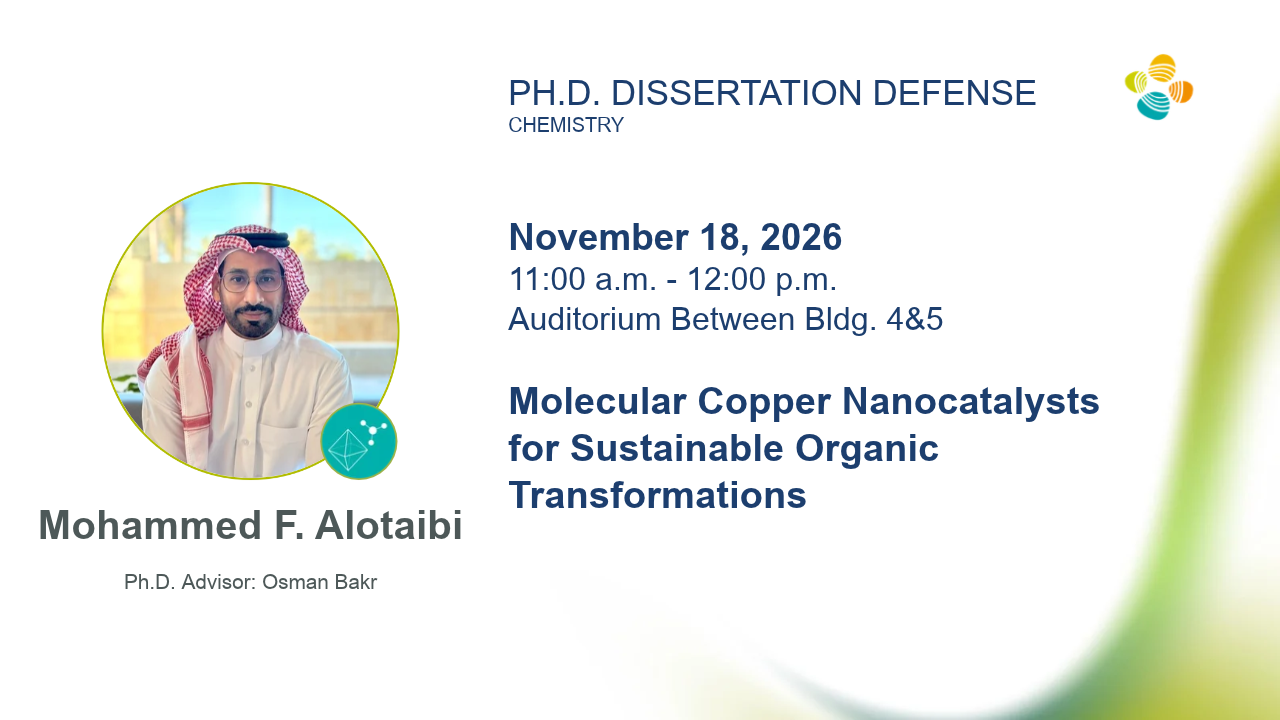
Molecular Copper Nanocatalysts for Sustainable Organic Transformations
Committee Members
- Ph.D. Advisor: Professor Osman Bakr (KAUST, Material Science and Engineering)
- External Examiner: Professor Yao Qiaofeng (Tianjin University, Department of Chemistry)
- Committee Chair: Professor Shadi Fatayer (KAUST, Material Science and Engineering)
- 4th Committee Member: Professor Huabin Zhang (KAUST, Chemistry)
Abstract
Catalysis plays a central role in modern science and industry. A large fraction of chemicals produced worldwide rely on catalytic processes, making catalysis essential to the global economy. Indeed, over 90% of industrial chemical production relies on catalytic processes. Catalysts are also important for renewable energy conversion and storage, waste treatment, and reducing greenhouse gas emissions. Therefore, developing more efficient and sustainable catalysts remains an important research goal. The design of next-generation catalysts requires a clear understanding of how precisely catalyst structure governs catalytic performance. Establishing precise structure–property relationships in conventional nanomaterials remains challenging because of their structural heterogeneity and the difficulty of identifying well-defined active sites at the atomic level. Atomically precise nanoclusters (NCs), often described as nanomolecules, provide a unique platform to address these challenges. Their discrete compositions and well-defined atomic structures enable systematic investigation of how subtle variations in size, atomic arrangement, composition, and surface chemistry influence their physicochemical properties and catalytic behavior.