Committee Members Information
- Ph.D. Advisor: Professor Carlos Grande (KAUST, Chemical Engineering)
- External Examiner: Professor Arvind Rajendran (University of Alberta, Canada Tenured Full Professor, Department of Chemical and Materials Engineering University of Alberta, Canada)
- Committee Chair: Professor Bassam Dally (KAUST, Mechanical Engineering)
- 4th Committee Member: Professor Ingo Pinnau (KAUST, Chemical Engineering)
Abstract
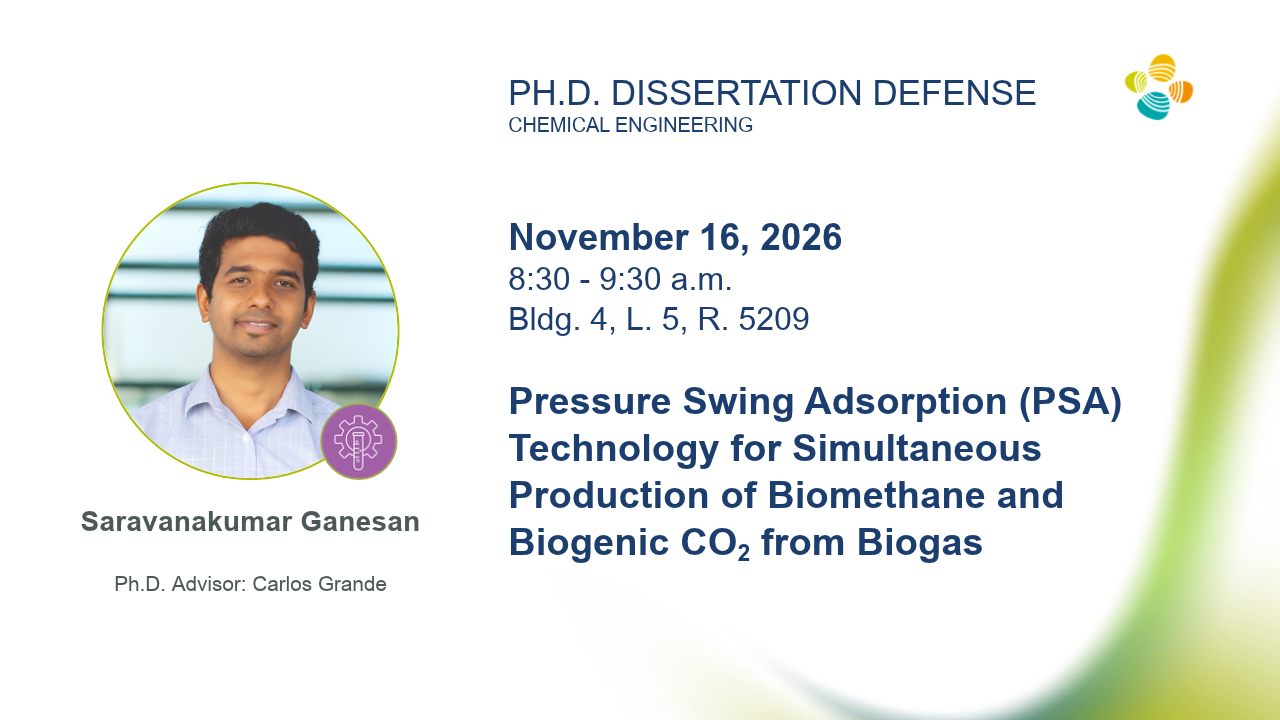
Biogas is one of the few renewable energy sources that can be stored, transported, and used interchangeably with fossil natural gas. Raw biogas is a mixture of roughly 55 to 70% methane and 30 to 45% carbon dioxide, which must be removed before the gas can be used as vehicle fuel or injected into gas grids. This purification, biogas upgrading, conventionally yields one valuable product, biomethane, while venting the separated carbon dioxide as waste. Yet that carbon dioxide, once concentrated to high purity, has genuine commercial value in food grade refrigerants, greenhouse enrichment, and synthetic fuels. Recovering both gases at high purity together is the central challenge this thesis addresses.
Pressure Swing Adsorption (PSA) is among the leading technologies for this separation, using solid adsorbent materials to preferentially capture carbon dioxide under cycling pressure. Conventional PSA cycles are optimized for a single product, and achieving high purity in both streams within a compact, economical plant has remained an open engineering problem. This thesis develops, validates, and experimentally tests different PSA configurations built for dual product separation, combining simulation, techno economic analysis, and pilot unit experimentation.
A validated PSA column model, incorporating bilinear driving force mass transfer kinetics and multisite Langmuir adsorption equilibria, provided the simulation backbone. Eight cycle configurations were evaluated, identifying a five-column cycle achieving 97.35 mol% methane and 99.55 mol% carbon dioxide purity simultaneously. A two-column system with a flexible tail gas balloon, a low-cost innovation decoupling the timing of key process steps, matched this performance while doubling productivity and cutting capital cost, at a levelized cost of 0.595 USD per Nm³. A complementary VSA configuration operating at ambient adsorption pressure eliminated the feed compressor, cutting energy use by 34%, at the cost of lower productivity.
The direction of the pressure equalization step between columns was found to have a major effect on performance, degrading purity and recovery together when performed incorrectly, validating a design choice used throughout the thesis. A second experimental investigation tested the lead trim cycle, a previously simulation only strategy, finding its real-world benefit modest than predicted, and identifying the adsorbent property responsible.
Together, these contributions show that dual product biogas upgrading is achievable at competitive cost using both medium and ambient pressure-based architectures and provide a validated simulation framework confirming key design principles: a practical pathway toward plants that valorize both of biogas's constituent gases, not only one.