Nov 2026
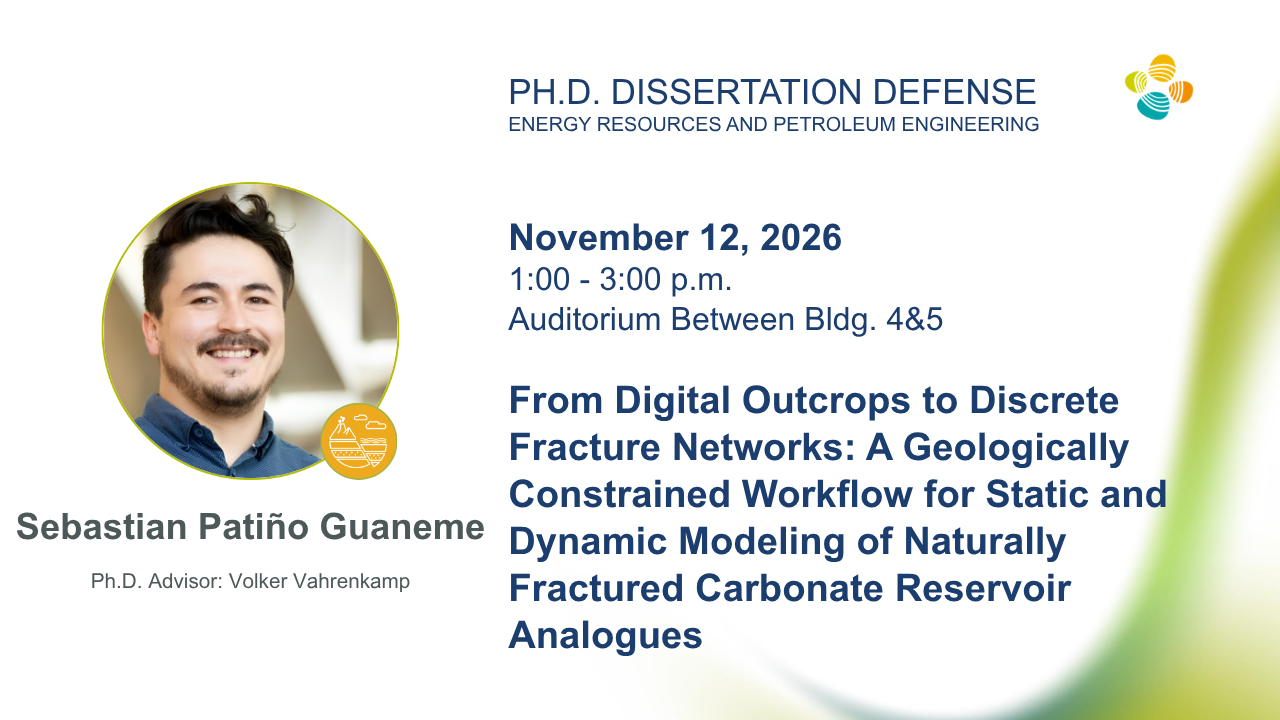
From Digital Outcrops to Discrete Fracture Networks: A Geologically Constrained Workflow for Static and Dynamic Modeling of Naturally Fractured Carbonate Reservoir Analogues
Abstract
Fracture networks exert first-order control on fluid flow in carbonate reservoirs. Yet, their geometry, intensity, hierarchy, and spatial organization remain insufficiently constrained because seismic data cannot resolve individual mesoscale fractures (cms to 10s of m) and well data are sparse and directionally biased. This thesis addresses that gap through a novel, integrated, geologically traceable workflow transforming outcrop observations into quantitative fracture parameters and mechanically conditioned discrete fracture network models. The Upper Jubaila Formation and Arab-D Member exposed at Wadi Daqlah, central Saudi Arabia, were investigated using six high-resolution UAV-based Digital Outcrop Models. More than 10,000 fractures were analyzed for orientation, size, intensity, spacing, stratigraphic confinement, lithological controls, and corridor organization. Three regionally consistent fracture sets were identified (N-S, NW-SE, NE-SW). Fracture sizes show dual scaling: shorter, bed-confined fractures follow lognormal distributions, whereas longer, nonstratabound fractures follow power-law behavior. Dolostone intervals are systematically more fractured than most limestone intervals, and 30 fracture corridors define localized zones of enhanced intensity. In order to translate outcrop fracture data into digital models, a new innovative workflow was developed. QuantaFrac is a new three-dimensional, stratigraphically constrained workflow that calculates fracture density, areal and volumetric intensity, and spacing; introduces a Fracture Concentration Index; and corrects for orientation bias and stratigraphic geometry. Synthetic validation confirmed accuracy for computed parameters and quantified uncertainty in stereological intensity and oblique-set spacing. These observations were integrated with a three-dimensional facies model, mechanical stratigraphy, and core-derived rock competence. The principal modeling innovation is a predictive volumetric fracture-intensity formulation combining spacing, fracture concentration, rock competence, and bed thickness, thereby replacing unconstrained stochastic assignment with explicit geological controls. This formulation provided the basis for a hierarchical DFN differentiating bed-confined, multi-bed-crossing, persistent, and corridor fractures while preserving fracture abundance and stratigraphic persistence. Sensitivity and bounding analyses showed that spacing, competence, and fracture concentration primarily control fracture abundance, whereas persistence governs the partitioning between short and large fractures. This thesis establishes the first integrated pathway for the Wadi Daqlah Arab-D analogue, from digital fracture mapping through validated quantitative characterization and facies-mechanical modeling to a predictive, uncertainty-aware three-dimensional DFN. It concludes that outcrops provide robust constraints on fracture geometry, scaling, hierarchy, and stratigraphic organization, whereas aperture and transmissibility should remain scenario-dependent when transferring the model to subsurface conditions.