Nov 2026
MSEAP Student Seminar
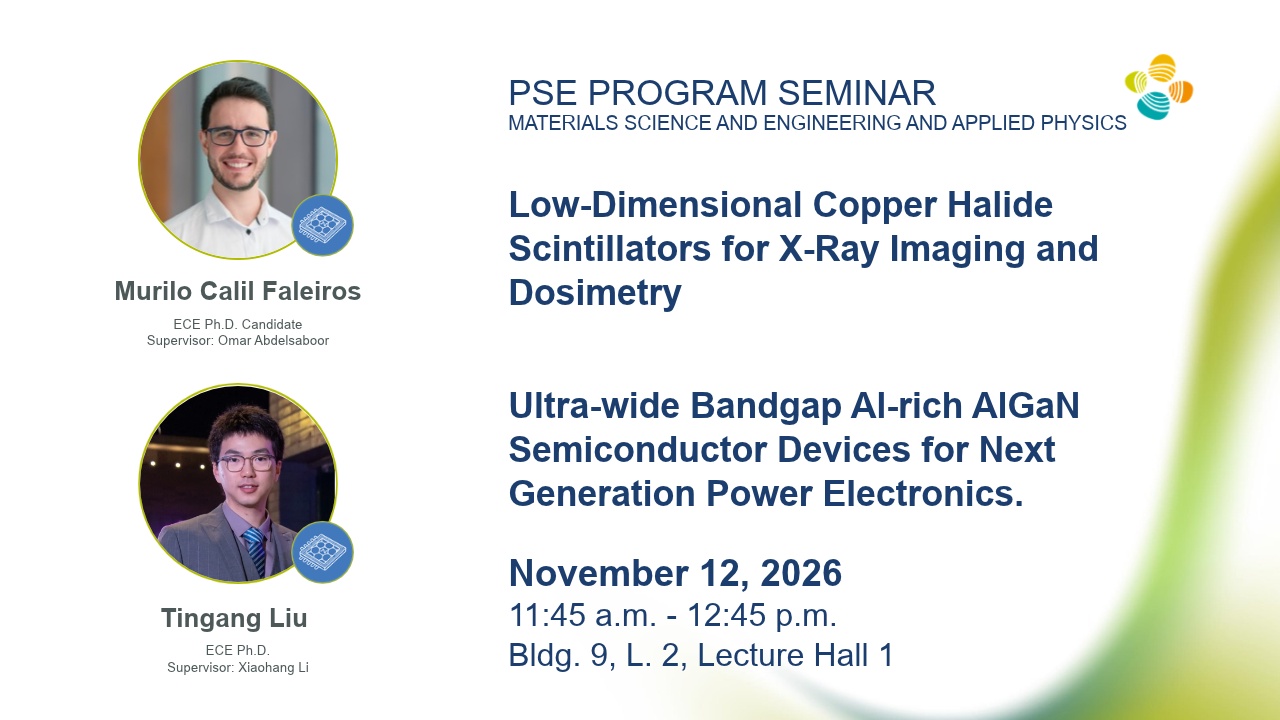
Low-Dimensional Copper Halide Scintillators for X-Ray Imaging and Dosimetry
By Murilo Calil Faleiros
Abstract
X-ray detectors mostly rely on scintillators, but conventional ones need high-temperature crystal growth, often contain toxic or rare-earth elements, and trade light yield against decay time. Low-dimensional copper halides such as Cs₃Cu₂I₅ and CsCu₂I₃ offer near-unity quantum yields, large Stokes shifts, lead-free chemistry and low-temperature processing, yet are rarely used. This thesis addresses what limits their deployment. Microdoping with bismuth makes Cs₃Cu₂I₅ brighter and more stable, producing high-resolution X-ray imaging screens, while manganese doping shifts its emission to match low-cost photodiodes for a wireless personal dosimeter. An electrochemical growth route produces films with controllable thickness and phase, adds fast emission channels for timing, and opens the way to conformal growth. At the system level, composite films coupled to silicon photomultipliers enable high-rate pulse counting, and filtered photodiodes combined with an embedded neural network estimate X-ray tube potential in real time for machine quality assurance. Together, these studies show the limiting constraint moving from material to instrument.
Ultra-wide Bandgap Al-rich AlGaN Semiconductor Devices for Next Generation Power Electronics.
By Tingang Liu
Abstract
Power electronics plays a crucial role in modern society, enabling efficient energy conversion and management across a wide range of applications, including power grids, electric vehicles, artificial intelligence (AI) data centers, and consumer electronics. Improving power conversion efficiency while achieving higher power density and reliability remains a central objective in the development of next-generation power electronic systems. Wide-bandgap (WBG) semiconductors, particularly SiC and GaN, have significantly advanced power device performance beyond the limitations of conventional Si-based technologies. Looking ahead, ultra-wide-bandgap (UWBG) semiconductors, including AlGaN, AlN, Ga2O3, and diamond, offer promising opportunities to further push the boundaries of power electronics.
Among these emerging materials, Al-rich AlGaN stands out for its exceptional material properties, including a large bandgap, high critical electric field, and polarization-engineering capabilities. However, several fundamental material and device challenges, such as inefficient donor activation, limited carrier mobility, high contact resistance, and fabrication-induced damage, continue to hinder the realization of its full potential. This seminar will provide an overview of the opportunities and challenges associated with UWBG Al-rich AlGaN power devices, followed by a discussion of recent research progress and contributions from the Advanced Semiconductor Lab (ASL) toward overcoming these limitations and advancing next-generation power electronics.
Biography
Tingang Liu is currently a Ph.D. candidate in the Advanced Semiconductor Lab (ASL) under the supervision of Prof. Xiaohang Li. His research focuses on ultra-wide-bandgap (UWBG) Al-rich AlGaN power semiconductor devices for next-generation power electronics. His expertise spans the entire device development process, including metal–organic chemical vapor deposition (MOCVD) epitaxial growth, cleanroom-based micro- and nanofabrication, and electrical characterization of semiconductor devices.