Nov 2026
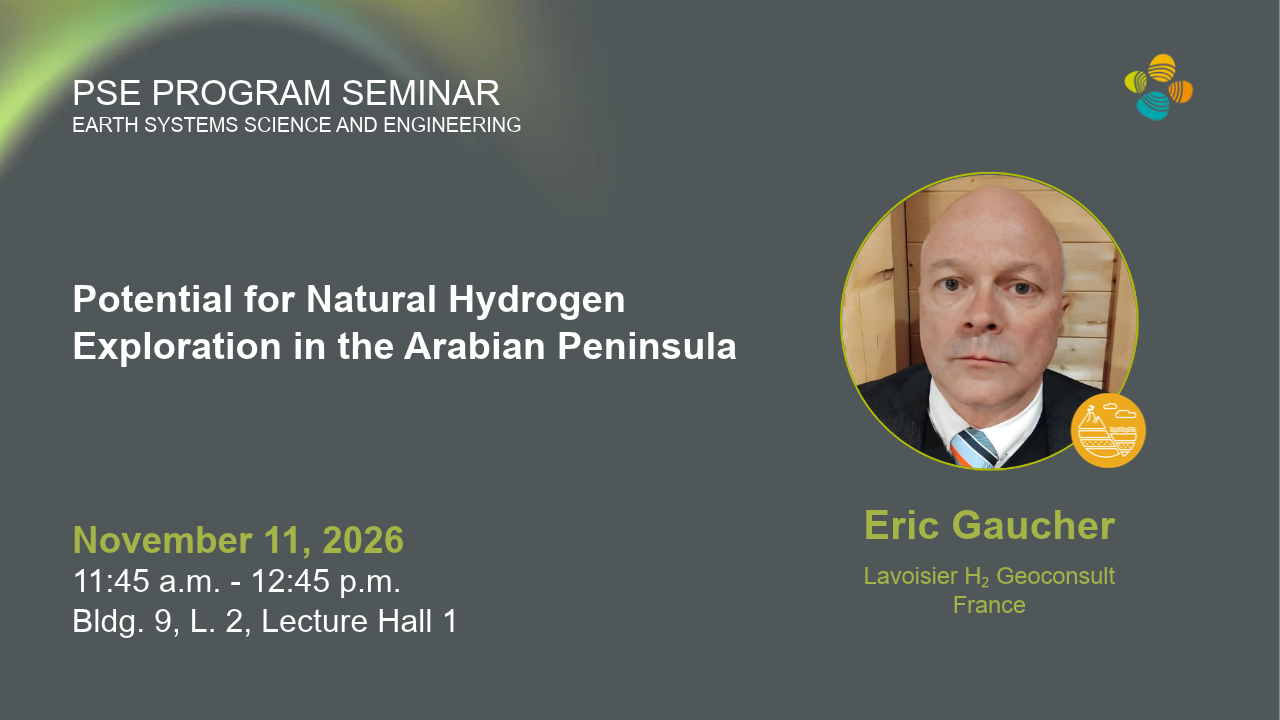
Potential for Natural Hydrogen Exploration in the Arabian Peninsula
Abstract
Natural hydrogen is a new area of exploration in natural resources, as the hydrogen molecule combines high energy potential with zero CO2 emissions. Following a phase of scientific research—during which measurements of naturally occurring hydrogen in soil and spring water were considered anecdotal and measurements of hydrogen in oil wells were deemed erroneous—we have, over the past 10 years, moved into a development phase to enable industrial exploration of this new substance (Gaucher, 2020; Gaucher et al., 2023). While there appears to be broad consensus on certain methodological aspects regarding the geology of rocks capable of producing hydrogen, exploration methods still require significant improvement. For this, we will discuss the recent paper of Etiope et al. (2026) on the main remaining scientific gaps for this exploration.
In particular, we will discuss our recent results demonstrating the value of measuring not only hydrogen concentrations in soils but also other reactive gases (CO₂, O₂, H₂S, CH₄) and inert gases (He, Rn, Tn) and when their concentrations are high enough, their isotopes. The reactivity and the contrast of masses of the gases determine their measured concentrations. We will discuss how the associated gases can provide interesting features for the understanding of hydrogen chemical behavior. And the mapping of the different gases in soil is also directly dependent on a combination of geology and of the mass of the gas. With a masse 2, for H2, 4 for He, and 222 for Rn, the transport properties of the different gases (advection, diffusion) are completely different. However, a precise understanding of this contrast makes it possible to clearly identify the major faults that form the primary migration pathways, from the source rock to the surface. The specific challenge in desert areas regarding the measurement of hydrogen seepage at the ground surface—where there is no soil—will also be addressed, along with a presentation of flux chambers that could replace point measurements of concentration.
We will also use real-world examples to discuss the significance of hydrogen measurements in historic wells and how to distinguish the real concentration of natural hydrogen from that resulting from casing corrosion. A rigorous analysis, based on the chemistry of the gas-associated waters, the chemistry of the gas mixture, and the dynamics of production tests, makes it possible to determine whether the hydrogen found in historic wells is the result of casing corrosion or whether it actually originates from the geological formation. This makes it possible to include in the data analysis well data that were previously discarded because operators were unaware that they were measuring indicators (shows) of the presence of natural hydrogen. Finally, considering our recent work on hydrogen generation through the geological ages based on geodynamic models (Zwaan et al., 2025, 2026) (Fig. 1A) we will discuss, where a real potential of exploration for natural hydrogen exists in the Arabian Peninsula. The seepages of Oman are emblematic, but we doubt about the existence of significant volume trapped in an obducted system because of a too low temperature of hydrogen production from rocks and because of the water availability needed to feed the hydrogen generation system (Fig. 1B). Other systems linked to the Red Sea could be more prolific because they are still in the “serpentinization windows” and have no problem of water availability. They could be very promising for the discovery of significant volumes of hydrogen.
Biography
Eric C. Gaucher is a geochemist expert. His work focuses on water–rock–gas interactions at the laboratory scale up to basin scale using experimental, field and numerical modeling methods. He is involved in all geo-energies and is one of the frontrunners in the Exploration of Natural H2. After 19 years in academic research (CEA, BRGM in France and the University of Bern in Switzerland) and 10 years in industry (TotalEnergies), he is now building bridges between the worlds of research and industry with a new start-up: Lavoisier H2 Geoconsult.
He graduated with two master degrees in 1993. The first was a Master of Earth Sciences from Lyon I University & École Normale Supérieure. The second was a Master of Hydrology from Paris Orsay University. He also completed his water-rock interaction PhD with CEA and Paris VII University in 1998.
Focused on solving industrial problems using the most advanced scientific methods, he has solved difficult questions linked to the water/clay equilibrium, stability of clays and cements, CO2 control by rocks, and carbonate diagenesis. Since 2016, he has been developing exploration methods for natural hydrogen gas (H2) and assessing the reserves of this new geo-energy. He is at the origin of the 2 first licenses of exploration in France and one in Switzerland. He is exploring in the Alps, India, USA and New Caledonia. He is also developing a new start-up RockyH2 for the engineered stimulation of the production of hydrogen from rocks and materials.
He is the task co-leader for Natural Hydrogen for the International Energy Agency TASK 49 and has published 130 peer-reviewed articles. Since 2024, he has been included in the Stanford University’s list of « World’s Top 2%” scientists ».