Nov 2026
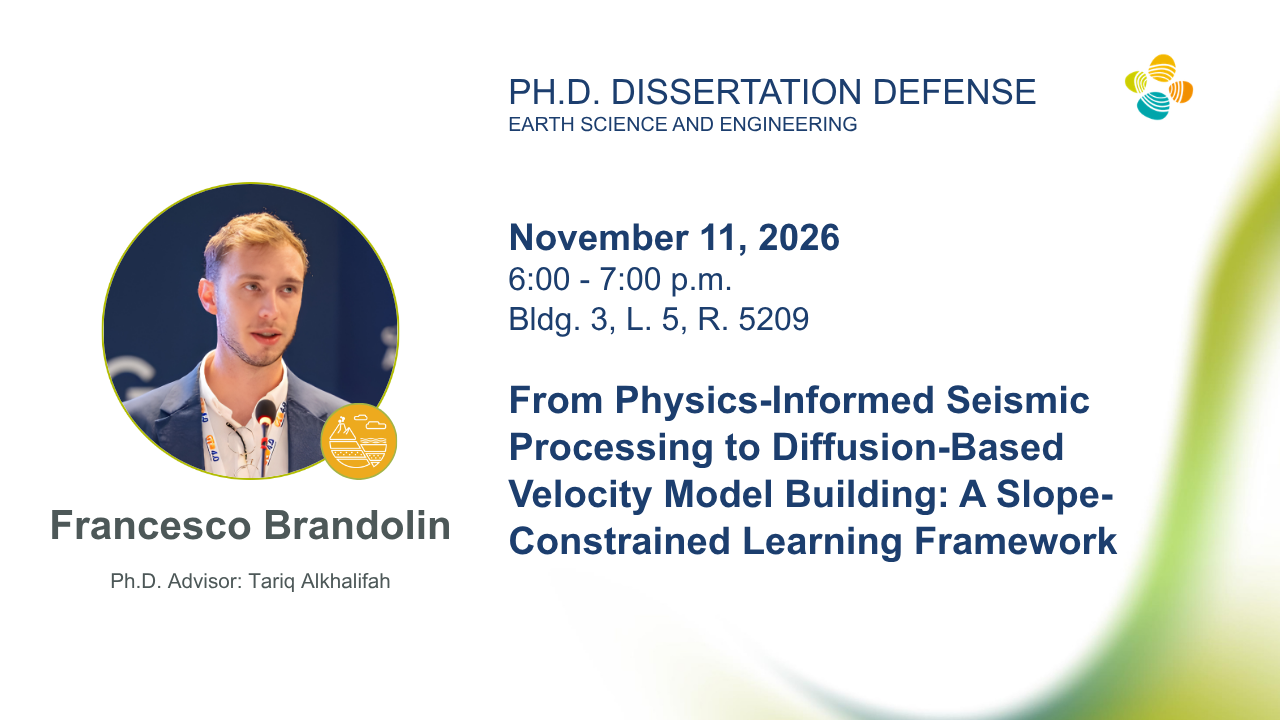
From Physics-Informed Seismic Processing to Diffusion-Based Velocity Model Building: A Slope-Constrained Learning Framework
Abstract
Seismic processing and velocity model building are fundamental components of subsurface imaging, yet both remain challenging due to incomplete observations, noise, and the ill-posed nature of the underlying inverse problems. Conventional approaches often rely on explicit regularization, computationally expensive forward modeling, or large amounts of training data. This thesis investigates how prior knowledge about the structural and kinematic characteristics of seismic wavefields and subsurface models can be incorporated into machine-learning methods to better constrain these problems. Particular attention is given to local slope information, which provides a compact description of seismic structures and can be incorporated into both physics-informed and generative learning approaches.
The first part of the thesis develops slope-assisted Physics-Informed Neural Networks (PINNs) for seismic data regularization, signal separation, and downward continuation. By embedding plane-wave partial differential equations, parameterized by local slope fields, into coordinate-based neural networks, these methods enforce the kinematic consistency of seismic events while reducing reliance on labeled data. The proposed approaches improve the stability and fidelity of the reconstructed wavefields across applications including seismic data interpolation, ground-roll removal, multichannel wavefield reconstruction, and downward continuation.
The second part of the thesis extends the use of structural information from physics-informed learning to generative modeling. We introduce diffusion-based approaches for velocity model building and editing, in which pre-trained denoising diffusion implicit models (DDIMs) provide a learned geological prior. The generative process is guided by well information and seismic images through a structurally preconditioned inversion. Local slopes extracted from seismic images define the structural preconditioner, promoting velocity variations that are consistent with the interpreted subsurface structure. By combining these constraints with the learned diffusion prior, the proposed framework enables efficient and high resolution velocity model building and editing through well velocity interpolation and extrapolation without requiring expensive forward modeling iterations.
Overall, this thesis demonstrates how local slope-based prior information can be incorporated at different levels of the learning process, from physics-informed constraints on seismic wavefields to structural and geological constraints in diffusion-based velocity model generation. Local slope information plays a central role in this progression, providing kinematic constraints for seismic processing and structural information for velocity model building. The resulting methods provide a pathway toward computationally efficient, data-efficient, and geologically consistent learning-based solutions for seismic processing and subsurface velocity model building.