Nov 2026
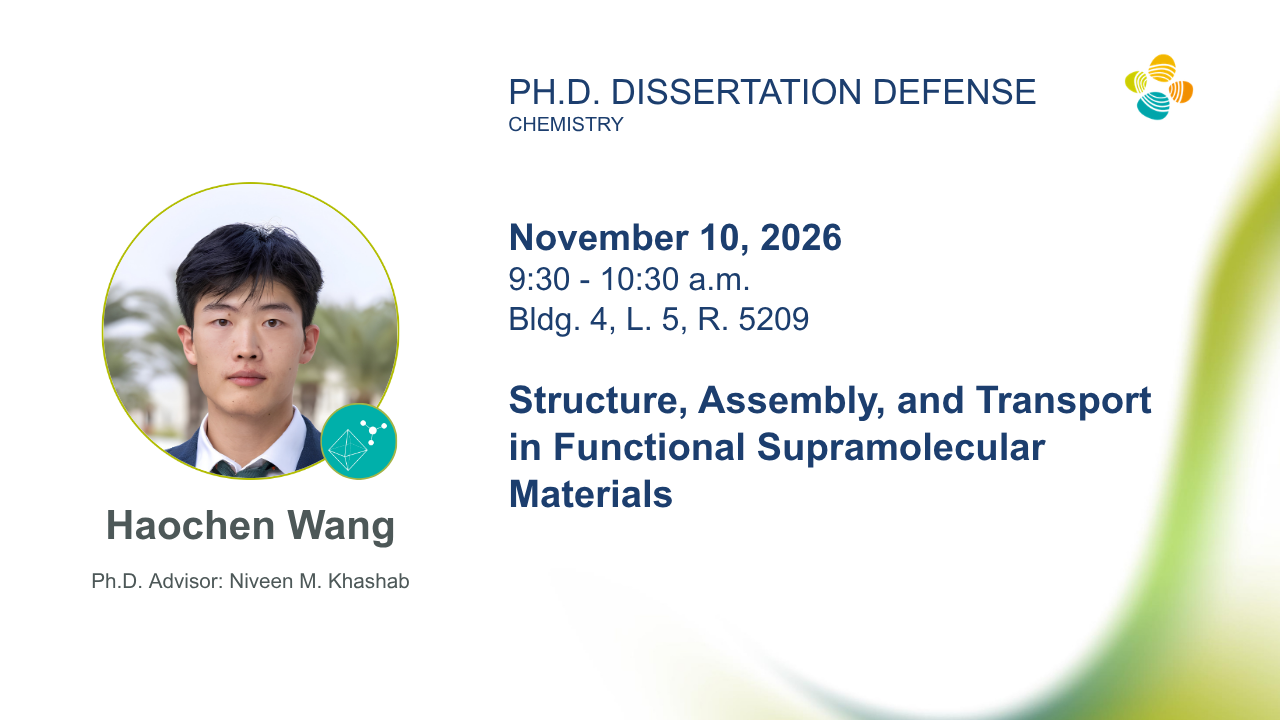
Structure, Assembly, and Transport in Functional Supramolecular Materials
Committee Members
- Ph.D. Advisor: Professor Niveen M. Khashab (KAUST Chemistry)
- External Examiner: Professor External Examiner (Tenured Associate Professor, Department of Chemistry, Zhejiang University)
- Committee Chair: Assistant Professor Shadi Fatayer (KAUST, Applied Physics)
- 4th Committee Member: Nikolaos Hadjichristidis (KAUST, Chemistry)
Abstract
Molecular cages and macrocycles provide well-defined cavities and interaction sites, but these features do not necessarily remain accessible once the molecules are incorporated into bulk materials. This thesis explores this problem through three systems in which molecular structure, supramolecular organization, and transport are closely linked.
A fully hydrocarbon organic cage was prepared and dissolved in 1,2,4-trichlorobenzene to form a Type II porous liquid. Single-crystal structures showed that the cage could accommodate small guests, while gas sorption, PALS, and computational studies indicated that accessible cavity space was retained after dissolution. The cage showed greater affinity for ethylene than ethane. When the porous liquid was used in repeated headspace extraction of a 1:1 ethylene/ethane mixture, the ethylene content increased to approximately 90% after six cycles.
The second part of the work focused on a fluorinated urea macrocycle that forms layered hydrogen-bonded crystals. The packing is dominated by directional N–H···O interactions within the layers and weaker contacts between them, giving rise to pronounced lamellar morphology and anisotropic cleavage. Crystallography, diffraction, microscopy, and AFM were used to relate the molecular packing to the observed sheet-like structure. The macrocycle was also incorporated into polyimide membranes, where its organization and interaction with the polymer influenced gas transport.
A protonatable TREN-derived cage was then converted into a water-immiscible cage–oleate porous ionic liquid. The cage remained structurally intact after protonation, and PALS and CO₂ uptake measurements indicated sub-nanometer free volume in the liquid. The material removed perrhenate from water, whereas oleic acid alone produced little Re depletion. Perrhenate removal was also maintained in the presence of molybdate, nitrate, sulfate, and high salt concentrations. The extraction showed a rapid initial stage followed by much slower transport, while changing the oleic-acid content altered the balance between cage concentration and liquid mobility.
These studies show that the function of a molecular host depends as much on its surrounding material environment as on the host itself.