Nov 2026
Conversion of Dimethyl Ether to Gasoline-Range Hydrocarbons Using Metal-Zeolite Catalysts
Committee Members
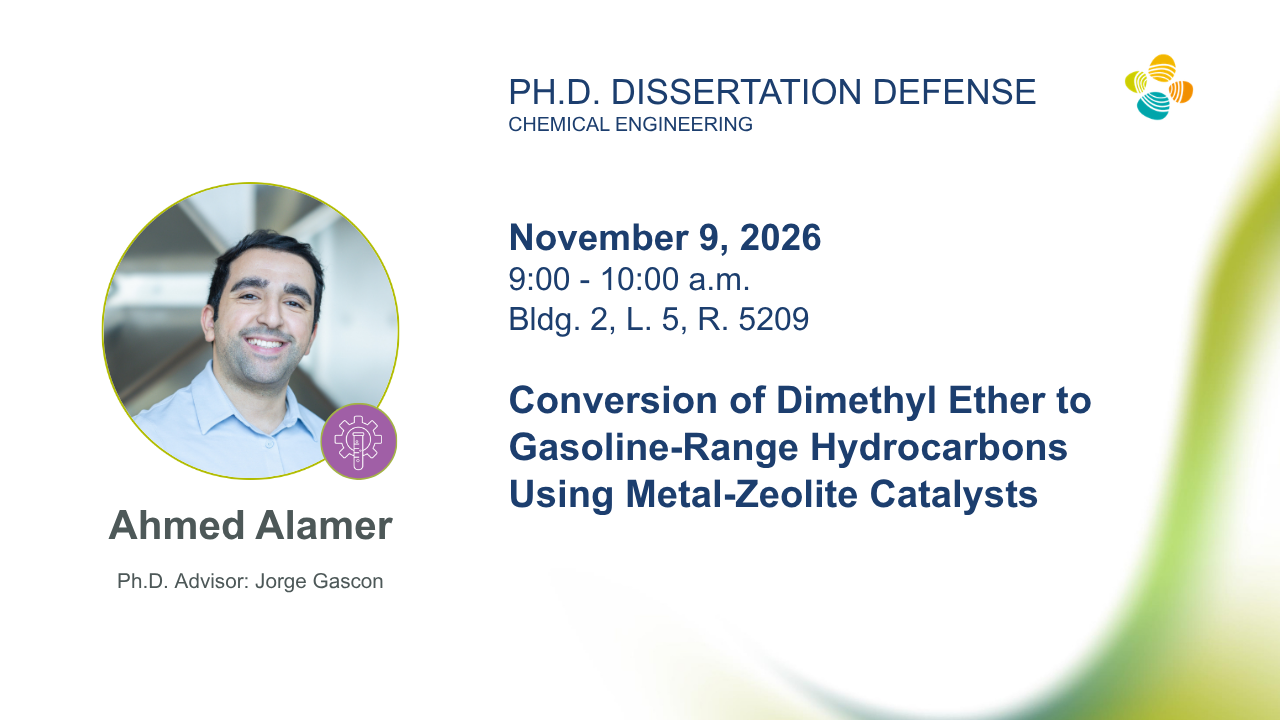
- Ph.D. Advisor: Professor Jorge Gascon (KAUST, Chemical Engineering)
- External Examiner: Professor Marcos Millan (KFUPM)
- Committee Chair: Professor Luigi Cavallo (KAUST, Chemistry)
- 4th Committee Member: Professor Javier Ruiz Martine (KAUST, Chemical Engineering)
Abstract
This dissertation investigates the catalytic conversion of dimethyl ether (DME) to gasoline-range hydrocarbons over ZSM-5 under H2-rich conditions, with the objective of controlling the balance between hydrocarbon chain growth, hydrogenation, and aromatization. The work progresses from high-throughput catalyst and operating-condition screening, through detailed fixed-bed evaluation of metal-promoted ZSM-5 catalysts, to identification of the reaction-generated working state responsible for selective low-aromatics gasoline formation over Ni/ZSM-5.
High-throughput screening first established the influence of zeolite acidity, residence time, metal identity, preparation method, and activation history on H2-assisted DTG. Increasing the SiO2/Al2O3 ratio of ZSM-5 suppressed secondary hydrogen-transfer and aromatization pathways and shifted the product distribution toward olefins and C5+ aliphatics. ZSM-5 with SiO2/Al2O3 = 371 was selected as the common high-silica support, and 350 °C, 15 bar, and H2/DME = 5 were established as the reference reaction environment. Screening of metal-promoted catalysts showed distinctly different behaviors: Cr and Mo remained relatively close to the parent zeolite, Zn and Mn maintained favorable gasoline-range production, Pt strongly promoted formation of saturated light hydrocarbons, and Ni exhibited an unusually strong dependence on loading, preparation route, and activation history.
Detailed fixed-bed testing of the parent and Cr-, Zn-, Ni-, Pt-, and Mn-modified ZSM-5 showed that promoter hydrogenation activity governs the competition between olefin chain growth and chain termination. Cr, Zn, and Mn retained olefin-rich product distributions and C5+ selectivities of approximately 60–63%, comparable to the parent zeolite, whereas Ni and Pt strongly hydrogenated the olefin pool and reduced C5+ selectivity to approximately 39–44%. Detailed analysis of the condensed liquid confirmed the same trend: strong hydrogenation decreased olefin content and increased saturated products but redirected substantial carbon toward light paraffins. The results therefore establish that hydrogenation should be moderated rather than maximized; the metal function must improve gasoline composition without consuming the olefin intermediates required for acid-catalyzed methylation and oligomerization.
Ni/ZSM-5 was investigated further because its catalytic behavior could be changed substantially through activation. Uncontrolled operation produced a long induction period, while pre-reduced metallic Ni remained excessively hydrogenolytic. In contrast, programmed DME/H2 induction at 400 °C generated NiAC/Z371, which reached high conversion immediately and produced an isoparaffin-rich gasoline-range liquid with CH4 and CO selectivities below 1% and substantially reduced aromatic content. Operando Ni K-edge XAS, supported by TEM, XPS, DRIFTS, and solid-state NMR, showed that NiOx evolves through metallic Ni toward an accessible Ni/NixC interfacial state while the zeolite hydrocarbon pool develops. Partial carburization moderates Ni reactivity without eliminating hydrogenation, allowing aromatic suppression and formation of saturated branched hydrocarbons while avoiding the severe hydrogenolysis associated with exposed metallic Ni.