Nov 2026
OMEx: A Good Candidate for Diesel Substitution
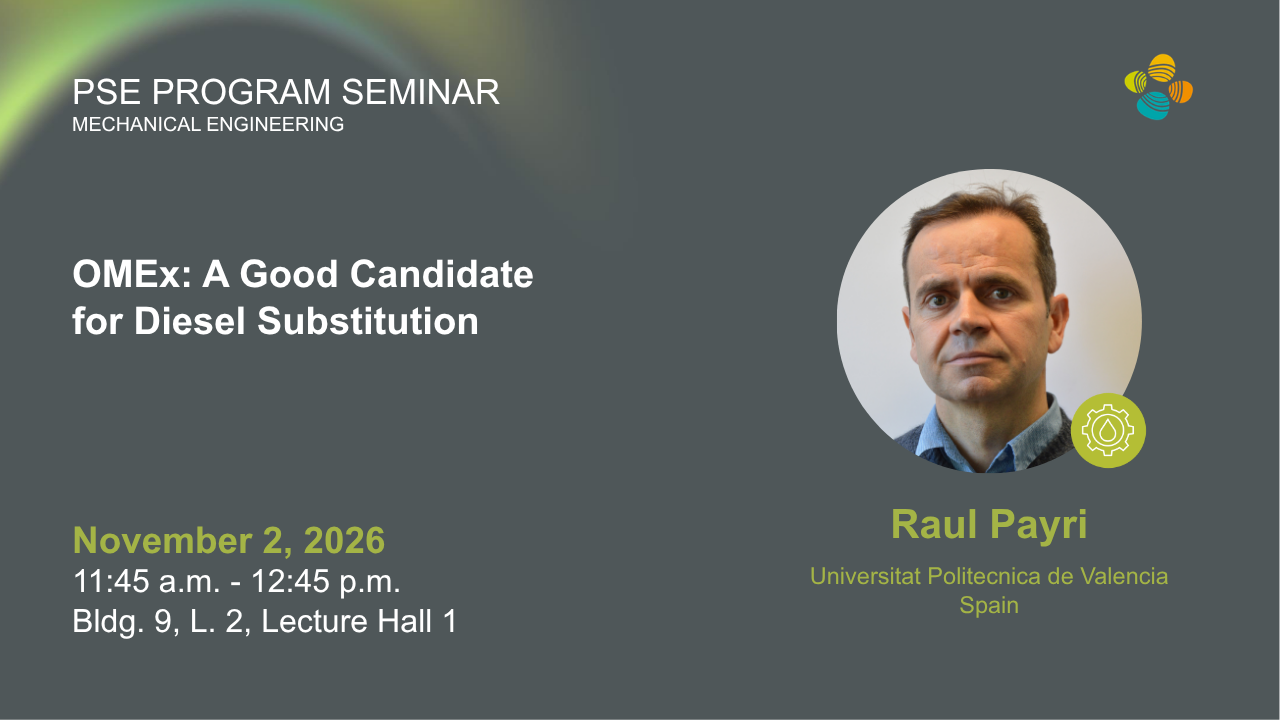
Abstract
This talk will explore two critical aspects of achieving carbon neutrality by 2050 within the European Union. First, it will examine the implications of reaching this ambitious target, comparing various technological and policy-driven pathways. Second, it will delve into the development and application of Poly-oxymethylene dimethyl ethers (OMEx) as a promising fuel for internal combustion engines (ICEs).
The discussion will highlight recent initiatives by the European Commission aimed at decarbonizing the transport sector, assessing the role of internal combustion engines and e-fuels as a viable alternative to battery-electric vehicles. E-fuels present several advantages, such as comparable performance to electric powertrains, enhanced utilization of renewable energy sources, and a potential for rapid transport sector decarbonization with minimal modifications to existing infrastructure.
Among e-fuels, OMEx stands out due to its unique chemical properties. Unlike conventional fossil-based fuels, OMEx lacks carbon-to-carbon bonds, which eliminates direct soot precursor formation. Its high oxygen content facilitates rapid oxidation and enables efficient combustion, making it particularly suitable for advanced autoignition-based combustion strategies. However, challenges remain, including its lower heating value and viscosity compared to traditional diesel fuels, which necessitate further optimization for practical deployment.
To provide a comprehensive evaluation of OMEx as a fuel candidate, this talk will present experimental findings on its spray characteristics under high-pressure and high-temperature conditions. Additionally, insights from testing in a transparent single-cylinder medium-duty engine and a 1.25 L metal engine will be shared, offering a detailed perspective on the combustion behavior, efficiency, and emissions of OMEx in real-world applications.
By addressing these aspects, this presentation aims to contribute to the ongoing discussion on sustainable transport solutions and the role of innovative e-fuels in meeting the EU’s carbon neutrality targets.
Biography
Prof. Raul Payri graduated as an industrial engineer in 1995. He completed his doctoral thesis in 1999. Teaching since 1998 he became Full Professor at Universitat Politecnica de Valencia in 2009. Dr. Payri is currently the Dean of Department of Thermal Engines and Machines (DMMT). Since 2010 he has been responsible for 50 projects with an overall budget of 7 million euros. He has worked in more than 200 research public and private projects funded by companies such as Stellantis, Ford, General Motors, Renault, Fiat, BMW, General Electric, Daimler, Delphi, Jaguar Land Rover, Carterpillar, Cummins, Toyota, ITP, Repsol, Aramco.
The dissemination of results has taken place over the publication of 160 articles in scientific journals. His h-citation index is 60 in google scholar and 46 in web of Science, the highest in mechanical engineering in Spain.
He has supervised 16 doctoral theses and over 125 bachelor and master projects. Doctor Payri is editor in chief of the International Journal of Engine Research
His research work is focused on the theoretical and experimental study of the injection and mixture formation of different fuels both for Internal combustion engines and gas turbines. Understanding the atomization, mixture, evaporation and combustion with different fuels such as: Diesel, gasoline, bio-ethanol, bio-Diesel, e-fuels, hydrogen, natural gas and ammonia is his main research activities.