Nov 2026
Hybrid Copper–Iodide Scintillators: Mechanisms and Applications
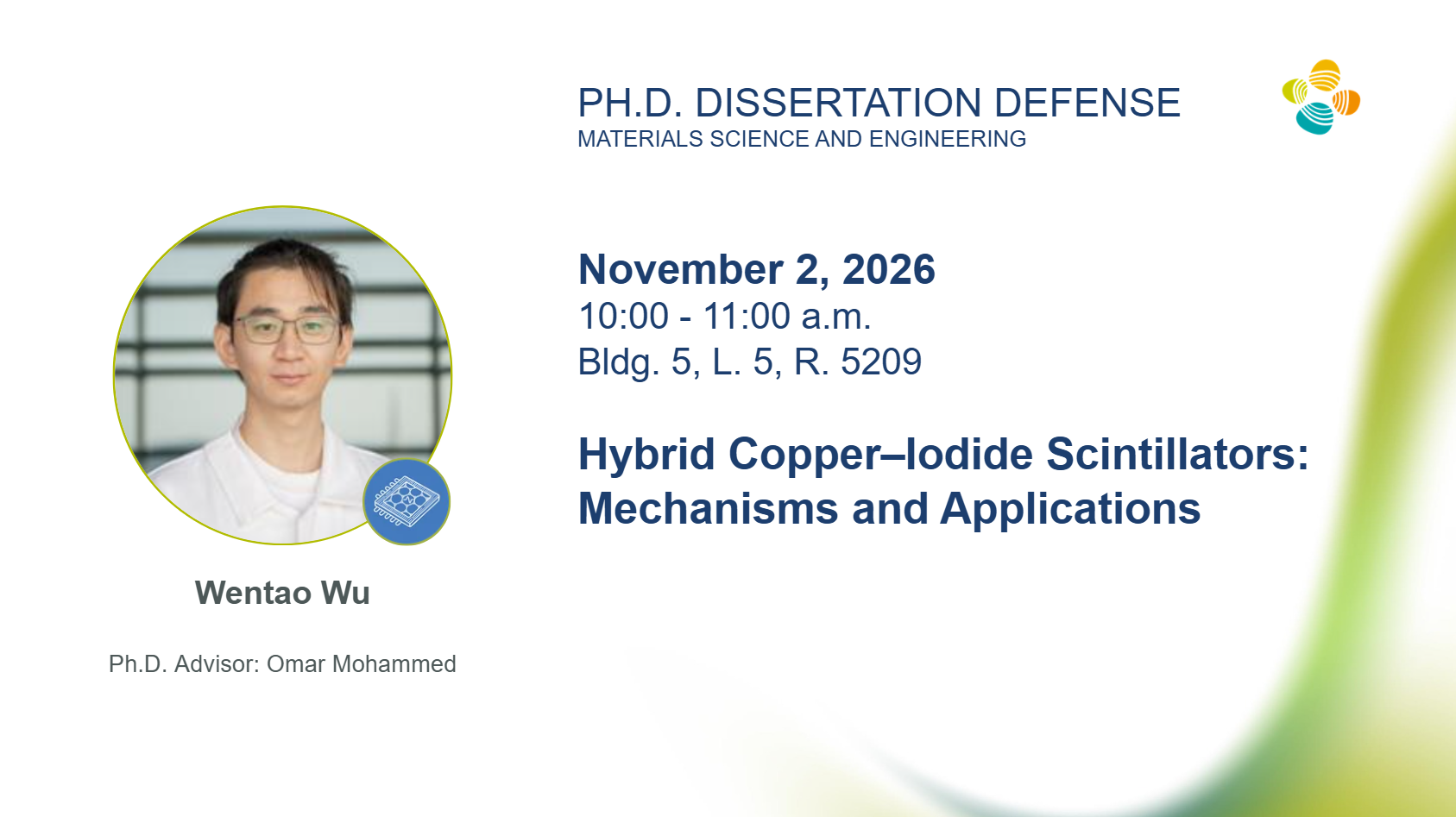
Ph.D. Dissertation Committee:
- Committee Chair: Prof. Osman Bakr
- Ph.D. Advisor: Prof. Omar Mohammed
- External Examiner: Prof. Zhiguo Xia
- Committee Member: Prof. Huabin Zhang
Abstract:
Scintillators convert high-energy radiation such as X-rays into visible light and are indispensable for radiation detection in medical, industrial, and security applications. Conventional inorganic scintillators are widely used but suffer from high cost, toxicity, and limited compositional tunability, motivating the search for alternative materials. Hybrid copper(I) iodides are a compelling option, combining strong X-ray attenuation, high emission efficiency, low toxicity and cost. Nevertheless, their scintillation efficiency is highly sensitive to structural details that remain insufficiently understood, while their integration into large-area detection screens remains challenging. This thesis systematically advances hybrid Cu–I scintillators through ligand engineering, core-geometry control, and glass-state integration, establishing how molecular and structural design governs their excited-state dynamics and scintillation performance. Across three chapters, these strategies enable highly efficient emission, reveal previously unresolved radiative pathways, and translate molecular Cu–I systems into high-performance scintillator films and transparent bulk glasses.
First, a ligand halogen-engineering strategy was employed to introduce high-electronegativity chlorine atoms onto the pyridine ligands of one-dimensional Cu–I coordination polymers, rigidifying the framework and suppressing the nonradiative recombination that limits these polymers. The resulting CuI(Cl-py) achieved a greatly enhanced radioluminescence intensity, low detection limits, and exceptional spatial imaging resolution.
Second, a core-geometry engineering approach was used to elucidate the scintillation behavior of zero-dimensional Cu–I clusters. Clusters with distinct cores— Cu1I1, Cu2I2, and Cu4I4—were synthesized with identical ligands. Low-temperature RL revealed a pathway in which excitons in Cu4I4 directly populate the ³CC state. By confining exciton generation, transport, and recombination within a single structural unit, Cu4I4 exhibited superior charge-transport characteristics and the highest light yield among the investigated clusters.
Third, a room-temperature solution vitrification strategy was developed to transform molecular Cu–I clusters into large, optically transparent scintillator glasses. Structural characterization confirmed that the glasses retain Cu–I cluster units and emissive states while lacking long-range order, and they combined excellent irradiation stability, a high light yield, and a spatial resolution of 30 lp mm-1, outperforming many melt-quenched glass scintillators.
Collectively, these results establish design principles for high-performance Cu–I scintillators and scalable fabrication routes that advance low-cost, large-area, high-resolution X-ray imaging screens.