Nov 2026
Numerical Investigation of Hydrogen Engine Injection, Mixing, and Combustion Dynamics
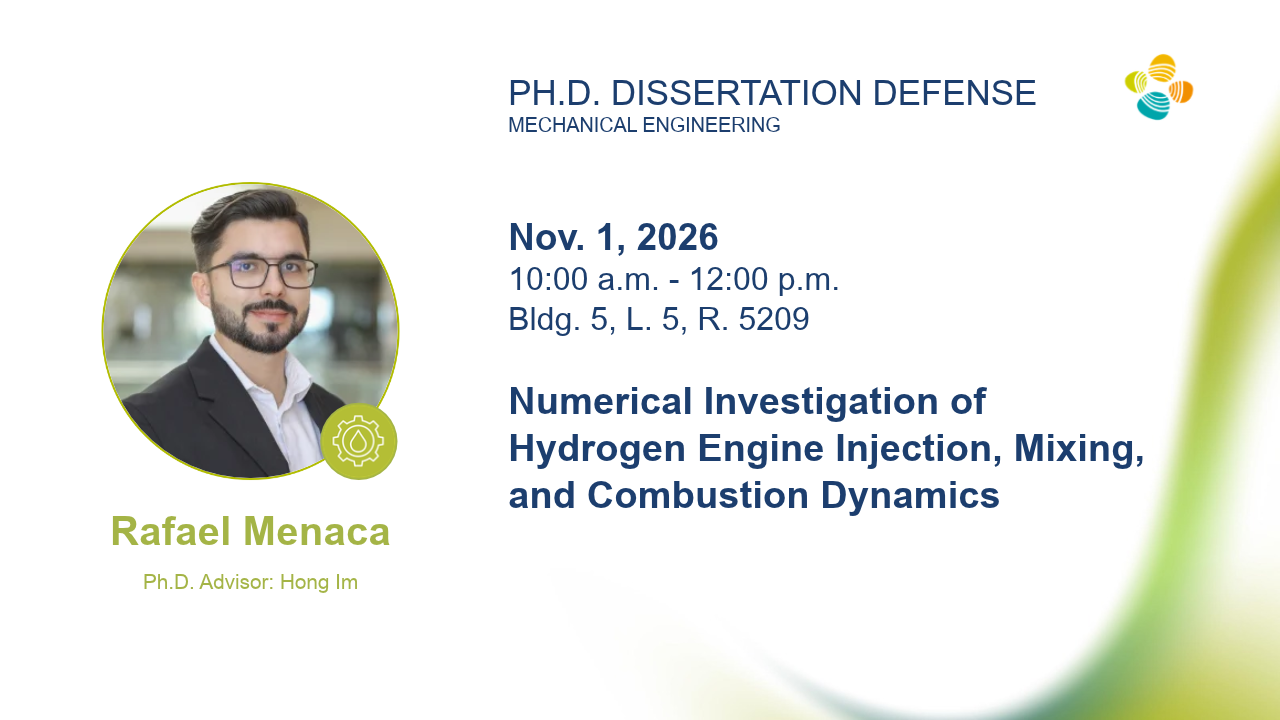
Committee members :
- Chair: Prof. Hussein Hoteit
- Advisor: Prof. Hong Im
- ME member: Prof. James Turner
- External examiner: Prof. Raúl Payri
Abstract
Hydrogen-fueled internal combustion engines offer a promising pathway toward low-carbon transportation, but their development requires predictive numerical methods capable of capturing the strongly coupled processes of injection, mixture formation, and combustion. Hydrogen introduces particular modeling challenges due to its low density, high diffusivity, wide flammability limits, susceptibility to diffusive-thermal (DT) instabilities, and, in direct-injection (DI) operation, complex supersonic jet dynamics. This work developed a computational framework balancing predictive capability and computational cost for the industrial development of hydrogen DI spark-ignition engines. Hydrogen injection was first investigated using Reynolds-averaged Navier-Stokes simulations of a prototype low- pressure DI injector. Comparisons with experiments showed that internal poppet-valve flow strongly affects in-cap turbulence and nozzle discharge. A lift-derived rate-of-injection boundary condition reproduced the measured downstream jet behavior, while mesh requirements within the narrow injector gap could be relaxed due to the secondary expansion occurring downstream of the jet-forming cap. Lean hydrogen combustion was subsequently examined across heavy-duty optical and metal engines and a high-performance engine. Conventional ignition-based and flamelet models underpredicted combustion rates under ultra-lean conditions. Incorporating DT effects into the G-equation formulation substantially improved flame development predictions. Finally, design-of- experiments, three-dimensional CFD, and machine-learning surrogate models were combined for engine optimization.
Biography
Rafael Menaca is currently a PhD candidate at KAUST in the Mechanical Engineering program as part of the Computational Reacting Flow Lab, under the supervision of Prof. Hong G. Im. He received his master's degree from KAUST, dedicating his thesis to modeling highly efficient hydrogen-powered OP2S engines. His recents projects involve collaborations with Aramco (FuelCom4) and Ferrari (Fleet consortium), conducting high-fidelity 3D-CFD simulations to advance hydrogen combustion technologies and improve predictive modeling methods.