Nov 2026
Chemistry Student Seminar
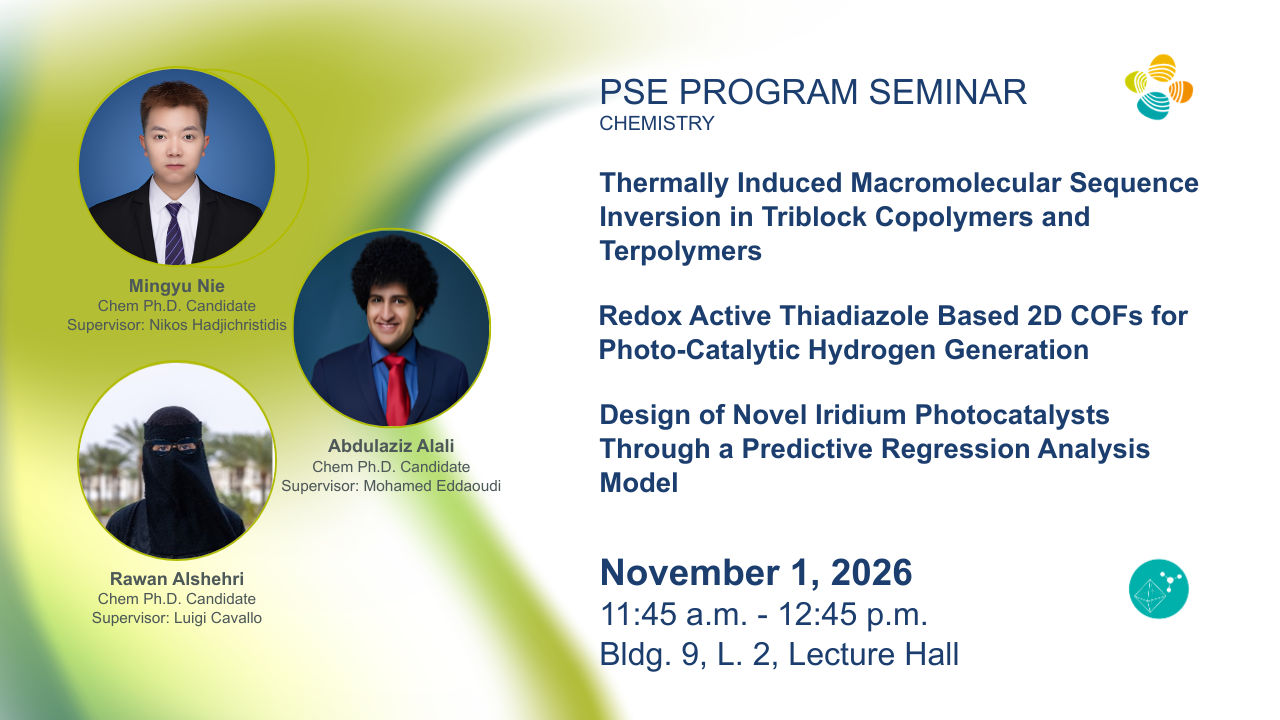
Thermally Induced Macromolecular Sequence Inversion in Triblock Copolymers and Terpolymers
By Mingyu Nie
Abstract
Dynamic control over polymer sequences remains a major challenge in synthetic macromolecules, limiting their adaptability relative to biomacromolecules. Herein, an intra-macromolecular sequence inversion in triblock copolymers and terpolymers is introduced using a furan-maleimide-anthracene Diels-Alder system, enabling thermal reconfiguration at 120 °C without altering composition or molecular weight. Bifunctional initiators bearing reversible Diels-Alder linkages allow the synthesis of symmetric (ABA) and asymmetric (ABC) triblock co/terpolymers. Upon heating, retro-Diels-Alder dissociation followed by anthracene–maleimide cycloaddition induces sequence inversion, yielding BAB or BAC architectures. Comprehensive experimental characterization confirms preservation of chain integrity, while revealing altered diffusion coefficients and distinct microphase-separated morphologies, highlighting the pronounced influence of sequence on polymer properties. This strategy establishes a paradigm for programmable polymer metamorphosis, opening new avenues toward stimuli-responsive materials with tunable self-assembly, crystallinity, and mechanical properties.
Biography
My name is Mingyu Nie, a MS/PhD student from the program of Chemistry, working on polymer synthesis in Prof. Nikos Hadjichristidis' lab. I got my bachelor's degree in 2022 from Sun Yat-sen University, Guangzhou, China.
Redox Active Thiadiazole Based 2D COFs for Photo-Catalytic Hydrogen Generation
By Abdulaziz Alali
Abstract
The pursuit of alternative energy sources to fossil fuels has garnered a lot of interest in hydrogen due to the promise of emission-free combustion. Methods to produce hydrogen both cheaply and cleanly are the subject of much academic research. Photo-catalytic hydrogen evolution reaction (HER) is one of the most sought after as it can provide low-cost and zero-emission conversion. 2D imine COFs have been shown to possess a great deal of photo-activity, and the new central moiety of 4,4'-Dihydroxy-[1,1'-biphenyl]-3,3',5,5' tetracarbaldehyde (DBTA) has also demonstrated strong photo-activity. In this work, a group of five new 2D imine COFs with a DBTA core were synthesized. Among them, a thiadiazole-based COF was found to produce 2500 µmol h⁻¹ g⁻¹ of hydrogen gas.
Biography
I am a KGSP alumnus and a UCSD graduate. I have been coming to KAUST to learn and study since middle school for summer programs, so between that, the KGSP scholarship, and now returning to KAUST for graduate studies, KAUST has been part of my life for almost half of my lifetime, and I plan to complete my academic journey here by obtaining my PhD.
Design of Novel Iridium Photocatalysts Through a Predictive Regression Analysis Model
By Rawan Alshehri
Abstract
Photocatalysis is extensively employed due to its capacity to facilitate unique reactions that are otherwise unattainable. Among the prominent photocatalysts are iridium complexes, valued for their distinctive properties and high tunability. In this work, a predictive linear regression model was developed to estimate the E0-0 energy, which is primarily relevant to excited redox potential and energy transfer capability. The model's reliability was validated through nested leave-one-out cross-validation, demonstrating that the descriptors and model consistently predict E0-0 accurately. A training dataset of 67 structures from 17 different sources was built from the literature, and feature engineering was performed using ground-state DFT properties for model training. The model achieves a blended Q2 value of 0.85 and a mean absolute error of 0.05 from nested leave-one-out cross-validation. A prediction library was also generated with structures based on the training data, identifying potential high-performance candidates.
Biography
Rawan Alshehri is a PhD candidate in chemistry at KAUST, where she works under the supervision of Prof. Luigi Cavallo. Her research focuses on the design of photocatalysts using machine learning models. Before starting her doctorate, she completed an MSc at KAUST in formic acid dehydrogenation with Prof. Andy. She was a recipient of the KGSP scholarship and completed her BSc in chemistry at Emory University.