Oct 2026
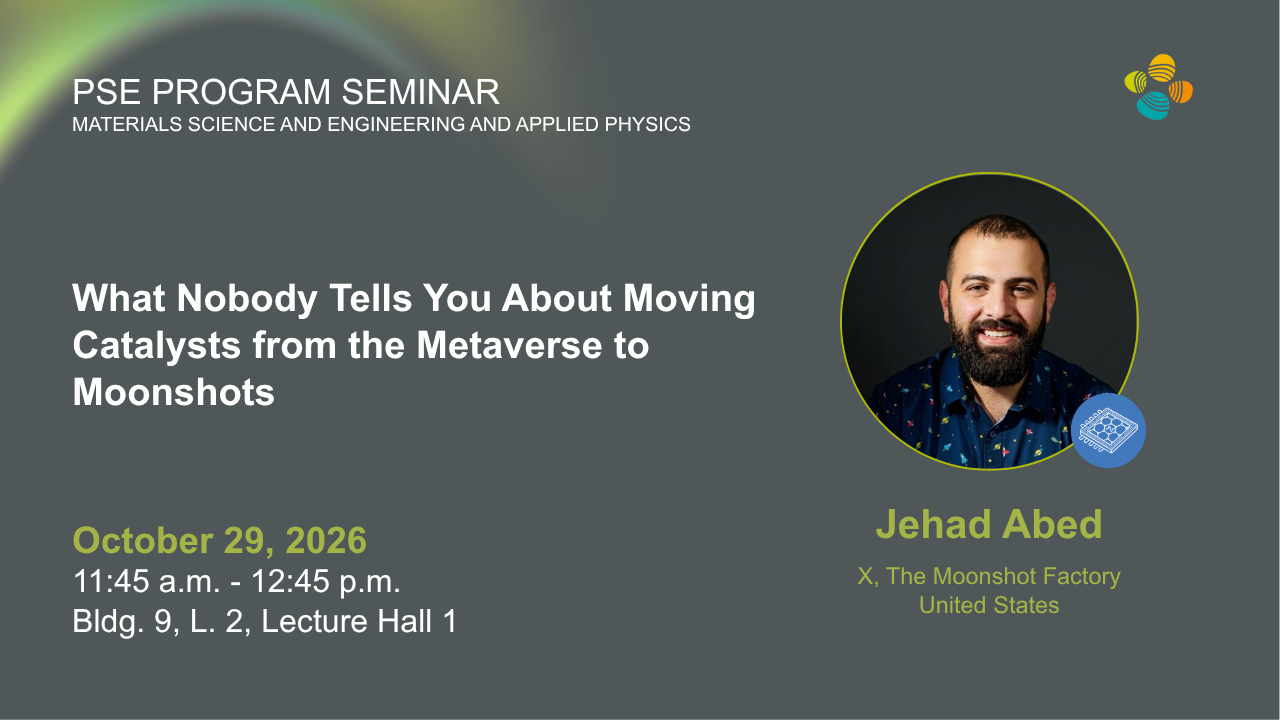
What Nobody Tells You About Moving Catalysts from the Metaverse to Moonshots
Abstract
Discovering next-generation catalysts is the critical bottleneck in decarbonizing heavy industry, closing the carbon cycle, and producing renewable fuels at planetary scale. Yet taking a catalyst from an initial concept to real-world impact requires navigating a complex physical pipeline.
The journey begins in the digital world. Guided by density functional theory and predictive machine learning models, screening workflows evaluate thousands of candidate compositions against theoretical descriptors like binding energies on pristine, atomically flat facets. When these candidates transition to physical synthesis, they immediately collide with the stochastic reality of lab chemistry. Surface reconstruction, unintended phase segregation, and subtle impurities disrupt idealized predictions. High-throughput robotics and automated experimentation can accelerate synthesis and increase statistical confidence, but robust performance at the bench often creates a false sense of readiness for scale up.
The true test comes when a catalyst must survive the leap from a static, microgram-scale analytical cell to an industrial reactor. Operating under high current densities in real gas-diffusion zero-gap electrolyzers introduces extreme mass-transport constraints, electrolyte management failures, and rapid degradation from dirty feedstocks. Materials engineered purely for low overpotentials in beaker cells routinely collapse under these device-level stresses.
Delivering true moonshots in chemical conversion requires inverting this pipeline: designing discovery workflows around system-level degradation modes from day one rather than optimizing isolated intrinsic activities. This talk traces the full life cycle of an electrocatalyst across these distinct environments—computational screening, automated bench synthesis, pilot-scale stacks, and final deployment—to pinpoint where discovery pipelines fail and what it actually takes to engineer materials that operate at scale.
Biography
Dr. Jehad Abed is a research scientist specializing in the intersection of artificial intelligence, material science, and energy abundance. He currently works as a Research Scientist in AI & Materials at X, The Moonshot Factory (Google's specialized innovation engine), where he focuses on rapid prototyping and discovering radical solutions for physical science innovation. Prior to joining X, he led a research team at Meta's Fundamental AI Research (FAIR) chemistry team to bridge first principle simulations and automated lab experiments. His work included releasing major experimental datasets like OCx25 (part of the Open Catalyst project) to design new catalysts for climate-focused applications. He was a materials scientist with CERT Systems, a team that successfully became a finalist for the $20 million Carbon XPRIZE by scaling up CO₂ electrolysis from a lab bench to a pilot plant. He served as the Program Director for the Alliance of AI-Accelerated Material Discovery (A3MD) consortium, directing catalyst discovery programs partnered with major industrial entities like Microsoft, Meta, BP, and TotalEnergies. In January 2025, he joined the Advisory Board for the Royal Society of Chemistry journal, Digital Discovery, helping shape industry innovations in autonomous labs. Dr. Abed completed his Ph.D. at the University of Toronto under the supervision of Professor Ted Sargent. During his doctoral studies, he was awarded the prestigious Vanier Canada Graduate Scholarship. He has been widely recognized for his work in sustainability, earning the title of Emerging Hydrogen Leader at the Canadian Hydrogen Convention in 2023. Rather than just working in purely theoretical simulations, his background functions in "the messy middle"—acting as a translator who scales raw material breakthroughs directly into factories and commercial products.