Oct 2026
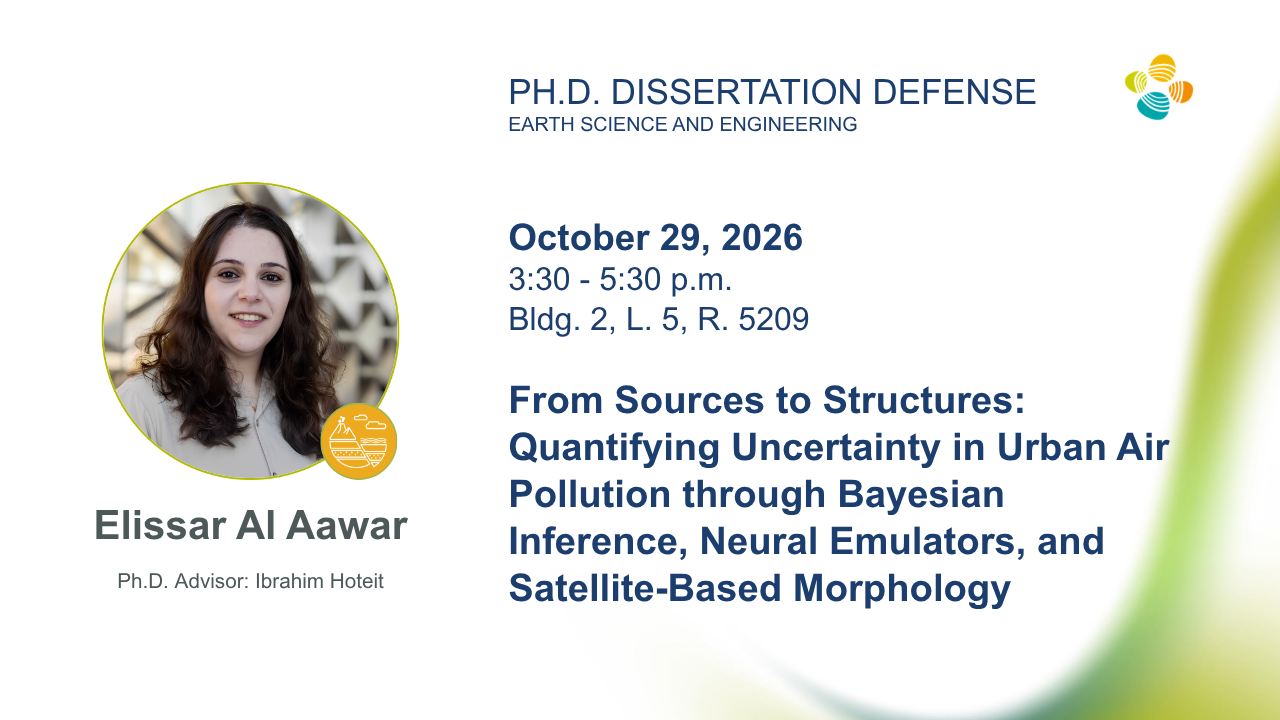
From Sources to Structures: Quantifying Uncertainty in Urban Air Pollution through Bayesian Inference, Neural Emulators, and Satellite-Based Morphology
Abstract
Urban air pollution poses significant risks to public health and environmental sustainability, particularly in densely built urban environments where pollutant transport is strongly influenced by complex flow dynamics and urban morphology. Effective air quality management requires both the identification of unknown pollution sources from concentration observations and the prediction of pollutant transport under uncertain urban conditions. These inverse and forward modeling problems are inherently affected by uncertainties arising from observations, model approximations, and incomplete knowledge of urban morphology. Addressing these challenges requires computationally efficient methodologies capable of quantifying and propagating uncertainty throughout the urban air quality modeling chain.
This thesis presents an integrated framework for uncertainty quantification in urban air pollution modeling by combining Bayesian inference, deep learning (DL), remote sensing, and CFD. For the inverse problem, a Bayesian source identification framework is developed to infer probabilistic emission source characteristics from concentration measurements. The framework incorporates the Wasserstein distance as a global discrepancy measure for comparing concentration fields, improving robustness to sparse observations and reducing sensitivity to the double-penalty effect associated with conventional local metrics. To alleviate the computational burden of Bayesian inference, DL surrogates are introduced to approximate both the discrepancy measure and the underlying Lagrangian dispersion model, enabling substantial acceleration while maintaining source localization accuracy.
For the forward problem, the thesis investigates uncertainty associated with urban morphology, with particular emphasis on building height. Two transformer-based frameworks, SwinH-Fuse and its Bayesian extension SwinBayes-Fuse, are developed to estimate building heights and associated predictive uncertainties from fused Sentinel-1 SAR and Sentinel-2 multispectral imagery. The resulting probabilistic urban morphology representations are propagated through CFD simulations to quantify the influence of geometric uncertainty on urban flow and pollutant dispersion predictions.
Results demonstrate that the proposed methodologies substantially improve the computational feasibility of Bayesian source inversion while preserving predictive accuracy. Furthermore, the uncertainty propagation analyses reveal that building-height uncertainty can significantly affect urban flow structures, pollutant concentration distributions, and associated environmental assessments. Collectively, this work establishes a unified uncertainty-aware framework that addresses both inverse and forward urban air pollution modeling problems, advancing the state-of-the-art in source identification, urban morphology characterization, and uncertainty propagation. The proposed framework supports more reliable environmental decision-making, urban planning, and air quality management in complex urban environments.
