Oct 2026
Thermal Earth Modeling Using Physics-Informed Neural Networks: Implications for Enhanced Geothermal Power Generation
Abstract
Conventional geothermal systems are geographically limited because they require the natural co-occurrence of high rock temperature, in-situ fluid for heat transport, and permeable or fractured rock for fluid flow. Recent technological advancements and field implementations have successfully demonstrated Enhanced Geothermal Systems (EGS), where heat transport and fluid flow are supplemented artificially through water injection and rock stimulation. EGS are applicable across diverse geographies, as naturally and sufficiently elevated subsurface temperatures are always present at certain depths. We developed a physics-informed, AI-enabled thermal Earth modeling framework to map geothermal resources in the upper crust across North America with spatial resolution of 16 km². We evaluated the EGS potential for power generation by conducting comprehensive techno-economic analysis, integrating geothermal resource characteristics, capital and operational costs, weather patterns, proximity to transmission lines, among other factors. We identified various EGS targets in the continental United States with competitive levelized costs of electricity in the range of 40 – 60 USD/MWh.
Biography
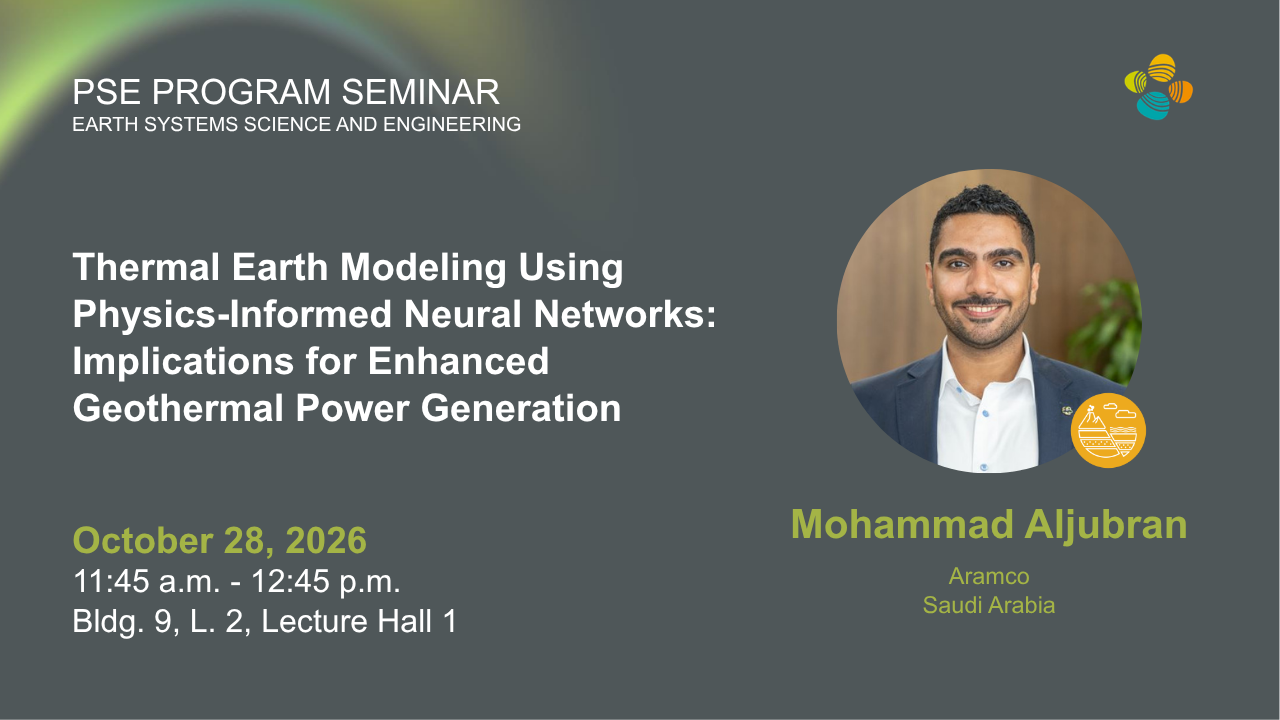
Mohammad Aljubran is a senior research scientist in the Saudi Aramco Upstream Advanced Research Center, focused on developing digital solutions for subsurface applications. He holds a PhD from Stanford University in Energy Resources Engineering, where he worked with Professor Roland Horne and developed a physics-informed, AI-enabled thermal Earth modeling framework to map geothermal resources in the upper crust across the continental United States and Alaska. Prior to his PhD, he spent five years working in upstream engineering and operations. Mohammad has published over 45 articles and holds seven granted patents. He received multiple awards, including the 2024 KAUST Ibn Rushd Postdoctoral Fellowship, 2024 Stanford University Henry J. Ramey Fellowship, 2022 Geothermal Rising Marcelo Lippmann Graduate Scholarship Award, and the 2019 Stanford University Frank G. Miller Fellowship.