Oct 2026
Chemistry Student Seminar
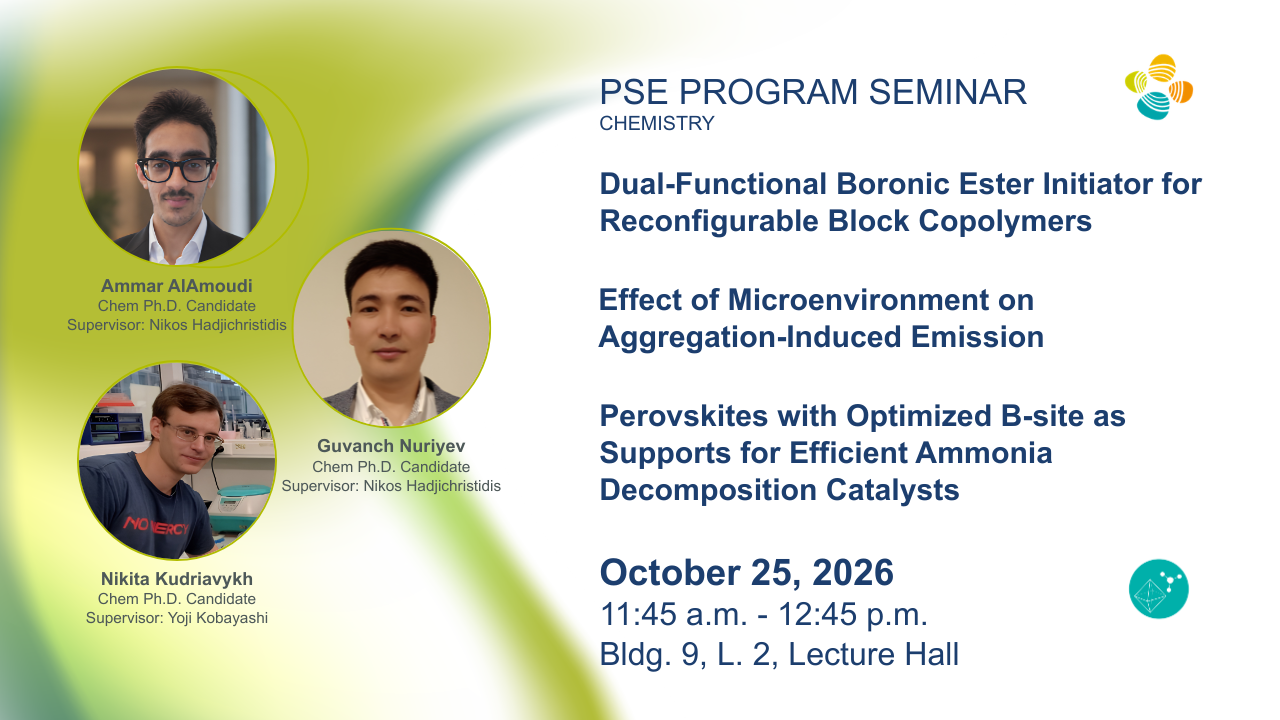
Dual-Functional Boronic Ester Initiator for Reconfigurable Block Copolymers
By Ammar AlAmoudi
Abstract
Dynamic covalent chemistry offers a versatile platform for constructing adaptive polymer materials through reversible bond exchange under mild conditions. Among dynamic covalent linkages, boronic esters are particularly attractive because of their rapid exchange with diols, tunable stability, and compatibility with a broad range of polymer architectures. However, boronic ester-containing polymers have predominantly been explored in crosslinked networks, side-chain-functionalized materials, or block copolymers in which the boronic ester serves as a static structural motif or undergoes exchange only with small molecules. Herein, a dual-functional initiator containing a central boronic ester junction was developed to synthesize well-defined poly(ethylene oxide)-block-poly(methyl methacrylate) (PEO-b-PMMA) copolymers. The initiator provided a hydroxyl group for ethylene oxide polymerization and a bromide group for ATRP of methyl methacrylate. Subsequent boronic ester exchange with diol-terminated poly(δ-valerolactone) (PVL) and poly(glycidyl phenyl ether) (PGPE) produced PVL-b-PMMA and PGPE-b-PMMA, respectively. This work demonstrates post-polymerization reconfiguration of block copolymers through polymer–polymer exchange at a dynamic covalent junction.
Biography
Ammar Ahmed Alamoudi is a Ph.D. student in Chemistry at KAUST, supervised by Professor Nikos Hadjichristidis. His research focuses on polymer synthesis, particularly controlled polymerization methods and organic synthesis. He earned his master's degree in chemistry from KAUST in 2023 (with Professor Nikos Hadjichristidis), following a bachelor's degree in chemistry with first-class honors from the Islamic University of Al Madinah in 2019. His master's research on amphiphilic block copolymers was published in Polymer Advanced Technologies and was recognized as a top-viewed article on Wiley in 2025. He also received the KAUST Dean's Award in Chemistry in May 2026.
Effect of Microenvironment on Aggregation-Induced Emission
By Guvanch Nuriyev
Abstract
Aggregation-induced emission (AIE) provides a powerful approach for developing polymeric materials with tunable photoluminescence through control of molecular motion and macromolecular structure. AIE luminogens, such as tetraphenylethylene (TPE), are highly sensitive to their local microenvironment: restricting intramolecular motion around the chromophore switches on strong fluorescence, while a loosely packed surrounding favors non-radiative decay. This presentation introduces polymer design strategies that engineer this microenvironment to control photoluminescence. In the first stage of this work, TPE was positioned at the chain end, mid-chain, or star core of poly(N-vinylpyrrolidone), showing that even at the single-chain level, chromophore topology tunes the local restriction of motion and hence emission intensity. The current stage extends this idea to a larger length scale, using well-defined diblock copolymers synthesized from a TPE-based dual initiator to place the chromophore precisely at the junction between two incompatible blocks. As these copolymers self-assemble into distinct microphase-separated morphologies, the surrounding microenvironment of the junction-localized TPE changes accordingly, allowing photoluminescence to serve as a sensitive readout of polymer self-assembly.
Biography
Guvanch Nuriyev received his B.S. in Chemistry with first-class honors from Magtymguly Turkmen State University (Ashgabat, Turkmenistan) in 2017, after which he worked as a chemistry teacher at high school. He joined KAUST in 2022, completing his M.S. in Polymer, Chemical Science in 2024 under Professor Nikos Hadjichristidis, and is now continuing as a Ph.D. student in the same group, where his research focuses on aggregation-induced-emission-active, topologically well-defined polymer architectures.
Perovskites with Optimized B-site as Supports for Efficient Ammonia Decomposition Catalysts
By Nikita Kudriavykh
Biography
Nikita Kudriavykh graduated from Novosibirsk State University (Novosibirsk, Russia), where he completed a 5-year specialist program in fundamental and applied chemistry. During his studies, he worked as a junior researcher at the International Tomography Centre SB RAS, investigating hydrogen ortho-para conversion on MOF-74 using magnetic resonance methods. He completed an MS thesis ("MAX Phase-based Supports for Efficient Ammonia Synthesis") at KAUST under the supervision of Professor Yoji Kobayashi, and continues his work in Prof. Kobayashi's lab. His research interests include heterogeneous catalysis, ammonia synthesis, ammonia decomposition, and the application of Joule-heated reactors to these processes.