Oct 2026
The Future of Global Climate Modeling: Emerging Directions
Abstract
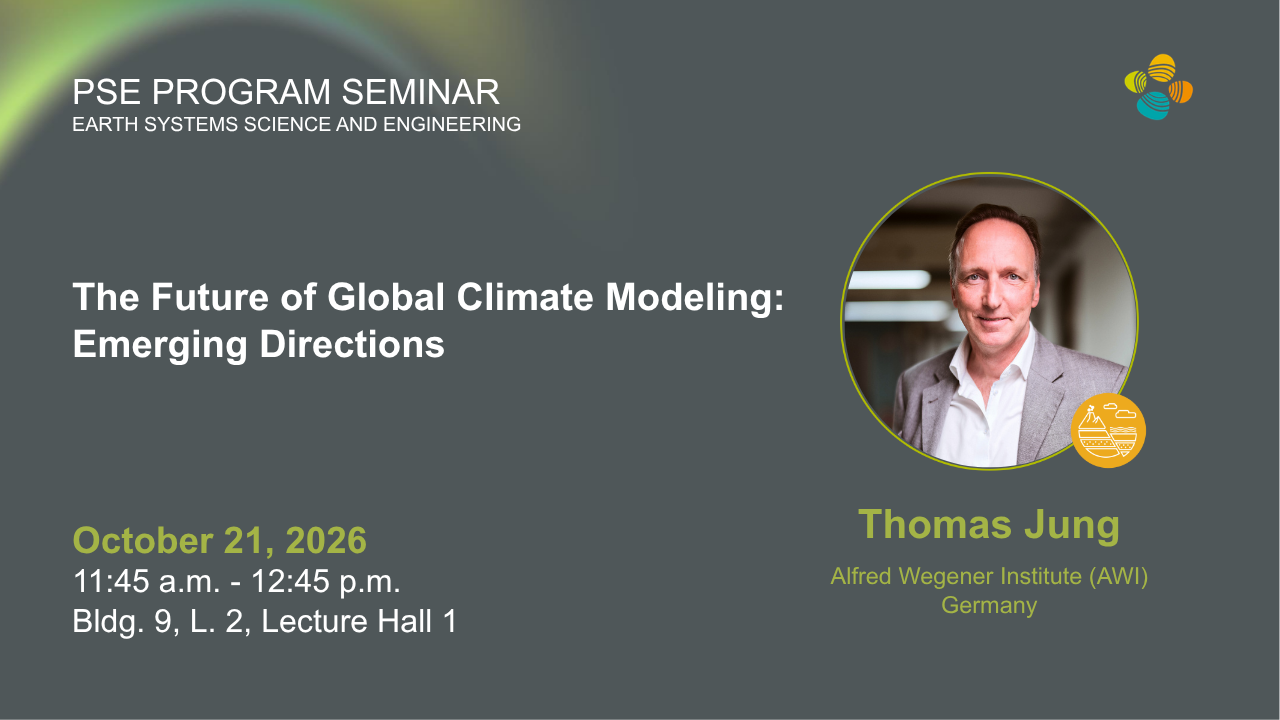
Global climate modelling is entering a period of rapid transformation. Advances in high performance computing, numerical methods and artificial intelligence are changing not only what climate models can simulate, but also how they are used and developed. In this presentation, I will discuss three emerging directions that contribute to shaping the next generation of global climate modelling, illustrating each with concrete examples.
First, global kilometre-scale modelling is bringing a new level of realism and local granularity to climate simulations. For example, weather in both the atmosphere and ocean is represented with much greater fidelity, while small-scale features such as land–sea breezes can emerge naturally from the interaction of the modelled processes and fine-scale geography. This richer representation of phenomena and their interactions across scales opens new possibilities for understanding and quantifying the regional and local manifestations of climate change and extremes.
Second, I will discuss the growing role of climate storylines. Rather than asking only how climate statistics might change, storylines enable conditional, event-based “what-if” experiments: How might a particular event (e.g. last week’s heatwave) unfold in a warmer climate, or under different large-scale conditions? Combined with high-resolution models, such experiments can make the impacts of climate change more tangible by connecting global change to physically consistent and locally relevant manifestations of climate risk. This ability to explore plausible alternative realities also provides a natural link to the emerging concept of Earth-system digital twins.
Finally, I will focus on AI-assisted, agentic model development. AI systems that interact directly with source code, testing frameworks, simulations and diagnostics are beginning to dramatically shorten development cycles, from coding and model porting to simulation and analysis. Beyond accelerating existing workflows, this fundamentally lowers the cost of turning a scientific question into a numerical experiment. By enabling us to ask more—and potentially bigger—questions, agentic AI will change not only how Earth system models are developed, but also how we use them to do science.
Biography
Thomas Jung is a climate scientist specializing in high-resolution Earth system modelling, climate dynamics and prediction. He is Head of the Climate Dynamics Section at the Alfred Wegener Institute (AWI) and Professor of Physics of the Climate System at the University of Bremen. Before joining AWI in 2010, he spent almost a decade as a scientist at the European Centre for Medium-Range Weather Forecasts (ECMWF). His research focuses on developing and applying advanced Earth system models, including global kilometre-scale simulations, climate storylines and, increasingly, artificial intelligence in climate science. He has coordinated several major national, European and international research initiatives, including the Horizon Europe project EERIE, and plays a leading role in the EU’s Destination Earth Climate Change Adaptation Digital Twin.