Oct 2026
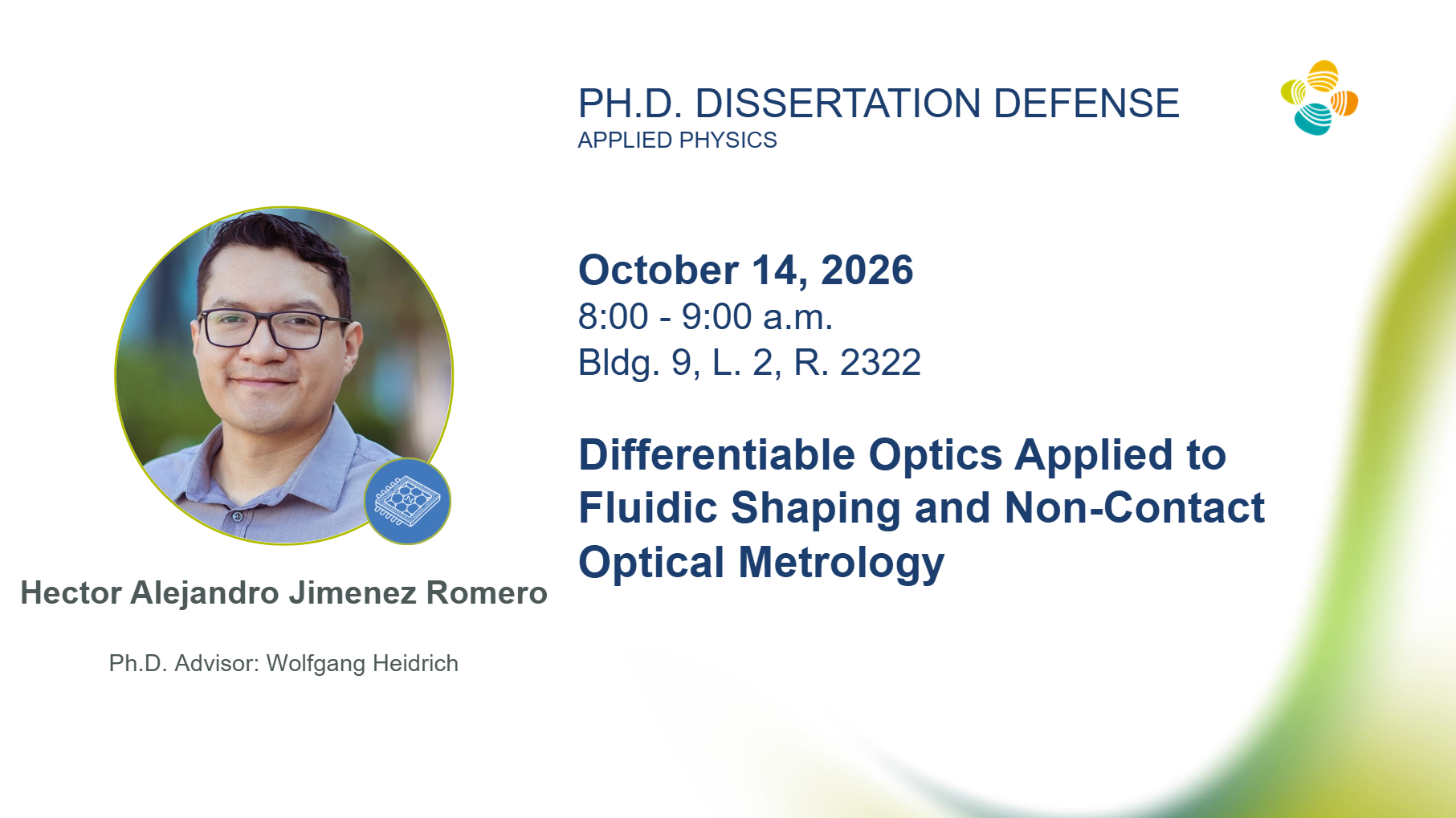
Differentiable Optics Applied to Fluidic Shaping and Non-Contact Optical Metrology
- Committee Chair: Prof. Kangming Li
- Ph.D. Advisor: Prof. Wolfgang Heidrich
- External Examiner: Prof. Moran Bercovici
- Committee Member: Prof. Jesus Alfonso A Caraveo Frescas
Zoom link: https://kaust.zoom.us/j/95119226941
Abstract:
Differentiable optics has recently been applied to automate and optimize optical systems. Its main advantage is that optical models can be integrated with fabrication, measurement, and reconstruction variables within a common optimization framework. This dissertation examines two building blocks for such an integration: the fabrication of fluidic lenses and the non-contact measurement of lens geometry.
In the first part, a fabrication technique is implemented to produce refractive surfaces from a curable resin immersed in an immiscible supporting liquid. This process is known as fluidic shaping. A differentiable model is used to obtain the fluidic and optical design parameters. The equilibrium surface model is connected to the physical fabrication quantities, including the supporting geometry, material properties, and dispensed volume. Material characterization and fabricated prototypes are then used to examine the transfer from the optimized prescription to the realized lens.
The second part starts from experimental measurements. Images of a known pattern are captured with and without the test lens, and optical flow is used to estimate the displacement caused by refraction. This displacement contains information about the lens geometry. The surface and pose parameters are optimized in stages until the ray displacements predicted by the forward model agree with the measured displacement field. In this way, differentiable ray tracing is used to recover the shape of plano-convex, biconvex, and plano-aspheric lenses without contacting their surfaces.
These two building blocks open a path toward a more general system in which the feedback loop could be closed in situ. A fully integrated system could then balance optical performance, fabrication deviations, and the decoding or reconstruction algorithm.