Oct 2026
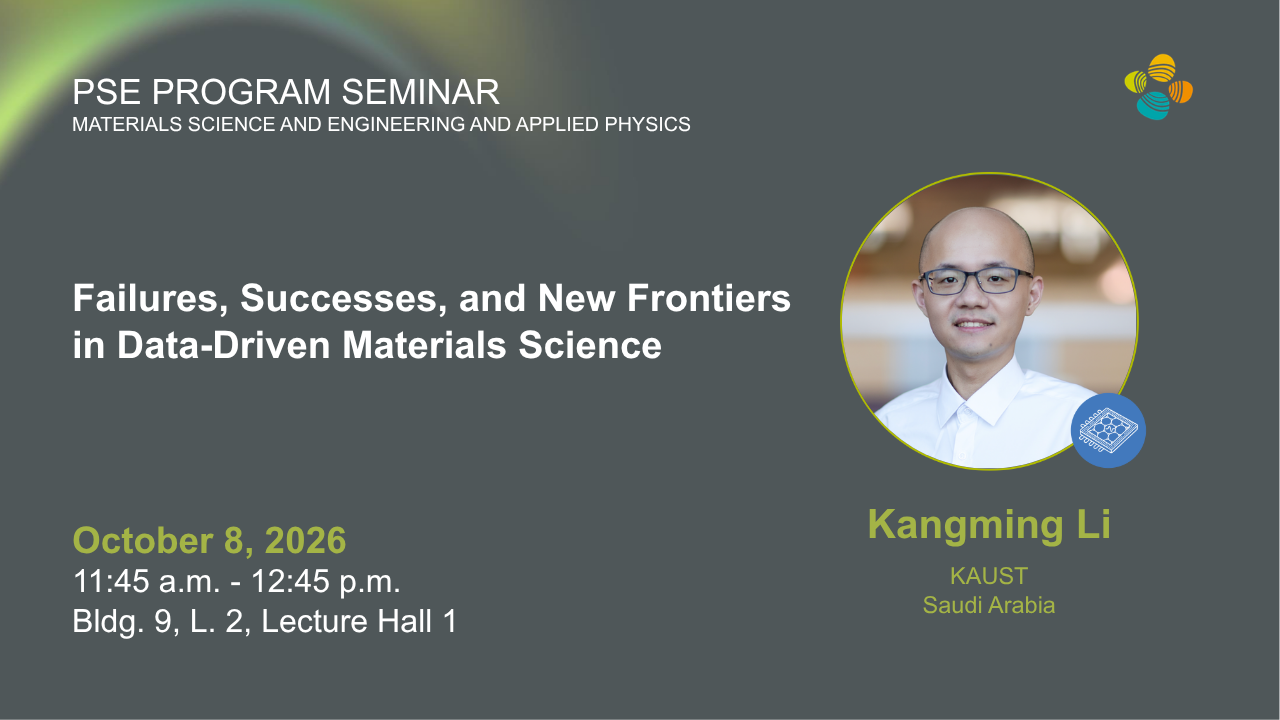
Failures, Successes, and New Frontiers in Data-Driven Materials Science
Abstract
High-throughput simulations and experiments, combined with data-driven methods, have the potential to transform materials science. Central to this emerging paradigm is the use of machine learning (ML) to accelerate materials discovery beyond traditional approaches based largely on trial and error or intuition. In this seminar, I will present several examples from our previous work on ML-driven materials modeling and experimentation, highlighting both the successes and limitations of these approaches in terms of robustness, transferability, and efficiency. I will also discuss how recent advances in machine learning interatomic potentials and agentic workflows are extending the frontiers of computational modeling and experimental automation, and what challenges remain before these tools can be used reliably for autonomous materials discovery.
Biography
Kangming Li is an Assistant Professor in the Materials Science and Applied Physics department at KAUST. He received his PhD in Physics from Paris-Saclay University and later worked at the University of Toronto as a postdoctoral fellow in Materials Science and Engineering, followed by a role as staff scientist in the Acceleration Consortium. His research focuses on the intersection of artificial intelligence, high-throughput atomistic modeling, and autonomous experimentation. At KAUST, his group develops trustworthy machine-learning methods, AI-driven workflows, and large-scale data approaches to accelerate the design, discovery, and optimization of materials.