Oct 2026
Toward Practical CO2 to Formate Electrosynthesis: Multi-Dimensional Engineering of Bismuth-Based Catalysts
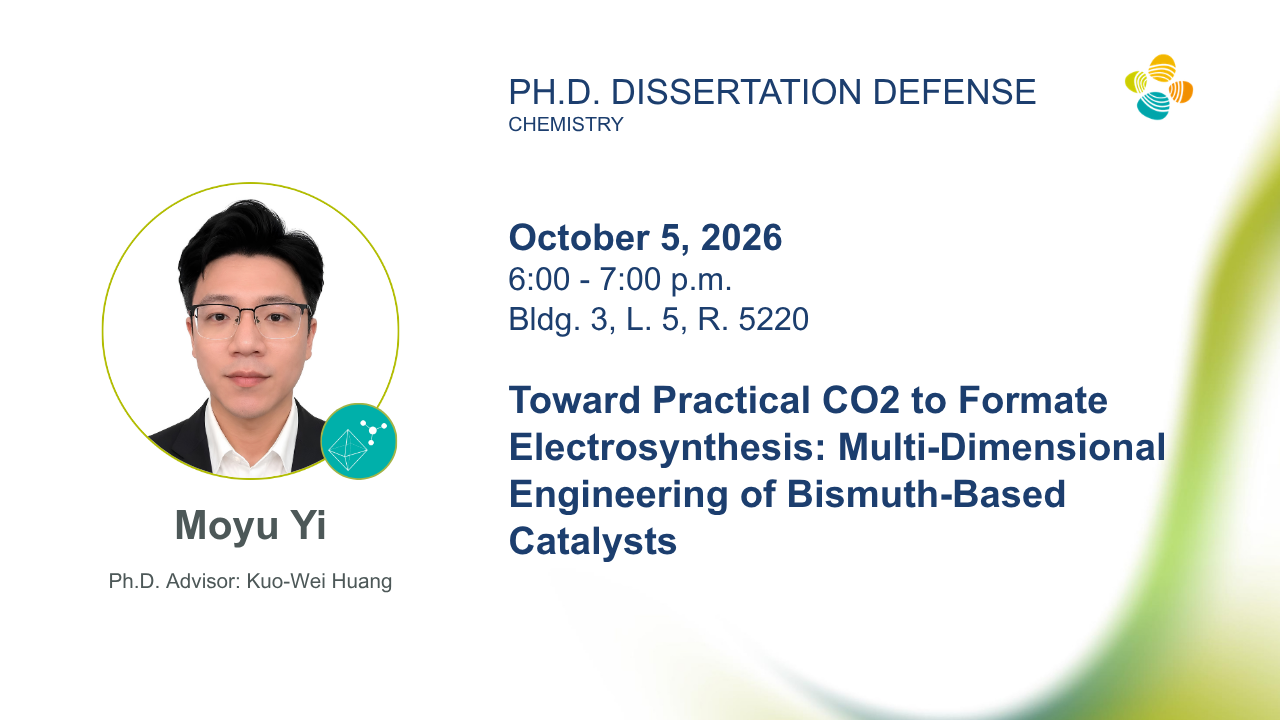
Committee Members:
- Ph.D. Advisor: Professor Kuo-Wei Huang (KAUST Chemistry)
- External Examiner: Professor Jenny Y. Yang (University of California, Irvine)
- Committee Chair: Professor Yun Hau Ng (KAUST,Professor Chemical Engineering)
- 4th Committee Member: Professor Huabin Zhang (KAUST, Chemistry)
Abstract
Converting carbon dioxide into formic acid with renewable electricity offers a compelling route to sustainable hydrogen storage: formic acid is a safe, energy-dense liquid carrier that is charged directly by electrocatalysis, so that the reaction which stores the electron also consumes the emission. Bismuth is the leading catalyst for this transformation owing to its intrinsic selectivity toward the *OCHO pathway, yet the selectivity of an element is not the performance of a catalyst. However, the distance between the two is set by three questions: where the reaction occurs, what holds the active site together under cathodic load, and how fast protons reach it. This dissertation engineers bismuth-based catalysts along all three dimensions.
The first study targets the idle planar terraces of bismuth nanoflowers, seeding them with Bi2O2CO3 quantum dots that reconstruct under cathodic bias into metallic bismuth nanoclusters, while the work-function mismatch at the underlying Bi/Cu heterojunction builds an interfacial field that accelerates electron transfer and stabilizes *OCHO. Geometric and electronic activation thus arrive in a single in-situ step, giving formate Faradaic efficiencies above 87% across 100-600 mA cm-2 and 0.16 mol of salt-free formic acid over 100 hours in a solid-electrolyte reactor. The second study makes the chemical bond the design variable: metavalent Bi-Te bonding in ultrathin Bi2Te3 nanoflakes delocalizes injected charge across the multicenter network instead of localizing it on bismuth, removing the electronic origin of self-reduction. Operando Raman, in-situ XRD and quasi in-situ XPS confirm that the lattice and its Bi3+ state remain intact, the only change being a self-limiting 1.61% loss of surface tellurium, confined to the outermost layer, which leaves the bulk framework unchanged while fully exposing the under-coordinated bismuth sites that carry turnover.
And the catalyst reaches 97% formate efficiency, -1.2 A cm2 in the flow cell, and 100 hours of stable operation in both flow cell and MEA. The third study targets interfacial water, the bottleneck at ampere-level current, where protons are consumed faster than the disordered Grotthuss relay can supply them. Trace silver retained through the reconstruction of a Bi2Se3 precursor reorganizes interfacial water into an ice-like, fully connected network, resolved by operando ATR-SEIRAS, and the kinetic isotope effect crosses from a normal 1.82 to an inverse 0.86, showing that O-H cleavage is no longer rate-determining. The resulting device sustains formate efficiencies above 80% up to 0.8 A cm-2, 200 hours at 200 mA cm-2, and 1.67 mol of formate over 110 hours at 1 A total current. Activating the sites, stabilizing the bonds, and ordering the water together establish a coherent basis for efficient and durable CO2-to-formate electrosynthesis as a practical route to renewable hydrogen storage.