Sep 2026
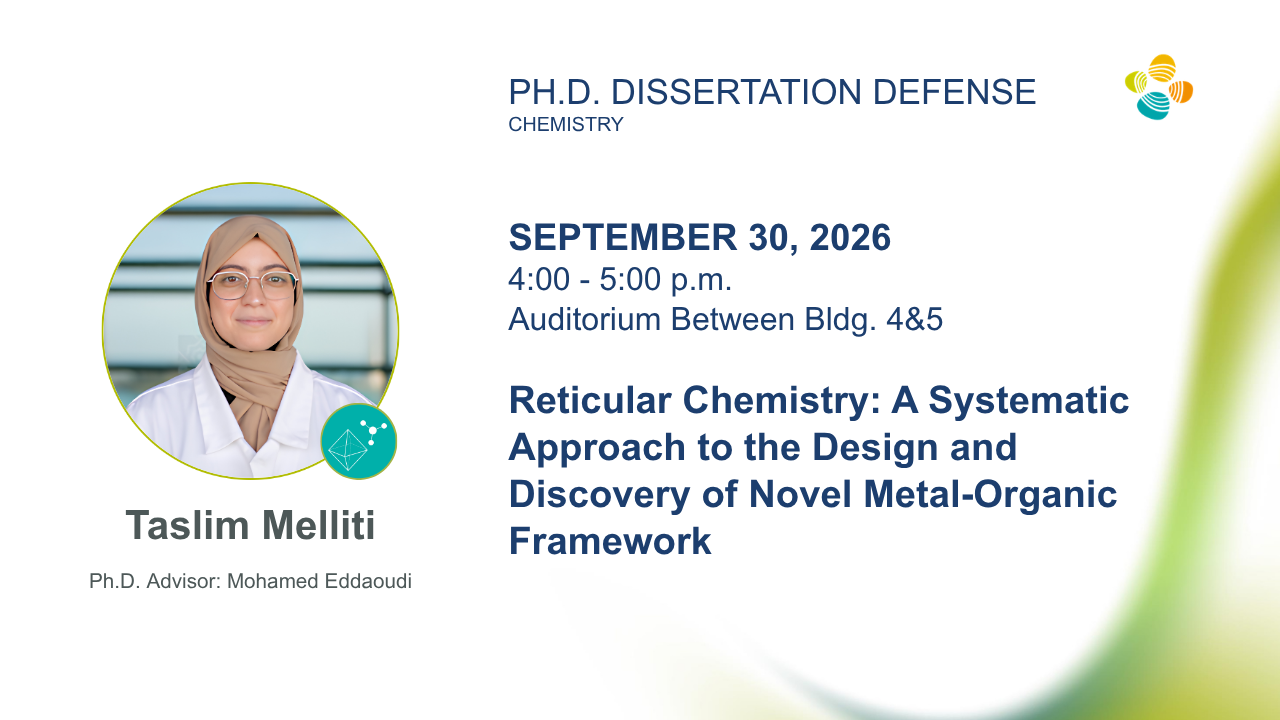
Reticular Chemistry: A Systematic Approach to the Design and Discovery of Novel Metal-Organic Framework
Committee Members Information
- Ph.D. Advisor: Professor Mohamed Eddaoudi (KAUST, Chemistry)
- External Examiner: Professor Nathaniel L. Rosi (University of Pittsburg, Department of Chemistry)
- Committee Chair: Professor Gyorgy Szekley (KAUST, Chemical Engineering)
- 4th Committee Member: Professor Yoji Kobayashi (KAUST, Chemistry)
Abstract
Metal-organic frameworks (MOFs) are a class of crystalline porous materials whose structures can be rationally assembled from metal clusters and organic linkers into predetermined topologies, offering precise control over pore size, connectivity, and function. Despite this design potential, the strong thermodynamic preference for a limited set of default topologies means that most computationally predicted MOF structures remain synthetically inaccessible, restricting the structural diversity available to reticular chemistry. This dissertation addresses this challenge by developing topological design principles and validating them through targeted synthesis across three distinct MOF platforms.
The work begins by extending net expansion and face decoration, established topological operations, to 28 parent nets, generating 24 new cage-containing topologies spanning tetrahedral, cubic, trigonal-prismatic, and octahedral cage geometries. A torsion angle parameter is introduced as a predictive design criterion, where topologies with torsion angles of 0° or 60° correspond to geometrically ideal, synthetically accessible node environments, while intermediate values identify targets that are more synthetically demanding. Among the topologies identified, hmc, flu-e, and daw are selected for experimental realization.
The hmc and flu-e targets are realized using the centring structure-directing agent (cSDA) strategy, in which nitrogen-donor ligands template specific windows to direct assembly toward the intended cage geometry. Five isoreticular hmc-MOFs and one flu-e MOF are synthesized, each incorporating three distinct, well-defined cage types. Control experiments confirm that the cSDA directs framework assembly rather than merely occupying pore space, and a geometric design equation relating ligand and cSDA length is shown to correctly predict all five hmc combinations prior to synthesis.
This design logic is then extended to the previously unreported xaw net and its derivatives, daw and dcw, targeted through the combination of a tetratopic linker, a bent ditopic linker, and the In₃O oxotrimer. Initial synthesis in the absence of a cSDA yields only a competing polymorph; introducing TPPP as a flexible cSDA demonstrates that selectivity, rather than size compatibility alone, governs which topology forms. Net clipping of the resulting In-dcw-MOF-413 further generates the pcp-t framework, though both new frameworks exhibit limited porosity upon activation, identifying framework stability as a remaining challenge.
The final part of this dissertation shifts to a distinct inorganic platform, holding the NiNbOF₅ pillar of the benchmark CO₂ sorbent KAUST-7 constant while systematically varying the organic ligand across six linkers of different geometry and connectivity. Unlike the pillar, the ligand is found to exert no predictable control over the resulting topology or porosity: two isoreticular frameworks differing by only two nitrogen atoms diverge completely in gas uptake, and one, NbOFFIVE-PYRM-Ni, exhibits reversible, CO₂-triggered gate-opening behavior not observed elsewhere in the series, tentatively attributed to its uncoordinated pyrimidine nitrogen atoms.