Sep 2026
Interfacial Engineering of the Photoanode in Perovskite Single-Crystal Solar Cells Enables High Efficiency and Operational Stability
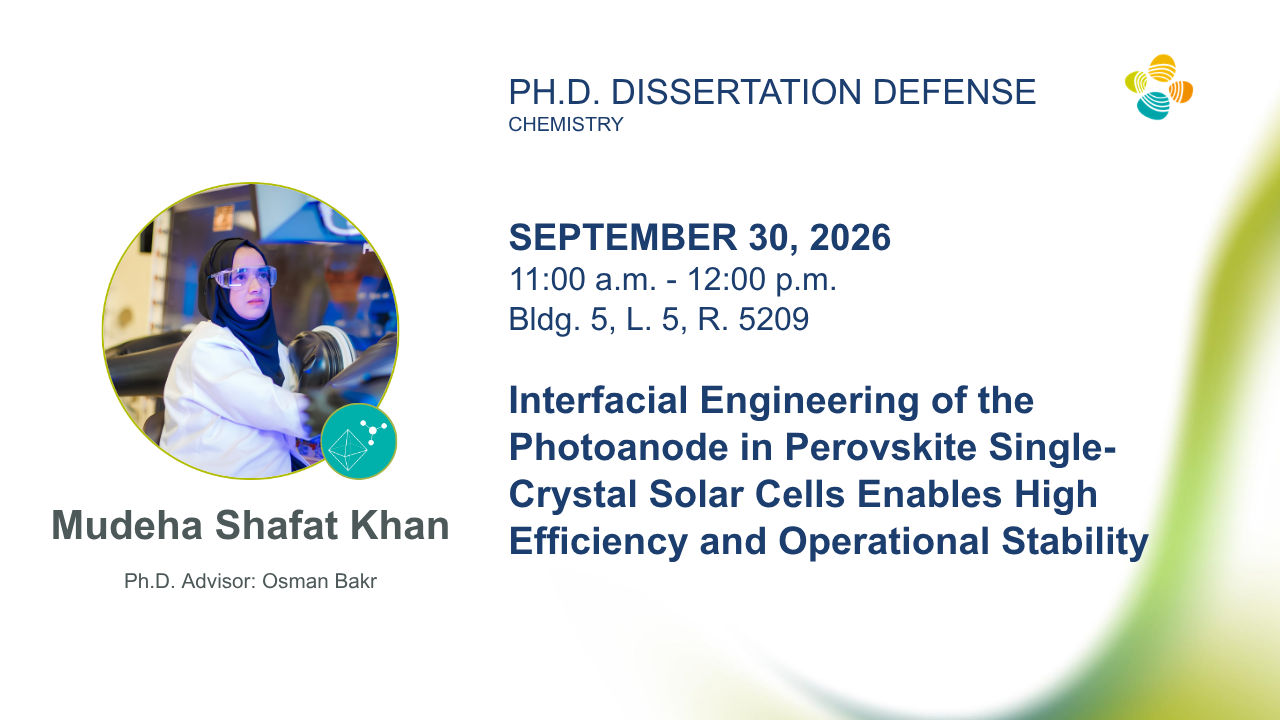
Committee Members:
- Ph.D. Advisor: Professor Osman Bakr (KAUST, Material Science and Engineering)
- External Examiner: Professor Zhaolai Chen (Shandong University China)
- Committee Chair: Professor Nazek El Atab (KAUST, Electrical and Computing Engineering)
- 4th Committee Member: Omar F. Mohammed Abdelsaboor (KAUST, Material Science and Engineering)
Abstract
Metal halide perovskite single crystals have emerged as a promising alternative to conventional polycrystalline perovskite films for next-generation photovoltaic technologies. Owing to their exceptional structural order, phase purity, and intrinsically low bulk defect densities, perovskite single crystals exhibit superior charge transport properties, extended carrier diffusion lengths, and enhanced intrinsic stability.
These characteristics eliminate the detrimental effects associated with grain boundaries and high defect concentrations commonly found in polycrystalline counterparts. Despite these advantages, the photovoltaic performance of single-crystal perovskite solar cells (SC-PSCs) remains limited by inefficient interfacial charge extraction, high surface trap densities, and poor interfacial stability, primarily arising from the weak interaction between the single crystal and charge-transport layers. Therefore, developing effective interfacial engineering strategies is crucial for realizing the full potential of SC-PSCs.
This thesis addresses the critical interfacial limitations that hinder the performance of SC-PSCs, despite their superior bulk properties. Two distinct interfacial engineering strategies are developed to overcome inefficient charge extraction and poor stability. In the first approach, a hydrophilic dielectric polymer is introduced at the hole-transport layer (HTL) interface to suppress charge recombination, yielding a champion efficiency of 25.0% with enhanced operational stability. In the second approach, a molecular blending technique incorporating diphenyl dithiol (BPDT) into the HTL is employed to simultaneously improve interfacial contact and chemical anchoring, achieving a 24.85% efficiency and retaining over 90% of initial performance after 1000 hours. Collectively, these findings establish effective pathways for advancing SC-PSC efficiency and durability through targeted interfacial modification.
-jpgf64a5d6c-a745-4a2a-882b-e4f50364e8d3.jpg?sfvrsn=439c23b6_2)