Sep 2026
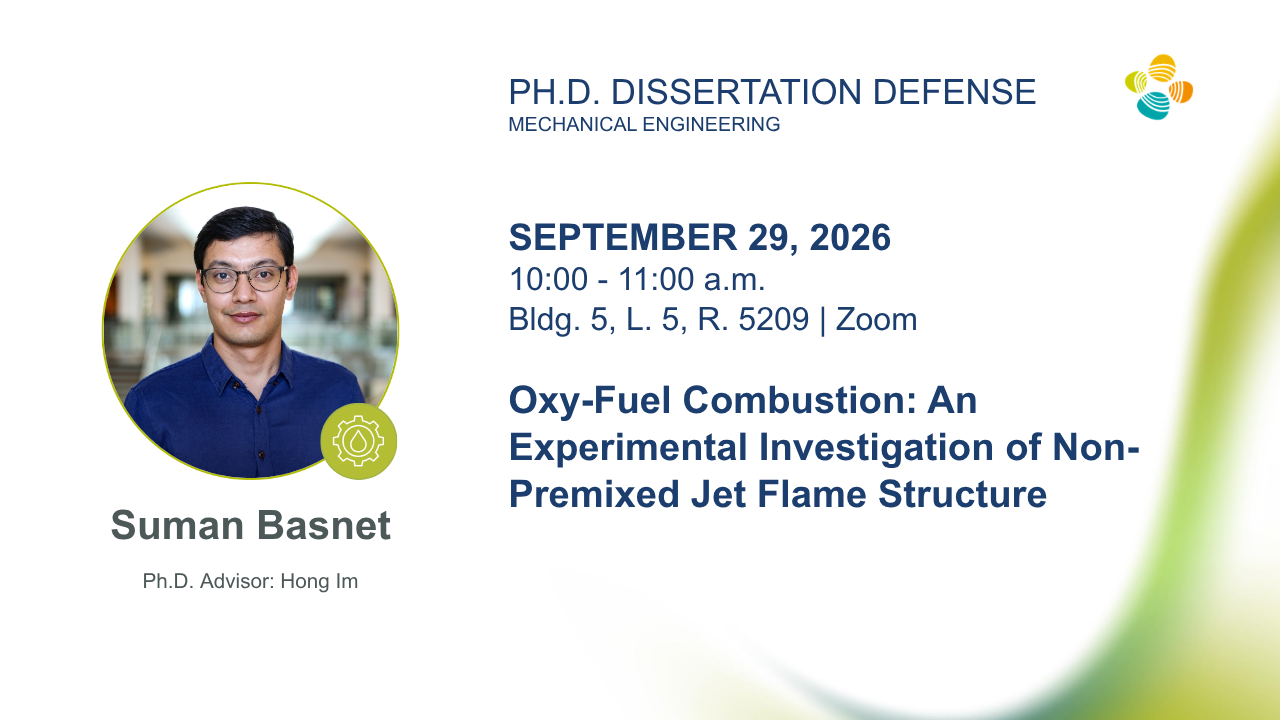
Oxy-Fuel Combustion: An Experimental Investigation of Non-Premixed Jet Flame Structure
COMMITTEE MEMBERS:
- Advisor: Prof. Hong G. Im (Mechanical Engineering Program, KAUST)
- External Examiner: Prof. Paul R. Medwell (School of Electrical and Mechanical Engineering, Adelaide University, Australia)
- Committee Chair: Prof. Yun Hau Ng (Chemical Engineering Program, KAUST)
- Committee Member: Prof. Tadd Truscott (Mechanical Engineering Program, KAUST)
- Committee Member: Prof. Gaetano Magnotti (INSA Rouen Normandie, CORIA, France)
Abstract
Decarbonization efforts have driven strong interest in oxy-fuel combustion, where air is replaced by O2/CO2 mixtures to enable NOx-free operation and a CO2-rich exhaust suited for carbon capture post-combustion. When paired with green hydrogen, oxy-fuel combustion can achieve a zero-carbon energy solution for industrial and advanced power-cycle applications such as the Allam-Fetvedt cycle. However, the thermochemical structure, preferential diffusion behavior, and pressure stability of oxy-fuel jet flames remain poorly understood, limiting the development of predictive simulation tools.
This dissertation presents three experimental studies addressing these gaps: the multi-scalar structure of oxy-H2/CH4 flames across O2/CO2 oxidizer composition; the role of preferential diffusion in CO2-diluted hydrogen flames examined across jet Reynolds numbers and hydrogen concentration; and the stability and near-field behavior of oxy-fuel flames at pressures up to 4.5 bar. One-dimensional Raman spectroscopy provides simultaneous temperature and major species measurements, with a Hybrid Matrix Inversion approach applied to resolve spectral interferences of species associated with the oxy-fuel condition. Counterflow flame simulations, using both multi-component and equal-diffusivity transport models, isolate the role of preferential diffusion, while CH chemiluminescence imaging with Abel deconvolution characterizes flame attachment and stability limits at elevated pressure. Results show that CO2 addition reshapes heat release and CO formation pathways, preferential diffusion of hydrogen measurably shapes flame thermochemistry at low strain rates, and elevated pressure shifts flame attachment closer to the burner rim while enhancing soot formation. Together, these findings advance the fundamental understanding of oxy-fuel combustion and provide quantitative data for validating next-generation simulation models.
Biography
Suman Basnet is a Ph.D. candidate in Mechanical Engineering in the PSE Division at KAUST, where he works at the Clean Energy Research Platform (CERP) under the supervision of Prof. Hong G. Im and Prof. Gaetano Magnotti. His doctoral research focuses on the structure and stability of oxy-fuel jet flames, investigated through advanced laser-based optical diagnostics. Prior to KAUST, he earned his Master’s degree in Space and Astronautical Engineering from La Sapienza University of Rome, Italy, and his B.Tech. in Aerospace Engineering from SRM University, India.