Sep 2026
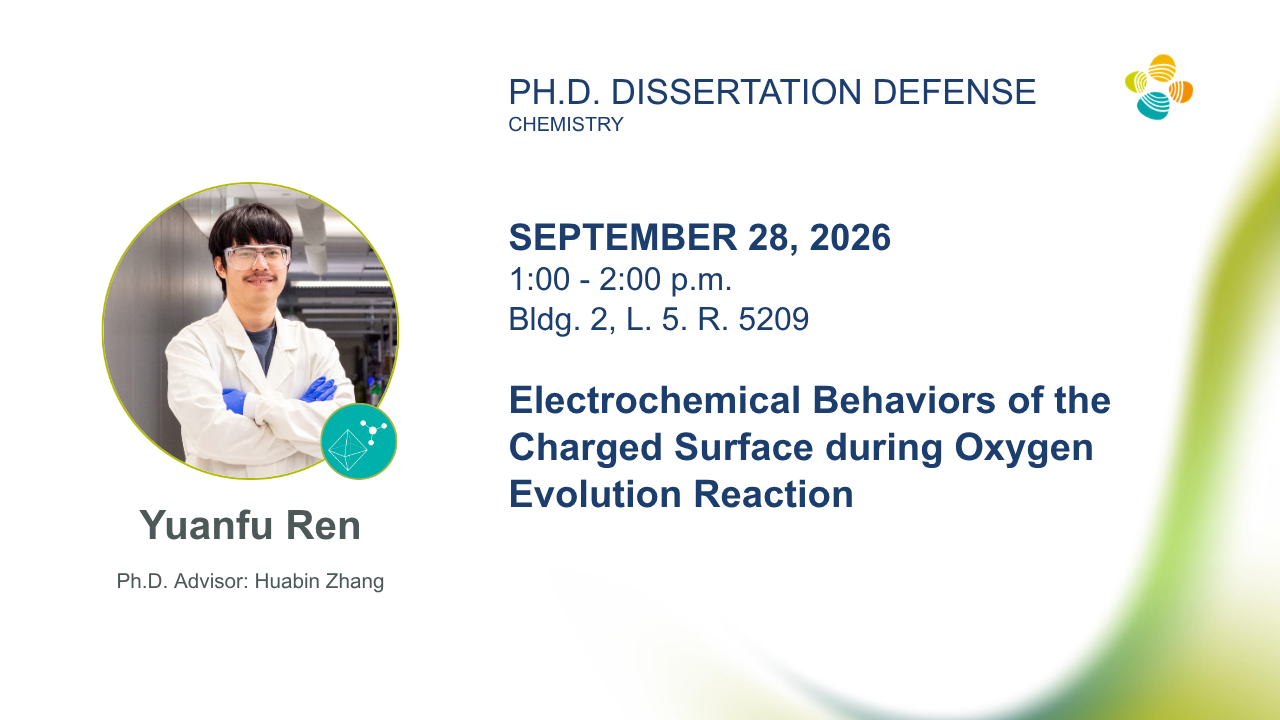
Electrochemical Behaviors of the Charged Surface during Oxygen Evolution Reaction
- Ph.D. Advisor: Professor Huabin Zhang, Chemistry, KAUST
- External Examiner: Professor Yao Zheng, School of Chemical Engineering, University of Adelaide
- Committee Chair: Professor Kuo-Wei Huang, Chemistry, KAUST
- 4th Committee Member: Assistant Professor Shadi Fatayer, Materials Science and Engineering, KAUST
Abstract
Green hydrogen produced by water electrolysis is important for the transition toward sustainable energy and chemical manufacturing. The oxygen evolution reaction (OER) represents a central challenge in water electrolysis because its sluggish kinetics impose substantial energy losses and constrain catalyst efficiency. Despite extensive efforts in developing advanced OER catalysts, establishing predictive structure–activity relationship remains challenging. Conventional interpretations of OER rely predominantly on electrode potential and current relationships. Such descriptions are inherently limited because the measured current contains overlapping contributions from interfacial charging, surface redox transformations, catalytic turnover, mass transport, and side reactions, while the applied potential cannot be mapped uniquely onto a specific local chemical state or elementary reaction. Understanding OER therefore requires a multidimensional and multiscale perspective capable of resolving the electrochemical behavior of the charged surface under operating conditions.
In this dissertation, a multidimensional electrochemical methodology is developed by exploiting the potential dependence, charge balance, temporal evolution, frequency response, pH dependence, and nonlinear response of electrochemical reactions, complemented by operando chemical-state characterization and O2 detection. This framework resolves the effects of coupled variables on elementary OER processes and identifies three representative modes of surface charging. First, charge can be accommodated at sites distinct from the principal catalytic centers and regulate their reactivity through electronic coupling and shared oxygen coordination. Second, oxygen-centered charging can emerge within suitable vacancy and hydrated coordination environments, enabling lattice oxygen to participate in and be replenished during O2 formation. Third, when charging occurs directly at the catalytic centers, their local coordination governs the formation, relaxation, and productive consumption of oxidized states. These findings establish that catalytic behavior depends not only on the identity of the active site, but also on the location of charge accommodation, the relationship between the charging and catalytic centers, and the coordination environment connecting charged states with catalytic turnover. By linking these principles to water electrolysis under practical operating conditions, this work demonstrates how multidimensional electrochemistry can bridge mechanistic studies and catalyst engineering, providing a broadly applicable framework for understanding and designing OER catalysts.