Sep 2026
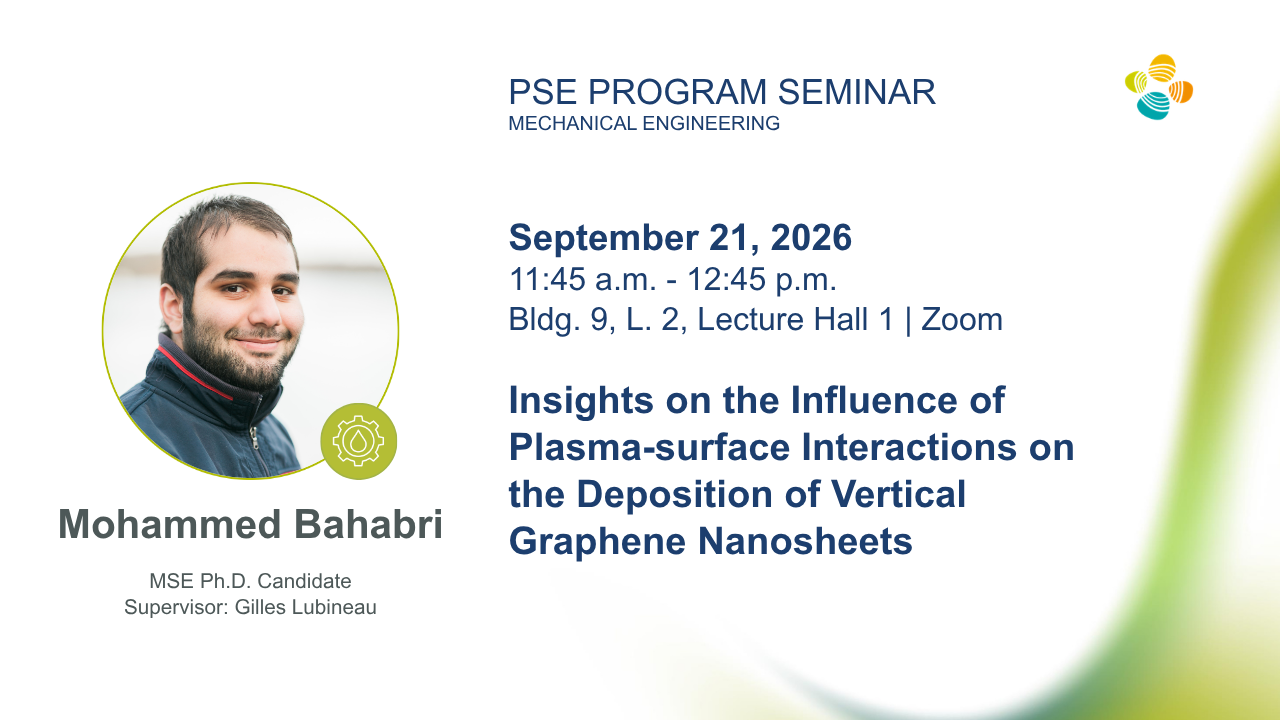
Insights on the Influence of Plasma-surface Interactions on the Deposition of Vertical Graphene Nanosheets
Zoom link: https://kaust.zoom.us/j/99407370904
Abstract
Vertical graphene (VG) nanosheets have garnered considerable attention due to their unique properties and large surface area, leading to their applications in various fields. However, classical synthesis processes suffer from limited yield, and little is known about the influence of different processing parameters on VG deposition, impeding its industrial adaptation. In this thesis, we investigated the effect of the plasma-surface interactions on VG’s growth on copper to apply them in sustainable desalination solutions.
To elucidate the substrate influence, we systematically varied multiple param-eters to control the growth of VG. We found that the open area (OA) controlled the flow through the substrate. At OA < 0.6, the growth was diffusion-limited, and VG height decreased as OA decreased due to the screening of reactants’ flow to the surface. On the other hand, at OA > 0.6, the VG growth is kinetic-limited, and VG height remains constant regardless of OA. Moreover, the substrate thick-ness affects VG deposition by two major effects: attenuating the flow through the aspect ratio, limiting VG growth, and controlling the crystallinity of VG by altering the heat transfer process.
The plasma influence was studied by changing the plasma power and pressure to understand the effect of plasma properties on the surface reactions. We found that increasing the power increased the VG height, while increasing the pressure decreased it. Utilizing optical emission spectroscopy revealed that increasing the C2:CH ratio led to more branching in the structures, while the CH:Hβ ratios had an influence on the deposition rates. The pressure-power coupling controlled
the reduced electric field. The coupling controlled the electron density, which dictates VG density, and controlled the bombardment energy, which affects VG crystallinity.
This understanding enabled the upscaling of VG synthesis to larger scales, paving the path for VG membranes to be employed in desalination applications. VG’s large surface area increases light absorbance, while its morphology makes it super-hydrophobic, which enhances evaporation rates, allows for facile cleaning, and gives it protective properties. This talk elucidates the plasma-substrate interactions and their influence on VG growth, paving the path for the large-scale synthesis of membranes for sustainable water solutions.
Biography
Mohammed Bahabri is a PhD student who works on the growth of Vertical graphene structures, their properties, and applications. Prior to joining the Mechanics of Composites for Energy and Mobility Laboratory (MCEM) in 2022, he worked during his Master’s degree in the Laboratory for Carbon Nanostructures under the guidance of Prof. Pedro Da Costa on various topics that include the growth and analysis of Carbon nanotubes and graphene-based structures.