Sep 2026
MSEAP STUDENT SEMINAR
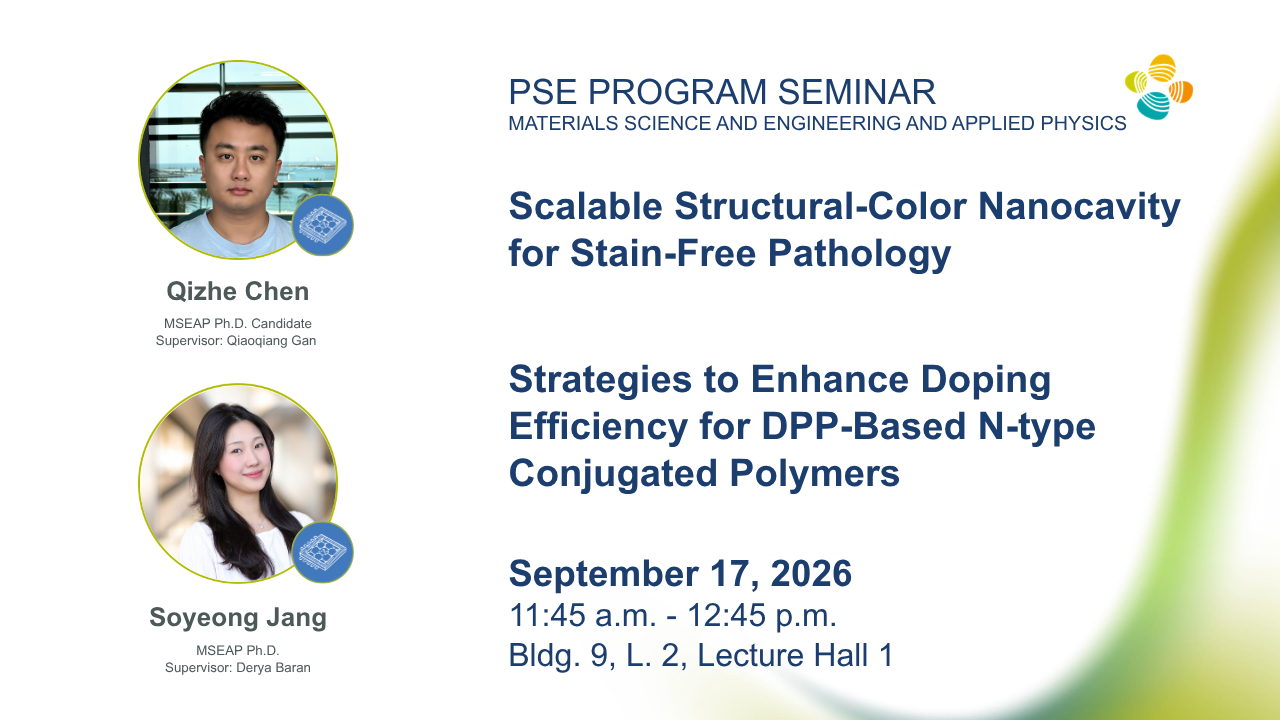
Scalable Structural-Color Nanocavity for Stain-Free Pathology
By Qizhe Chen
Abstract
Pathology increasingly demands imaging technologies that are scalable, cost-effective, and compatible with existing clinical infrastructure. While advanced nanophotonic and label-free imaging techniques can provide rich contrast, their adoption is often limited by complex fabrication, expensive instrumentation, and substantial workflow disruption. Structural-color nanocavities offer a promising route to bridge this translational gap. By translating intrinsic tissue properties into visible color contrast, they enable stain-free visualization without the need for staining reagents or complex optical systems. In this seminar, I will introduce a scalable structural-color nanocavity platform for stain-free digital pathology, focusing on its scalable fabrication, the mechanisms underlying tissue-dependent color contrast, and compatibility with existing imaging workflows for diagnosis.
Biography
Qizhe is a Ph.D. candidate in the Materials Science and Engineering program at King Abdullah University of Science and Technology, where he is conducting research under the mentorship of Prof. Qiaoqiang Gan in the Sustainability and Photonics Energy Research (SuPER) Lab. His research focuses on structural-color material platforms for stain-free pathology, combining optical design with material–tissue interactions to enable label-free tissue imaging and analysis.
Strategies to Enhance Doping Efficiency for DPP-Based N-type Conjugated Polymers
By Soyeong Jang
Abstract
Conjugated polymers (CPs) are promising materials for organic thermoelectrics (OTEs) because of their intrinsically low thermal conductivity, mechanical flexibility, and solution processability. Their electrical conductivity can also be tuned over several orders of magnitude through molecular doping, making them attractive for thermoelectric power generation. Nevertheless, the performance of n-doped conjugated polymers continues to lag behind that of their p-doped counterparts, largely because achieving efficient doping without compromising the microstructure required for charge transport remains challenging. This work examines the factors that govern doping efficiency in n-doped conjugated polymers, with particular emphasis on solvent affinity, polymer chain-length ensembles, and side-chain chemistry. Molecularly doped polymer films were investigated using optical spectroscopy, quantitative polaron analysis, grazing-incidence wide-angle X-ray scattering (GIWAXS), electron paramagnetic resonance (EPR), and thermoelectric characterization.
The results demonstrate that nominal dopant concentration alone is not a reliable predictor of doping efficiency. Instead, the doping outcome is governed by dopant incorporation, charge generation, and the extent to which the polymer retains a microstructure capable of supporting efficient charge transport. Solvent affinity determines the preferential distribution of the dopant within the polymer matrix, whereas polymer chain-length ensemblesshape the pathways available for charge transport. Side-chain chemistryregulates host-dopant compatibility and, in catalyzed doping systems, controls the accessibility of the catalyst to dopant-rich lamellar regions. This spatial accessibility determines whether the catalyst concentrates or redistributes the local dopant population. Across the systems studied, enhanced doping efficiency and thermoelectric performance are associated with the effective generation and transport of charge while minimizing disruption to the solid-state transport network. Overall, this work establishes that high electrical conductivity and power factor in n-doped conjugated polymers cannot be achieved solely through the use of stronger dopants or higher dopant loadings. Rather, efficient charge generation must be balanced with the preservation of a favorable molecular microstructure that supports charge transport. These findings provide practical design principles for enhancing doping efficiency and advancing n-type organic thermoelectric materials.
Biography
Soyeong Jang received her B.S. and M.S. degrees in Physics from Pukyong National University, South Korea, in 2016 and 2020, respectively. During her master’s studies under the supervision of Prof. Sung Heum Park, she investigated organic photovoltaic cells. In 2021, she began her Ph.D. studies in Materials Science and Engineering at King Abdullah University of Science and Technology (KAUST), where she successfully defended her dissertation in July 2026. Her doctoral research focuses on molecular doping and microstructure-controlled charge transport in n-type conjugated polymers for organic thermoelectric applications.