Aug 2026
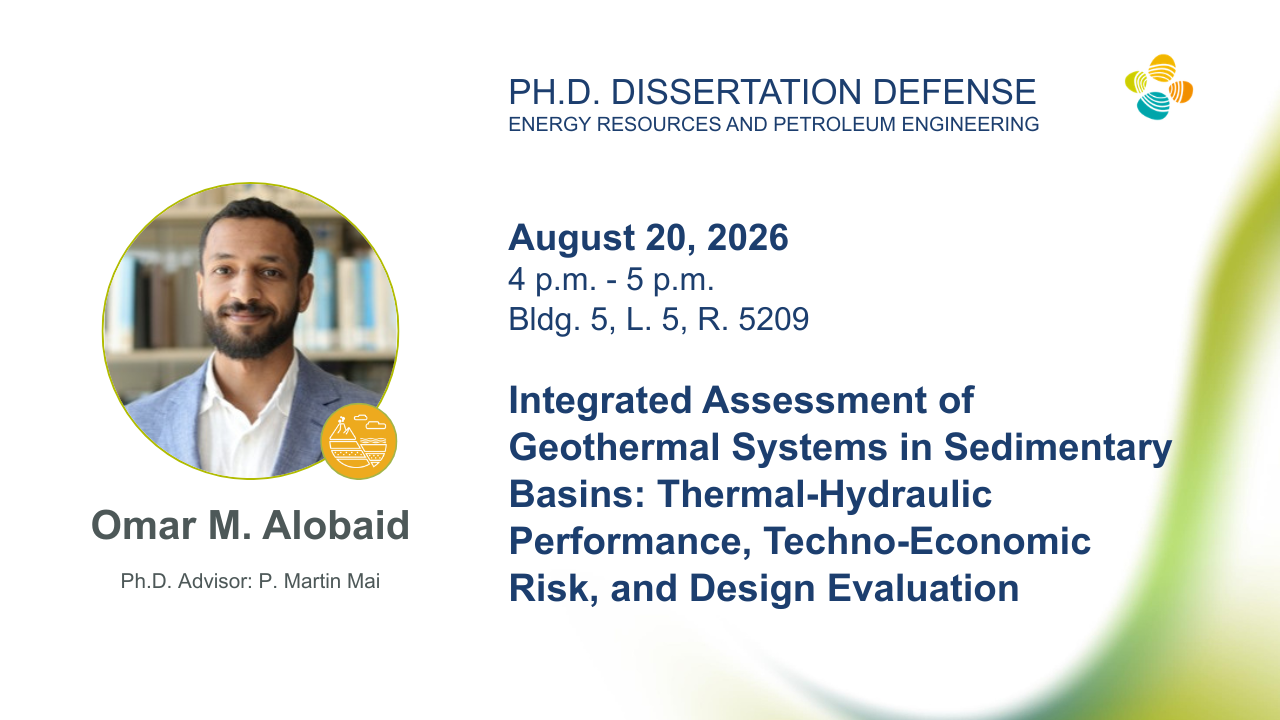
Integrated Assessment of Geothermal Systems in Sedimentary Basins: Thermal-Hydraulic Performance, Techno-Economic Risk, and Design Evaluation
Abstract
Sedimentary basins comprise widely distributed geothermal resources, however, the presence of heat at depth does not guarantee feasibility in terms of extraction and economics. Whether that heat can be extracted at useful rates, sustained over the project lifetime, and delivered at an acceptable cost depends on coupled geological, hydraulic, thermal, operational, and economic controls that are uncertain during early development. This dissertation shows that sedimentary geothermal feasibility cannot be judged from temperature alone. My research addresses the problem through an integrated framework that links physics-based three-dimensional thermal‑hydraulic simulation, stochastic geological modelling, techno-economic assessment, and machine-learning surrogate modelling. The work is organized as a paper-based thesis spanning two contrasting extraction concepts: closed-loop geothermal systems (CLGS), which isolate the working fluid from the formation and rely on heat transfer through the wellbore wall, and hydrothermal doublets, which use the reservoir itself as the heat exchanger.
Two studies examine U-shaped CLGS in deep sedimentary formations. A three-dimensional model with realistic casing and cement layers, incorporating advective heat transport, shows that groundwater flow can raise cumulative thermal output by up to 27% over 40 years relative to conduction-only conditions, whereby the largest gain is achieved if flow is oriented perpendicular to the lateral section. The geothermal gradient and reservoir depth dominate the geological controls, and net power is maximized near an intermediate injection rate rather than the highest one. A companion techno-economic study compares single-lateral and multilateral configurations across 190 transient simulations, finding levelized cost of heat (LCOH) between 53 and 193 USD/MWhₜₕ (median 93 USD/MWhₜₕ), showing that drilling and exploration costs account for roughly 86% of capital cost. Additional lateral wells raise thermal output but with diminishing returns. All modelled configurations remain above the competitive direct-use range, indicating that resource temperature and drilling cost govern CLGS feasibility more strongly than loop geometry alone.
For hydrothermal doublets, I developed a fully coupled probabilistic framework that propagates uncertainty across a ten-dimensional parameter space using Latin Hypercube Sampling, linking stochastic porosity‑permeability fields, three-dimensional thermal‑hydraulic simulation, and economic post-processing over roughly 3,500 realizations. Geological uncertainty alone produces P10, P50, and P90 LCOH values of 25.1, 33.4, and 45.9 USD/MWhₜₕ at 600 m well-spacing, respectively, with geothermal gradient and mean formation porosity emerging as the dominant economic controls. The sampled Gaussian heterogeneity descriptors and well spacing exert comparatively weak influence on cost. However, such large-scale ensemble simulations are computationally expensive. Therefore, I develop a multi-stage Fourier neural operator (FNO) surrogate, trained on 1,535 coupled simulations, to reproduce three-dimensional plume evolution, 40-year well response, and rare cases of strong drawdown, recovering LCOH to within 0.38 USD/MWhₜₕ. The surrogate enables more than 50,000 coupled 40-year evaluations on a desktop CPU, about a year of equivalent serial full-physics runtime. This approach therefore efficiently, supports probabilistic plume mapping, sensitivity analysis, and risk-constrained design, and estimating in the tested case study a 14% probability that the 5 K cooling plume reaches the producer within 40 years.
Taken together, these case studies show that the same sedimentary setting may support different development strategies depending on reservoir permeability, thermal recharge, drilling cost, and heat-market conditions, and that physical performance and discounted economic performance respond to different controls. The principal contribution of this dissertation is a coherent decision-support framework that clarifies which geothermal concept suits a given setting, which uncertainties dominate the outcome, which characterization data are most valuable to acquire next, and which design variables are worth optimizing. In conclusion, my research demonstrates that, if validated against the quantities that drive decisions, neural-operator surrogates can move uncertainty-aware geothermal appraisal from a computational shortcut to a practical tool for early-stage screening and design in sedimentary basins.
-jpgb8962e00-cace-4ba5-9e6b-43f2625777db.jpg?sfvrsn=b923ac8e_2)