Jul 2026
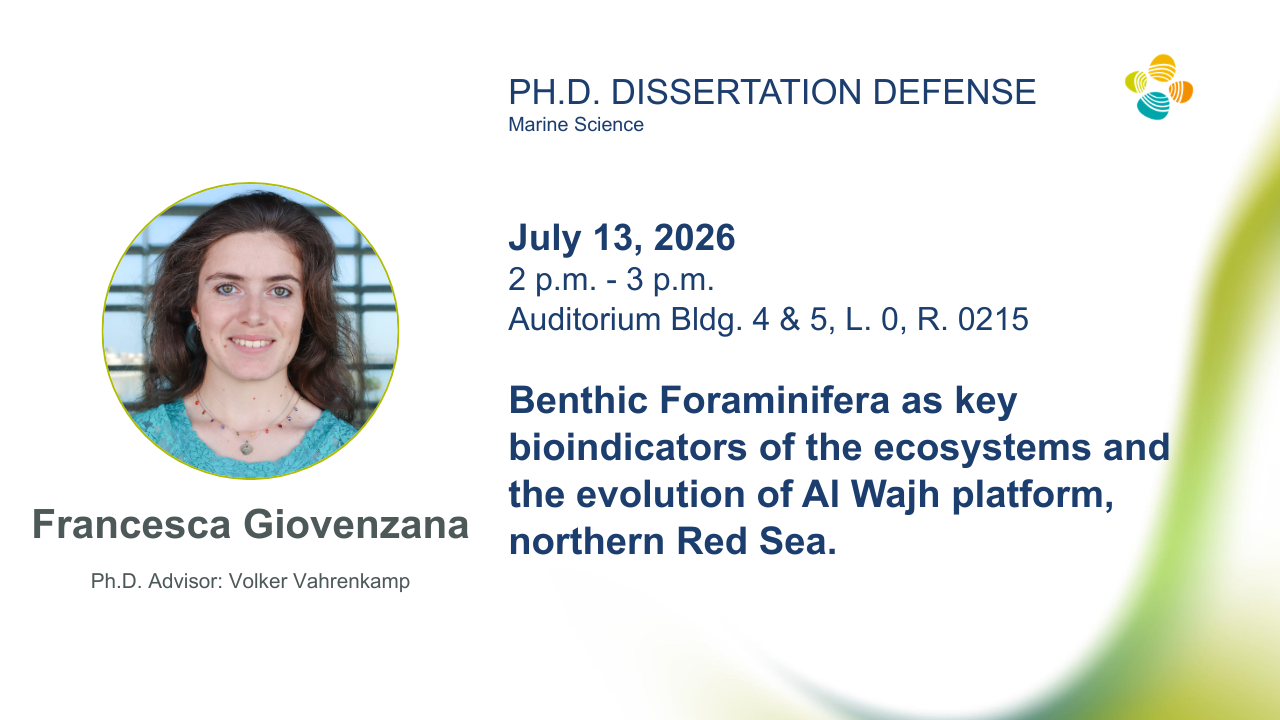
Benthic Foraminifera as key bioindicators of the ecosystems and the evolution of Al Wajh platform, northern Red Sea
Zoom link: https://kaust.zoom.us/j/97835618896
Abstract
Benthic foraminifera are widely used as indicators of marine environmental conditions due to their sensitivity to ecological gradients and their excellent preservation potential in the sedimentary record. In addition to their assemblage composition and morphology, the geochemical signatures preserved within their calcitic tests provide valuable information on environmental and oceanographic conditions, making them powerful tools for both modern ecological investigations and paleoenvironmental reconstructions. As a result, benthic foraminifera offer a unique opportunity to link present-day ecosystem dynamics with long-term environmental change.
This PhD project focuses on the Al Wajh platform, a large carbonate platform and coastal lagoon system located along the northeastern Saudi Arabian Red Sea coast. Despite its ecological importance and its location within a region currently undergoing rapid coastal development under Saudi Vision 2030, the ecology, environmental variability, and long-term evolution of this carbonate system have remained poorly documented.
This research aims to investigate the environmental dynamics of the Al Wajh platform and its lagoon through an integrated study of benthic foraminiferal ecology, geochemistry, and paleoecology. Specifically, the objectives are to (i) characterize the spatial distribution of modern benthic foraminiferal assemblages and identify the environmental factors controlling their distribution within the lagoon, (ii) reconstruct the Holocene environmental evolution of Al Wajh lagoon using sedimentological, micropaleontological, and chronological records, (iii) evaluate the potential of larger benthic foraminifera as environmental monitoring tools through geochemical analyses, and (iv) characterize benthic foraminiferal communities inhabiting adjacent mesophotic carbonate environments and assess their paleoenvironmental significance. The results demonstrate that benthic foraminifera provide a sensitive record of environmental variability across the Al Wajh platform and its lagoon, from modern ecological gradients to Holocene environmental change. Modern assemblages reveal a clear ecological zonation within the lagoon controlled by hydrodynamics, sediment characteristics, and connectivity with the open Red Sea, while Holocene records show that sea-level fluctuations and associated changes in water exchange governed the environmental evolution of the lagoon throughout the last ~9,000 years. Geochemical analyses of Sorites orbiculus indicate that larger benthic foraminifera respond to local environmental conditions and preserve robust temperature-related signals, supporting their application as both environmental monitoring tools and paleoenvironmental archives. Mesophotic assemblages document a clear differentiation between upper and lower mesophotic ecosystems and provide valuable modern analogues for interpreting fossil carbonate systems.
Based on extensive fieldwork and an unprecedented amount of collected data, this PhD research advances our understanding of the ecology, environmental dynamics, and long-term evolution of the Al Wajh platform and its lagoon by providing the first integrated ecological, geochemical, and paleoenvironmental assessment of this carbonate system. The results establish essential baseline data for future environmental monitoring and provide new modern analogues for the interpretation of tropical carbonate environments in both modern and fossil settings.